Case file 007 · Cognitive Psychology
Ulric Neisser

Fig. 1 — Drawing by the archive · free to use
On the morning after the explosion of the space shuttle Challenger, 29 January 1986, Ulric Neisser had 106 students fill in a questionnaire: Where were you when you heard? Who told you? What did you do next? Two and a half years later he brought the same people back and asked the same questions. He had what scarcely any memory study has — a record from the day of the event.
Neisser was born on 8 December 1928 in Kiel, the son of an economist who recognised the danger earlier than most: the family emigrated to the United States in 1933. Ulrich became Ulric — the “h” he sacrificed himself later, as a concession to the new language, and colleagues called him Dick anyway. The biography of the immigrant child who wants to belong he himself read, in retrospect, as a motive: first the model student’s ambition, then the lifelong mistrust of whichever school was ruling.
He studied at Harvard, where behaviourism reigned and bored him, went to Swarthmore College for his master’s to Wolfgang Köhler — the emigrated Gestalt psychologist whose insistence on the meaningful whole shaped him more than any learning curve —, worked at MIT with George Miller, and took his doctorate back at Harvard in 1956: the same year that would later count as the birth year of cognitive science. The ingredients of his training — Gestalt thinking, information theory, mistrust of the psychology of training — are exactly the ingredients of the book that made him famous.
In 1967 appeared Cognitive Psychology. The book gave a field its name and its order: perception, attention, memory and thinking as information processing, describable in stages between stimulus and response. For a discipline that behaviourism had forbidden for four decades to speak of inner processes, it was a liberation — and Neisser, professor at Cornell, became the eponym of a movement he had never meant to found. The computer analogy the book popularised he himself always treated with reservation: humans process information, but they are not calculators with storage slots.
Nine years later the author was his own book’s sharpest critic. Cognition and Reality (1976) charged the young cognitive psychology with having withdrawn into artificial laboratory tasks. His term of indictment was ecological validity: whoever measures memory with syllable lists learns something about syllable lists. The guild took it badly — the founding father faulting the founding —, and Neisser carried the reputation of the productive contrarian from then on with visible pleasure.
At Cornell also arose the experiments on selective attention that became famous only a generation later: in the 1970s Neisser superimposed video images of two ball games and had viewers count passes — and most of them missed a woman with an umbrella walking through the middle of the picture. Daniel Simons, whose gorilla experiment grew out of it, has always named the original. It is typical of this career that its best-known finding runs under someone else’s name.
From this turn followed the rest of his work: memory for real events. He checked John Dean’s Watergate testimony against the White House tapes — the witness with the supposedly fabulous memory had remembered the gist rightly and the sentences wrongly throughout —, collected the field studies of the discipline in Memory Observed, launched after the Challenger explosion the questionnaire operation that became this folder’s case file, and made the self-overestimation of remembering a testable subject.
A second field he entered late and from a sense of duty: after the quarrel over The Bell Curve he chaired the task force of the American Psychological Association that delivered the 1996 report Intelligence: Knowns and Unknowns — the attempt, in a poisoned debate, to write down what the field knows about intelligence and what it does not. That the sceptic of laboratory tests of all people moderated this balance sheet was no accident: someone was wanted whom both sides trusted to separate findings from claims. To the same Neisser goes back the volume The Rising Curve, which moved the worldwide rise in test scores — the Flynn effect — into the centre of the debate.
Those who experienced him in seminar report a questioner, not a lecturer: the most famous exercise consisted of bringing along one’s own most vivid memory — and then testing together what it might fail on.
Neisser taught at Cornell and Emory and died on 17 February 2012 in Ithaca of the consequences of Parkinson’s disease. He had founded a field and contradicted it for twenty years — and both, the founding and the contradicting, with the same argument: that psychology must deal with real life if it is to be worth anything.
The question concerns an experience almost everyone knows. With extraordinary news, the moment seems to burn itself in: the place, the activity, the person who told you. Roger Brown and James Kulik named these flashbulb memories in 1977 and conjectured a dedicated biological mechanism that records such moments photographically — a “Now print!” signal that stores the whole scene at biologically significant events. Their evidence was reports of where people were when Kennedy was shot: vivid, detailed, of great subjective certainty. What they lacked was the only thing that counts — a standard against which the reports could be checked.
Neisser had a private thorn here which he made public: his own flashbulb memory of Pearl Harbor. He still knew precisely that the radio bulletin had interrupted a baseball game — until, decades later, it struck him that no one broadcasts baseball in December. The memory was vivid, coherent, rock-solid and demonstrably false. A field that considered such memories photographic had a problem, and Neisser — who charged memory research anyway that its syllable lists said nothing about life — saw here the ideal test case.
It could only be tested with a record from the day itself — and precisely that no one had, because no one knows when a catastrophe will strike. Neisser and Nicole Harsch used the opportunity: on the morning after the Challenger explosion of 28 January 1986 — half the country had watched the launch live, because with the teacher Christa McAuliffe a civilian was aboard for the first time — 106 students at Emory University filled in a questionnaire. Where were you? What were you doing? Who told you? What happened next? Plus items on their emotional state and the source of the news. The sheets went into the filing cabinet; the study now consisted of waiting.
Two and a half years later, in the autumn of 1988, they reached 44 of them again. The same questions, plus a rating of how certain the person was of their memory, on a scale of one to five. Half a year later came an interview in which the discrepancies were raised. Every answer was compared with the person’s own record from the day after the event — attribute by attribute, place, activity, source, on a scale from zero to seven.
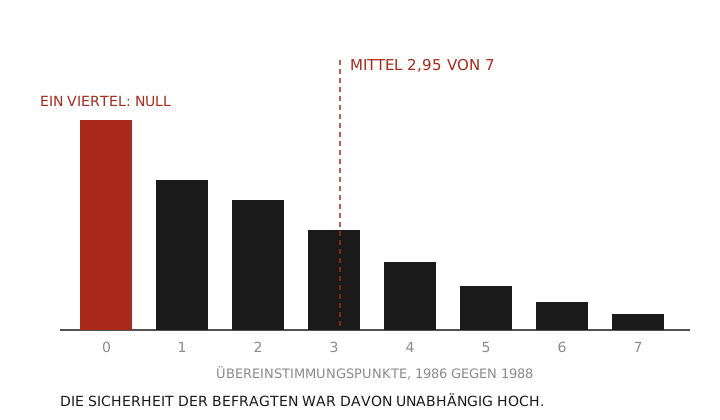
The mean accuracy score was 2.95 out of a possible 7. A quarter of those questioned scored zero points — not a single statement agreed with what they themselves had written down two years earlier. And the new accounts were by no means pale: they were fluent, detailed, often more dramatic than the original — “a fellow student told me in seminar” had become a television in the dorm room, the incidental news a moment of shock. And the finding that first makes the matter disquieting: confidence was high and had practically nothing to do with accuracy — the correlation between certainty and correctness lay near zero.
Especially revealing are the cases in which subjects were shown their own sheet. They acknowledged the handwriting as their own — and stayed with the new memory nonetheless. One participant said, in effect: that is my handwriting, but I remember it differently. The written proof from one’s own hand lost against the inner picture. The difference between document and memory can hardly be staged more sharply, and it is no accident that this scene — the presented protocol in one’s own hand — became the study’s most-quoted detail: it is the archival principle as an experiment.
The interpretation Neisser and Harsch offered was more careful than their title. It is not the event itself that burns in, but the story one has told since: whoever has passed the news on a hundred times remembers, in the end, the most practised version — often the one in which they learned it “on television,” because the television image of the explosion retroactively colonised all the tellings. Memory turns out to be an editorial desk, not an archive; it takes the current version for the original.
The textbook version likes to make of this: flashbulb memories are false. More precise is: they are no more accurate than ordinary memories, but are held with far greater certainty. The mechanism Brown and Kulik conjectured does not exist — what exists is a feeling of vividness that does not bring reliability with it. For eyewitness testimony precisely this scissors is the problem: courts weigh confidence, and confidence is here the least diagnostic feature.
A word on this study’s currency, because it is often read past: what was measured is consistency, not truth. The day-after record too can contain errors — it is only the earliest available version, not the event itself. What the comparison shows is therefore, strictly, not that the late memory is false, but that it has moved away from the early one without its bearer noticing. For the study’s point that is entirely enough: a memory that contradicts itself and is certain both times cannot be photographic.
The direct comparison with everyday memory was supplied in 2003 by Jennifer Talarico and David Rubin: they had students record, on the day after September 11, both the attack and an ordinary event of the same days. The consistency of both memories declined over the months in step — only vividness and certainty stayed high for the flashbulb memory alone. What is special about it is accordingly not how it stores, but how it feels.
The methodological critique belongs in the file: 44 of 106 is an attrition rate that burdens every generalisation, the sample consisted of students of a single university, and the event was personally inconsequential for most — perhaps, runs the objection, only what does not really touch you fades. It was a study of opportunity, with the weaknesses of its opportunity.
The practical application is unspectacular and effective: where wording matters, only the early record helps. Investigating authorities and air accident boards interview witnesses as fast as possible not out of impatience but for exactly this reason — every week of distance replaces memory with narrative. Neisser’s filing cabinet full of first-day forms is the model of this practice in miniature.
The study’s path into the profession itself had something of a field experiment about it: Neisser and Harsch published it in 1992 in an edited volume on flashbulb memories — not in a journal with an impact factor — and it nonetheless became one of the most-cited chapters of memory research. For an archive that also keeps the routes of reception, that is worth a note: what carried the finding was not the place of publication but the impossibility of explaining it away — every reader owns a rock-solid memory they have never tested.
The study also stands for a programme Neisser had prescribed to his own field. In 1978 he gave a lecture that was read as a reckoning: if an aspect of memory matters in everyday life, then psychology had hardly ever studied it. Laboratory research measures what can be measured cleanly — syllable lists, reaction times — and avoids what people actually retain and forget. The lecture set off a debate about ecological validity that occupied the field for years, and it explains why of all people the author of the textbook that had named cognitive psychology ran a survey about a rocket disaster. The study is a manifesto redeemed.
What stands today: the finding, and at a much larger sample. After 11 September 2001 a working group around William Hirst followed more than 3,000 people over ten years — this time planned, multi-city, with people for whom the event was anything but inconsequential. Result: memory for one’s own circumstances changes markedly in the first year, then remains stable in its — partly false — version, and confidence in it stays high throughout. Even proximity to the event did not protect. Neisser’s 44 students have held; the replication crisis has found nothing to object to in this file. It is one of the few studies in the archive whose core sentence can be passed on without deduction: the most vivid memory is as much in need of revision as any other — it just does not feel that way.
The term Neisser turned against his own field in 1976 sounds technical and means something simple: does a laboratory finding hold outside the laboratory?
The question is not rhetorical, because there are good reasons for artificial tasks. Measure memory with nonsense syllables and you switch off prior knowledge and can count cleanly. The price is that nobody ever learns nonsense syllables. Neisser’s charge was that cognitive psychology had paid that price for twenty years without booking it: it studied what was easy to measure rather than what people actually do.
The rejoinder came promptly and is not weak. Everyday studies have many uncontrolled influences; measure in the field and you often end up not knowing what was responsible. What came out of the quarrel was not a winner but a division of labour that still shapes the field: mechanisms in the laboratory, validity in the field — and the obligation to show both before speaking of a finding. Neisser’s own Challenger study is the model case: a field study with the control of a laboratory experiment, because the record from the previous day existed.
Replication status: replicated.
The core finding — flashbulb memories change like ordinary memories while confidence in them stays high — has been confirmed with far larger samples. The study around William Hirst followed more than 3,000 people over a decade after 11 September 2001 and found the same pattern: a marked drop in agreement over the first year, stabilisation thereafter, consistently high certainty.
Primary source:
- Neisser, U., & Harsch, N. (1992). Phantom flashbulbs: False recollections of hearing the news about Challenger. In Winograd & Neisser (Eds.), Affect and Accuracy in Recall (pp. 9–31). Cambridge University Press. — The 106 questionnaires from the morning after and the 44 follow-ups.
- Neisser, U. (1967). Cognitive Psychology. Appleton-Century-Crofts. — The book that gave the field its name.
- Neisser, U. (1976). Cognition and Reality. Freeman. — The self-criticism; origin of the debate about ecological validity.
The counter-thesis that was tested:
- Brown, R., & Kulik, J. (1977). Flashbulb memories. Cognition, 5(1), 73–99. — The assumption of a separate, photographically working mechanism.
Replication:
- Hirst, W., et al. (2015). A ten-year follow-up of a study of memory for the attack of September 11, 2001. Journal of Experimental Psychology: General, 144(3), 604–623. — Over 3,000 participants, ten years.
German-language:
- Markowitsch, H. J., & Welzer, H. (2005). Das autobiographische Gedächtnis. Klett-Cotta, Stuttgart. — Places the finding within research on autobiographical remembering.