Topic 05
Stimulus and Response
Gestalt & FieldBehaviorismCognitive Psychology
The first organised dissent came not from cognitive psychology but from Berlin: the Gestalt school disputed, as early as 1912, that perceiving and thinking can be assembled from stimulus-response building blocks. Wertheimer’s apparent motion showed an impression contained in no single stimulus, and Köhler’s chimpanzees solved tasks for which no reinforcement history held the ready answer — insight as restructuring rather than chaining. Behaviourism never refuted this objection, only outvoted it; the cognitive turn inherited it.
For forty years psychology was in large part a field that kept quiet about the inside. In 1913 Watson demanded that introspection be given up and that the discipline confine itself to observable behaviour; the aim was to be prediction and control, not understanding. The renunciation was not a dogma without a reason. What two observers can count independently of each other can be replicated; what a person reports about their own experience cannot.
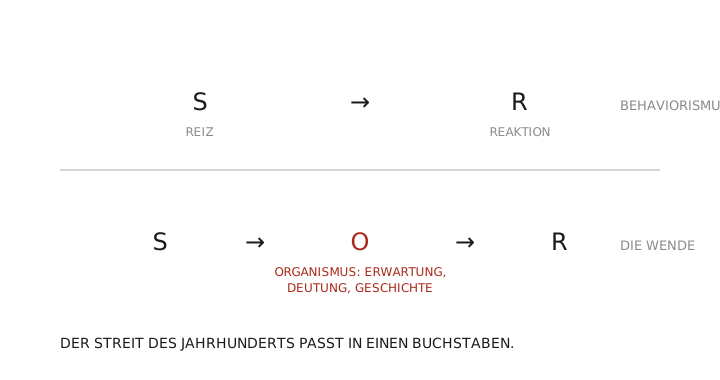
The gain from that renunciation is still in use. Pavlov’s conditioned reflex is among the best-evidenced phenomena in the field and is stable across species, kinds of stimulus and decades. Skinner’s operant chamber made behaviour continuously measurable rather than countable in trials, and his schedules of reinforcement describe a pattern that sits inside every slot machine and every feed today: irregular reward binds more strongly than reliable reward. Both findings stand independently of the theory that produced them.
The price was reach. The programme explains well how a response becomes more or less frequent; it explains badly how someone forms a sentence they have never heard. Chomsky’s 1959 review of Skinner’s Verbal Behavior went precisely there, and the review’s effect on the field was greater than that of the book it reviewed. The question was not whether reinforcement works, but whether it is enough.
The end came not as a refutation but as a shift of interest. Neisser’s Cognitive Psychology gave a name in 1967 to a field that wanted to describe inner processes again — as information processing, in stages between stimulus and response. What behaviourism had forbidden was not thereby permitted again but stated differently: not as a report about experience, but as a model from which measurable predictions can be derived.
The files under this topic show the transition in its weaknesses too. Watson’s best-known experiment has a sample of one, no control condition and an open ending; Skinner’s reading of his pigeons' superstition was replaced in 1971 by Staddon and Simmelhag with a more economical explanation. And Neisser charged his own field, nine years after founding it, with having retreated into artificial laboratory tasks — the same charge behaviourism had had to listen to, newly cast.
Sheets on this theme
- Case file 020Max WertheimerProfile
- Case file 020Max WertheimerCase file
- Case file 020Max WertheimerNote
- Case file 020Max WertheimerEvidence
- Case file 021Kurt LewinProfile
- Case file 021Kurt LewinCase file
- Case file 021Kurt LewinNote
- Case file 021Kurt LewinEvidence
- Case file 022Wolfgang KöhlerProfile
- Case file 022Wolfgang KöhlerCase file
- Case file 022Wolfgang KöhlerNote
- Case file 022Wolfgang KöhlerEvidence
- Case file 004Iwan PawlowProfile
- Case file 004Iwan PawlowCase file
- Case file 004Iwan PawlowNote
- Case file 004Iwan PawlowEvidence
- Case file 005John B. WatsonProfile
- Case file 005John B. WatsonCase file
- Case file 005John B. WatsonNote
- Case file 005John B. WatsonEvidence
- Case file 006B. F. SkinnerProfile
- Case file 006B. F. SkinnerCase file
- Case file 006B. F. SkinnerNote
- Case file 006B. F. SkinnerEvidence
- Case file 007Ulric NeisserProfile
- Case file 007Ulric NeisserCase file
- Case file 007Ulric NeisserNote
- Case file 007Ulric NeisserEvidence
- Case file 008Daniel KahnemanProfile
- Case file 008Daniel KahnemanCase file
- Case file 008Daniel KahnemanNote
- Case file 008Daniel KahnemanEvidence
- Case file 009Elizabeth LoftusProfile
- Case file 009Elizabeth LoftusCase file
- Case file 009Elizabeth LoftusNote
- Case file 009Elizabeth LoftusEvidence
- Case file 032Amos TverskyProfile
- Case file 032Amos TverskyCase file
- Case file 032Amos TverskyNote
- Case file 032Amos TverskyEvidence
From the journal
- 1903Pavlov presents classical conditioningAfter pairing with food, a neutral stimulus triggers salivation on its own.Iwan Pawlow
- 1912The Seeing of Motion appearsTwo blinking lines, one seen motion — and the doctrine of elements collapses.Max Wertheimer
- 1917The Mentality of ApesSultan joins two tubes — the solution arrives in one stroke.Wolfgang Köhler
- 1920Little Albert experimentAfter seven pairings, fear of the rat, generalised to similar things.John B. Watson
- 1938The Behavior of OrganismsVariable reinforcement produces the highest rates and the greatest resistance to extinction.B. F. Skinner
- 1939The leadership-style studies appearSame club, different style, different climate — the field's first deliberately built social climate.Kurt Lewin
- 1967Cognitive Psychology is publishedThe book gives a field its name and its order: processing in stages between stimulus and response.Ulric Neisser
- 1974Misinformation effect demonstratedOne verb more than doubled the reported broken glass.Elizabeth Loftus
- 1974Heuristics and errors of judgmentTversky and Kahneman show how useful shortcuts can create systematic errors under uncertainty.Amos Tversky
- 1979Prospect TheoryLosses weigh roughly twice as heavily as equal gains.Daniel Kahneman
- 1992Phantom FlashbulbsMean accuracy 2.95 of 7 — with confidence high throughout.Ulric Neisser