Case file 025 · Development
Mary Ainsworth
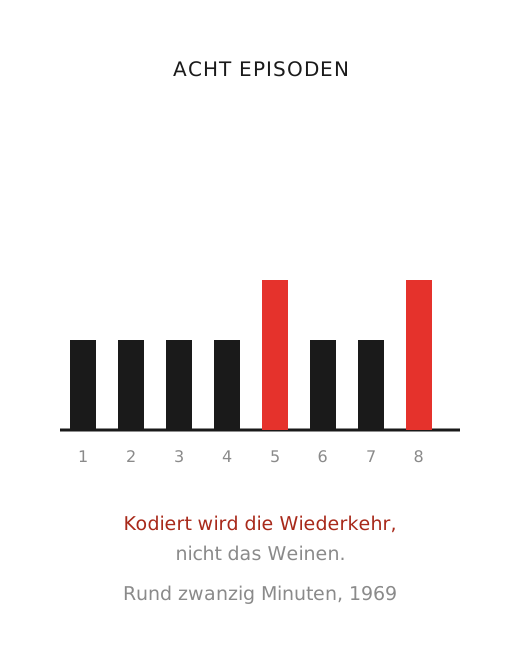
Fig. 1 — Drawing by the archive · free to use
A living room in Kampala, 1954: a Canadian psychologist sits with an interpreter in a Ganda household, two hours every fortnight for nine months, and writes down what she sees — how an infant cries when the mother leaves the room, how he greets her when she returns, how far he ventures from her and how quickly he comes back. Mary Ainsworth did not invent attachment research at a desk but on the floors of other people’s houses, with the dullest instrument in science: the record book.
Ainsworth was born Mary Dinsmore Salter on 1 December 1913 in Glendale, Ohio; the family moved to Toronto when she was five. At sixteen she went to the University of Toronto — drawn, she said, by William McDougall’s Character and the Conduct of Life, which she had found in the library — and took her doctorate there in 1939 under William Blatz on his security theory: the thesis that children need a secure base from which to explore the world. The concept she would make a world concept twenty years later stood in her own dissertation.
The war brought the detour: Ainsworth served as an officer in the Canadian Women’s Army Corps, worked on selection procedures and returned to Toronto as a lecturer in 1946. In 1950 she married the doctoral student Leonard Ainsworth and followed him to London — a decision she later commented on with bitterness, because she arranged her career around his, and which at the same time set everything in motion: in London she read a job advertisement from the Tavistock Clinic and became a co-worker of John Bowlby, who was just then analysing James Robertson’s separation films.
When the couple went to Uganda in 1954, she took the question with her and made of it attachment research’s first field study: 26 families, 28 infants, observations in the home rather than the laboratory, with notes on crying, following, greeting and exploring. Infancy in Uganda appeared in 1967 — the data base from which the attachment patterns come, and the proof that the theory does not cling to Western living rooms. In Baltimore, where she went in 1956 to Johns Hopkins University, she repeated the procedure with 26 American families: 72 hours of home observation per child across the first year of life — a quantity of data scarcely any later study approaches.
The road to Uganda was, moreover, no research plan but a turn of private life — she followed her husband’s post — and the study came about without funding, with an interpreter she paid herself. Ainsworth later commented on this dryly: she gathered the most important data of her life because she happened to be there and did not know what else she should be doing.
The Strange Situation, which she devised in 1964 as a short laboratory test alongside, was meant as a supplement and became the standard. In 1975 she moved to the University of Virginia, where she taught until retirement and trained the generation that carries the field — Mary Main, who developed the disorganised pattern and the Adult Attachment Interview, Everett Waters, Inge Bretherton, Sylvia Bell and others. The divorce in 1960 and the analysis she underwent afterwards she later described as turning points; scientifically the years that followed were her most productive.
The price of this career was an academic one: until the professorship in Baltimore, Ainsworth worked for years in positions below her qualification — as lecturer, carried along as a colleague’s wife, at times with the explanation that the faculty did not appoint married couples. She later described how, at her first faculty meeting in Baltimore, she was seated at a separate table with the secretaries. Attachment research is thus also evidence of how much science arises at the margins of the staffing plan.
Her Uganda work appeared only in 1967, thirteen years after the fieldwork — the records were handwritten narrative protocols, and it took time before they became a book offering categories rather than anecdotes. This delay explains part of the field’s history: by the time the Strange Situation became famous, few knew the observational work out of which it had grown, and the twenty-minute laboratory procedure took the place of the home visits it had originally been meant only to supplement.
In summary, the most sensitive mothers are usually accessible to their infants and are aware even of their more subtle communications, signals, wishes, and moods.
The honours came late and then all at once: the American Psychological Association’s award for distinguished scientific contributions in 1989, the gold medal for life achievement in 1998, honorary doctorates, festschriften. Ainsworth died on 21 March 1999 in Charlottesville, Virginia, aged eighty-five, of a stroke. Of the two names attachment theory carries, hers is the empirical one: Bowlby had the idea that closeness is a need in its own right — Ainsworth made it measurable, and that is why she stands in this archive with the rarest stamp: replicated.
The question
The question Ainsworth solved in 1964 was Bowlby’s problem: his theory claimed an attachment system with a secure base and return behaviour — but how does one measure such a thing? Questionnaires to mothers capture opinions, not relationships; interviews with one-year-olds are no option; and home observation, her own method, cost seventy hours per child. What was missing was a short, standardised procedure that makes the system visible by gently stressing it. The thought that came of it is as simple as it is compelling: attachment shows itself not in the comfortable state but when separation and strangeness activate it.
The design
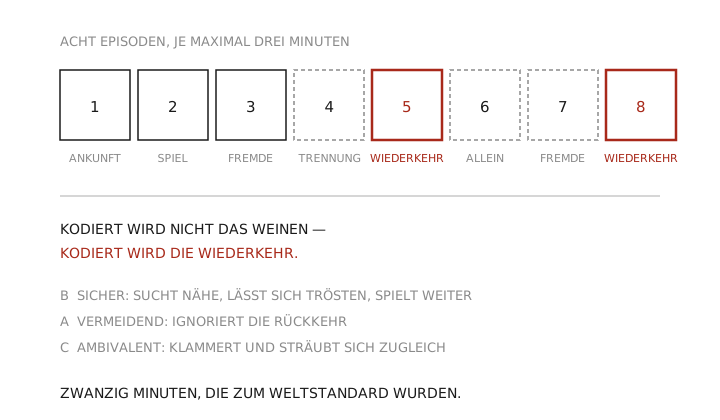
The procedure takes twenty minutes and consists of eight episodes of rising stress. Mother and child come into a playroom; the child explores. A strange woman enters, speaks with the mother, turns to the child. The mother leaves — the child stays with the stranger. The mother returns, comforts, leaves again, this time the child is entirely alone. The stranger returns, then the mother. Each episode lasts at most three minutes and is broken off if the child cries too much. Observers behind the one-way screen code second by second: exploration, proximity-seeking, contact-maintaining, resistance, avoidance.
The numbers
The finding that rebuilt developmental psychology sits in a place owed to Ainsworth’s gift for observation: not in the separation but in the reunion. Almost all one-year-olds protest when the mother goes; how they receive her when she returns divides the children into groups. The securely attached — in Baltimore the majority — greet, let themselves be comforted and return to play: the mother is the base from which one explores. The insecure-avoidant seem unimpressed, turn away, play pointedly on — their heart rate, though, as later studies showed, rises like the others': it is a strategy, not composure. The insecure-ambivalent are barely to be soothed, seek closeness and push away at once, and do not come back to play.
The second finding was the theoretically more important one and came from the home observations, not the laboratory: the patterns depended on how the mothers had responded to signals in the first year. Not the amount of attention but sensitivity — noticing signals, reading them correctly, answering promptly and appropriately — predicted the laboratory group. With that, Bowlby’s theory had a hinge between experience and behaviour, and attachment research a programme.
This mother is exquisitely attuned to B (baby)’s signals; and responds to them promptly and appropriately.
How strictly the procedure is built shows in what it forbids. The episodes are limited to three minutes and broken off at strong crying; the coding follows scales for proximity-seeking, contact-maintaining, avoidance and resistance that must be specially trained — certification courses for it exist to this day. And the classification rests not on a single behaviour but on the pattern across both reunions. Whoever merely counts how long a child cries measures nothing; which is why the Strange Situation, for all its brevity, is no quick test but a craft.
The reception
The reception made the procedure a world standard within twenty years — and the criticism set in where standards are always vulnerable: at generalisation. The great meta-analysis by van IJzendoorn and Kroonenberg in 1988, over some two thousand Strange Situations in eight countries, found the three patterns everywhere — but in shifted proportions: more avoidance in northern Germany, more ambivalence in Japan and Israel, and the variation within countries was larger than between them. Japanese infants, never left alone, are beside themselves in the separation episode — does the procedure there still measure attachment, or degree of strangeness? The debate is not closed; the cautious reading is that the patterns are universal but their frequencies culturally co-shaped.
The test
Where the differences come from, research has since tested in both directions. On the parental side stands sensitivity, and its transmission across generations became measurable: Mary Main’s Adult Attachment Interview asks parents about their own childhood and rates not the harshness of the story but the coherence of its telling — and thereby predicts, taken even before the birth, the child’s attachment classification above chance. On the child’s side stands temperament: critics objected early that the Strange Situation might measure only irritability. The test came out differentiated — temperament predicts how fiercely a child protests, the attachment classification to whom it turns; the same child can be classified differently with father and with mother, which a pure measure of temperament could not do.
The archival turn was supplied by a student. Mary Main and Judith Solomon reviewed in the 1980s the tapes of children Ainsworth’s coders had been unable to classify — and found a pattern in the non-pattern: children who freeze on the reunion, turn in circles, walk toward the mother and break off mid-movement. In 1986 this became the fourth category, disorganised, and it is the clinically most consequential: in risk groups — maltreatment, severe depression, unresolved parental loss — it clusters strongly and predicts later difficulties most clearly. The residue the procedure could not classify became, of all things, its most important finding.
The procedure’s reach also has clear limits, and the file names them. The Strange Situation is built for children between about twelve and eighteen months; for older children and adults there are other instruments whose interrelations are weaker than the textbook diagram suggests. The patterns are measures of relationships, not traits of the child — the same child can be classified differently with two attachment figures, which forbids individual diagnosis: a twenty-minute test says little about one child and much about groups. And the commercial offshoots that sell parents attachment diagnoses share only the name with the procedure.
A misunderstanding has accompanied the labels from the start. “Insecure” sounds like a diagnosis but is a description of strategy: the avoidant child has learned not to show its distress, because showing it helps little with this particular caregiver; the ambivalent one has learned to show it especially plainly, because irregular attention rewards exactly that. Both are sensible adaptations to an environment, and in unburdened samples the majority of children are securely attached, while the avoidant group is the largest of the rest — common enough not to be a diagnosis. The file stresses this because in the advice literature the categories are regularly read as damage reports.
What makes the procedure reliable also makes it scarce. The classification cannot be picked up on the side: whoever wants to code the Strange Situation goes through weeks of training on tape material, must then solve a test set of cases with sufficient agreement against a fixed standard, and must demonstrate that agreement again at intervals, because coding judgements drift. This requirement is the reason for the good reliability figures in the literature — and for its imbalance: studies using the Strange Situation are expensive, their samples therefore small, and large numbers arise only by pooling many small data sets. Whoever set out to simplify the procedure has regularly made it worse; the short forms and questionnaire variants proposed since the 1980s do not reach the discriminating power of the original arrangement.
| Study | Figures |
|---|---|
| Uganda, from 1954 | 26 families, 9 months, 2 hours every fortnight |
| Baltimore, home observation | about 70 hours per child in the first year |
| Strange Situation | 8 episodes, at most 3 minutes each, about 20 minutes |
| van IJzendoorn and Kroonenberg, 1988 | 32 samples from 8 countries, N = 1,990 |
| The fourth category | Main and Solomon, 1986 |
What remains
What stands today carries the rarest stamp in this archive. The Strange Situation is a reliable procedure with good inter-observer agreement and results stable across weeks; the patterns are findable across cultures; and the predictive power is documented in longitudinal studies across decades — the Minnesota study followed its children into their fourth decade. At the same time the effects are moderate, not fateful: meta-analyses find associations between sensitivity and attachment security that are clear but not large — more than one cause is at work — and intervention studies show that sensitivity can be trained and attachment security thereby improved: the causal evidence correlations alone cannot supply. The file therefore closes with a rarity: a theory from the psychoanalytic corner has travelled the whole road through field observation, standard procedure, cross-cultural comparison, longitudinal study and randomised intervention. Whoever wants to know what durable psychology looks like finds it in this folder — twenty minutes of laboratory, sixty years of checking.
The famous shortcut
The Strange Situation is famous because it takes twenty minutes. What carries it is unfamous because it took seventy hours: the home observations in Baltimore, four hours every three weeks, through the first year of life, in twenty-four living rooms. Before that lay Uganda: twenty-six families around Kampala, two hours every fortnight for nine months, with an interpreter, on the floors of other people’s houses. The shortest procedure in attachment research stands on the longest fieldwork in its discipline.
Without that groundwork the laboratory test would have remained a curiosity. Only the records from the kitchen table permitted the decisive check: the children who reacted securely in the laboratory had mothers at home who had noticed signals, read them correctly and answered promptly. The laboratory test therefore measures something that arose elsewhere — it diagnoses a history of relationship, not a trait of the child.
How expensive that groundwork was can be worked out. Four hours every three weeks across a year gives about seventy hours of observation per child; with twenty-four families that is more than sixteen hundred hours of record before the first classification was assigned. Add the time for transcribing, ordering and reading the material through again. No present funding line would approve such a sum without a query, and hardly any doctoral student could fit it inside a qualification period.
Why the order counts
The road can be walked backwards, and that is exactly what regularly happens. Whoever begins with the laboratory test and treats the fieldwork as prehistory ends up with an instrument that has never been calibrated: a scale whose meaning is no longer tested but assumed. Ainsworth’s own order was the other one. She observed for months without knowing what she was after, and built the test only once she knew which behaviour was worth the name. The twenty minutes are a summary of seventy hours, not a saving.
That order also explains why the procedure resists simplification. The short forms and questionnaire variants proposed since the 1980s take over the categories but not their descent. They ask parents for judgements where Ainsworth coded behaviour, and they do not reach the discriminating power of the original design. What is missing is not computing power but observation time.
The second half of the groundwork sits in the coding rules. Out of the home records came scales for proximity-seeking, contact-maintaining, avoidance and resistance — categories that were not invented but drawn off from what had been seen. Anyone who learns today, in a certification course, to code the Strange Situation learns exactly these abstractions, and learns them because somebody watched for a year beforehand.
What the note records
The note records this because professional practice tends to keep the shortcut and forget the detour. A procedure is only as valid as the fieldwork it was calibrated against. Ainsworth’s fame rests on a twenty-minute procedure; her science rests on filing cabinets.
For this archive the case is therefore more than a personal file. It belongs to development and attachment, and it shows in one example what this folder otherwise only asserts: that the quality of a measure does not sit in its handiness but in what was done before its first use. Whoever cites the Strange Situation cites twenty-four living rooms with it.
Replication status: replicated. The patterns are findable across cultures, the procedure is reliable, its predictive power documented in longitudinal studies — with moderate, not fateful, effects.
- Primary sources. Ainsworth, M. D. S. (1967). Infancy in Uganda: Infant Care and the Growth of Love. Baltimore: Johns Hopkins Press. Ainsworth, M. D. S., Blehar, M. C., Waters, E., & Wall, S. (1978). Patterns of Attachment: A Psychological Study of the Strange Situation. Hillsdale: Erlbaum. — Procedure, coding, Baltimore data.
- Cross-cultural. van IJzendoorn, M. H., & Kroonenberg, P. M. (1988). Cross-cultural patterns of attachment: A meta-analysis of the Strange Situation. Child Development, 59(1), 147–156. — 32 samples from eight countries, N = 1,990: patterns everywhere, proportions shifted, variation within larger than between countries.
- The fourth category. Main, M., & Solomon, J. (1986). Discovery of an insecure-disorganized/disoriented attachment pattern. In: Brazelton & Yogman (eds.), Affective Development in Infancy. — Out of the residual pile came the clinically most important finding.
- The German-language longitudinal work. Grossmann, K., & Grossmann, K. E. (2004). Bindungen — das Gefüge psychischer Sicherheit. Stuttgart: Klett-Cotta. — The Bielefeld and Regensburg studies; the source for the north German distribution that stands out in the cross-cultural comparison.
- Longitudinal and intervention. Sroufe, L. A., Egeland, B., Carlson, E., & Collins, W. A. (2005). The Development of the Person. New York: Guilford. — The Minnesota study. Bakermans-Kranenburg, M. J., van IJzendoorn, M. H., & Juffer, F. (2003). Less is more: meta-analyses of sensitivity and attachment interventions in early childhood. Psychological Bulletin, 129(2), 195–215. — d = 0.33 for sensitivity, d = 0.20 for attachment security; the causal evidence.