Topic 09
Measurement and Method
BeginningsDevelopmentClinic & Therapy
This archive has a quiet thesis, and it stands in nearly every file: it is not the better idea that prevails but the more testable one. What can be put into numbers and reproduced by strangers gets tested, corrected and taken into guidelines; what hangs on the person of its inventor gets admired and dies with him. This theme collects the evidence.
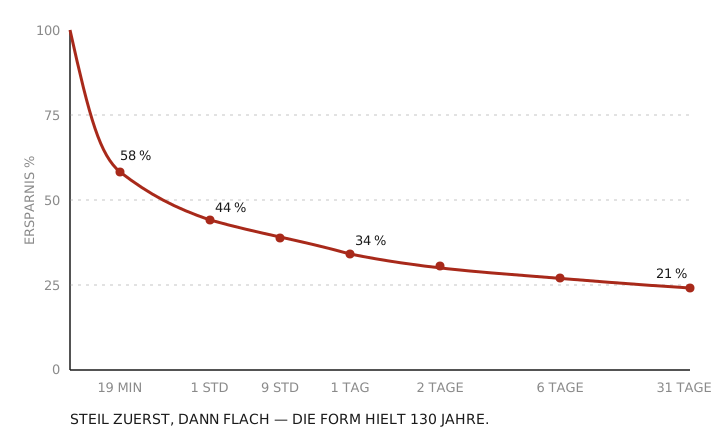
At the beginning stands a wager. Wundt built the laboratory in Leipzig and confined it to what could be measured at the apparatus; the higher processes he declared inaccessible. Ebbinghaus took the wager, invented the meaningless syllable and the savings method — and his one-man experiment of 1885 passed its literal repetition a hundred and thirty years later. The lesson is uncomfortable for any arithmetic of sample sizes: replicability is not a question of case numbers alone but of transparency. A single man with a metronome can measure more durably than a field with funding — if he writes down what he does, and does what he writes down.
That measurement has its price is shown by developmental psychology. Ainsworth’s Strange Situation owes its reliability to a coding discipline that cannot be picked up on the side — weeks of training, test sets, drift checks. Precisely this requirement makes the studies expensive and their samples small: the quality of the measurement and the size of the data stand in a trade-off the literature seldom declares. Whoever set out to simplify the procedure has regularly made it worse.
The clinic supplies the counterpart with the sign reversed. Beck built a measure and a manual to go with his therapy — and precisely for that reason cognitive therapy became the most-tested talking treatment in the world, while Ellis, who was there earlier, shrank to a paragraph in the textbooks. The priority question is settled and beside the point at once: whoever measures writes the history of influence. The Beck Depression Inventory has outlived its originator as Ebbinghaus’s curve outlived his.
Measurement does not protect against error — it only makes error findable. The shrinking effects of the early therapy trials, publication bias, the career of undersized samples: all of it is on record under the replication crisis theme, and it is no objection to measuring but its result — a field auditing itself with its own tools. In this archive things are overturned almost always by better methods, seldom by better arguments.
The rule the theme comes down to was demonstrated by Ebbinghaus and institutionalised by Ainsworth: write it down so that others can refute you. Everything further — preregistration, shared data, many-lab studies — is a footnote to that sentence.
Sheets on this theme
- Case file 017Wilhelm WundtProfile
- Case file 017Wilhelm WundtCase file
- Case file 017Wilhelm WundtNote
- Case file 017Wilhelm WundtEvidence
- Case file 018William JamesProfile
- Case file 018William JamesCase file
- Case file 018William JamesNote
- Case file 018William JamesEvidence
- Case file 019Hermann EbbinghausProfile
- Case file 019Hermann EbbinghausCase file
- Case file 019Hermann EbbinghausNote
- Case file 019Hermann EbbinghausEvidence
- Case file 023Jean PiagetProfile
- Case file 023Jean PiagetCase file
- Case file 023Jean PiagetNote
- Case file 023Jean PiagetEvidence
- Case file 024John BowlbyProfile
- Case file 024John BowlbyCase file
- Case file 024John BowlbyNote
- Case file 024John BowlbyEvidence
- Case file 025Mary AinsworthProfile
- Case file 025Mary AinsworthCase file
- Case file 025Mary AinsworthNote
- Case file 025Mary AinsworthEvidence
- Case file 034Eleanor J. GibsonProfile
- Case file 034Eleanor J. GibsonCase file
- Case file 034Eleanor J. GibsonNote
- Case file 034Eleanor J. GibsonEvidence
- Case file 029Aaron T. BeckProfile
- Case file 029Aaron T. BeckCase file
- Case file 029Aaron T. BeckNote
- Case file 029Aaron T. BeckEvidence
- Case file 030Albert EllisProfile
- Case file 030Albert EllisCase file
- Case file 030Albert EllisNote
- Case file 030Albert EllisEvidence
- Case file 031Martin SeligmanProfile
- Case file 031Martin SeligmanCase file
- Case file 031Martin SeligmanNote
- Case file 031Martin SeligmanEvidence
From the journal
- 1879The Leipzig institute begins its workA room in the Konvikt building becomes the first laboratory of a new discipline.Wilhelm Wundt
- 1885On Memory appearsA single subject — the author — and a forgetting curve replicated in 2015.Hermann Ebbinghaus
- 1890The Principles of Psychology appearsTwelve years of work, two volumes — and the stream of consciousness gets its name.William James
- 1936The Origins of Intelligence in ChildrenThree children, one cloth, six stages — object permanence becomes observable.Jean Piaget
- 1944Forty-four juvenile thievesAmong the affectionless thieves, early and lengthy separations clustered.John Bowlby
- 1957Rational PsychotherapyThe ABC scheme appears in print — six years before Beck's first cognitive paper.Albert Ellis
- 1960The visual cliffEleanor Gibson and Richard Walk make depth perception testable without any risk of falling.Eleanor J. Gibson
- 1967Learned HelplessnessThree groups, the same shocks, one difference: control.Martin Seligman
- 1969Attachment appearsThe first volume of the trilogy — attachment as a biological system, not a by-product of drives.John Bowlby
- 1977Therapy Beats the Pill41 patients, twelve weeks — talking treatment holds up against imipramine.Aaron T. Beck
- 1978Patterns of Attachment appearsTwenty minutes of laboratory, three patterns — and the key lies in the reunion.Mary Ainsworth
- 2011Flourish appearsFrom happiness to flourishing: five components instead of one measure.Martin Seligman