Case file 003 · Psychoanalysis
Anna Freud
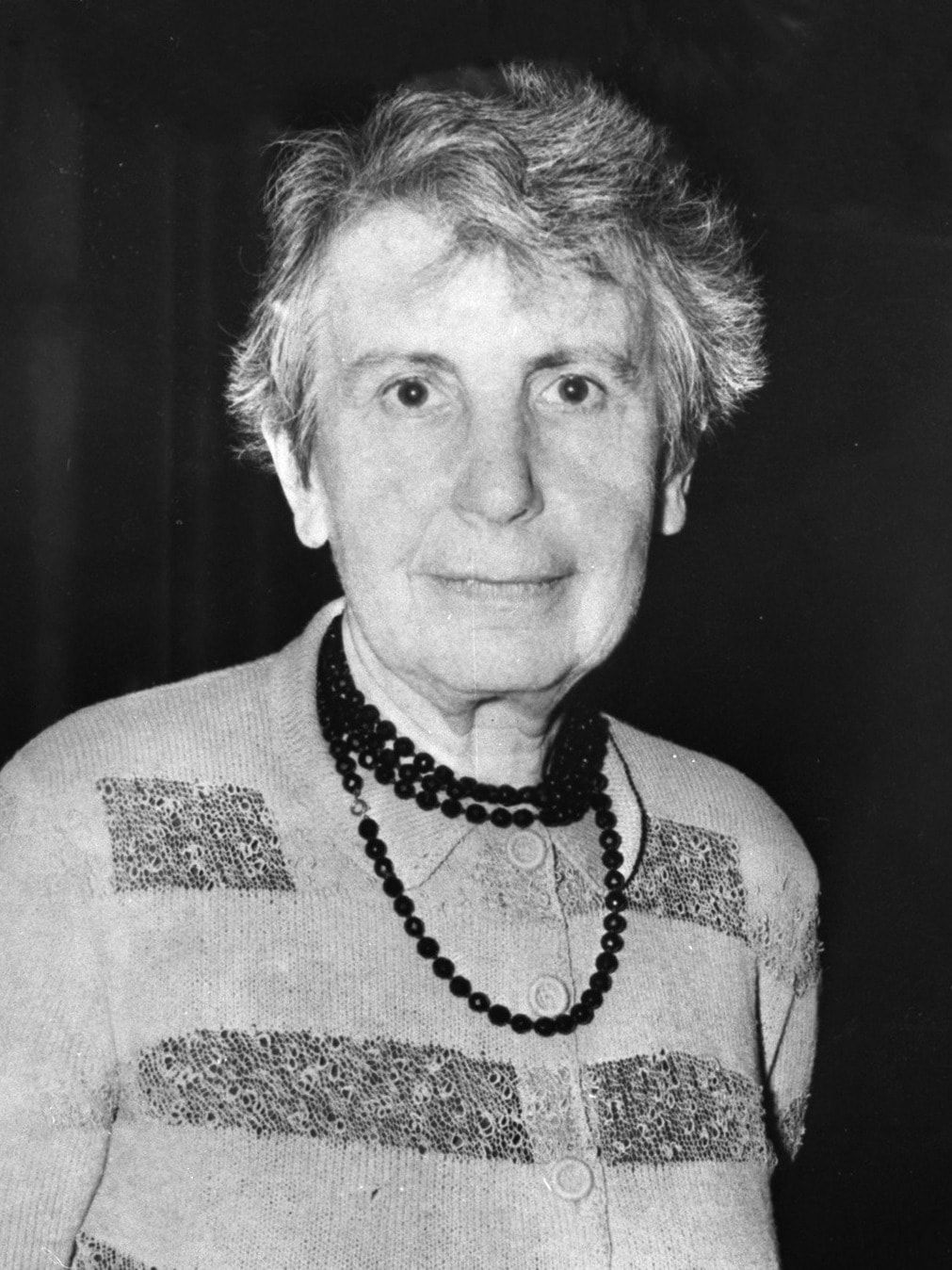
Fig. 1 — CC0 · Wikimedia Commons

In January 1941 a nursery opened in a house in Hampstead for children whose families the German air war had driven from their homes. There Anna Freud and Dorothy Burlingham kept records for years: who cried when, who attached to whom, who came back from a weekend with their mother and could not be reached for days. Out of those index cards grew one of the first systematic observational studies of children in catastrophe.
Anna Freud was born on 3 December 1895 in Vienna, the youngest of six children — in the same year her father closed the prehistory of psychoanalysis with the Studies on Hysteria. She was the only one of the six to follow him into the field, and she came to it by a detour: she trained as an elementary school teacher and taught for several years before turning to psychoanalysis. That prehistory shows in her later work — she was interested in what children do in everyday life, not only in what they say in the consulting room, and she trusted nursery teachers to be useful observers.
She underwent her analysis with her father, in sessions from 1918. Even then that was a breach of the rules — analysing one’s own daughter violated principles Freud himself had formulated — and it remains the most discussed point of her biography; the literature treats it as what it is: a conflict of interest in the founding generation that no one could correct, because the rule-giver was the rule-breaker. In 1922 she was admitted to the Vienna Psychoanalytic Society with the paper Beating Fantasies and Daydreams; from 1923, after her father’s cancer diagnosis, she became his nurse, secretary and representative in one person — the daughter who read his papers aloud at congresses.
In the Vienna years she built what had not existed before: a training in child analysis. At the society’s training institute she taught educators and analysts; with Dorothy Burlingham, the American friend and lifelong working partner, came an experimental kindergarten for workers' children and the Jackson Nursery for toddlers — precursors of the later London nurseries. In 1936 appeared The Ego and the Mechanisms of Defence, her principal work, as a gift for her father’s eightieth birthday.
Two years later the Anschluss forced the family to flee. In March 1938 Anna Freud was summoned by the Gestapo and interrogated for a day — by the traditional account she carried Veronal on her for the worst case. After her release, father and daughter emigrated to London. There she nursed him until his death in September 1939 and then, with her rival Melanie Klein in the same city, became the second authority of British psychoanalysis.
The conflict between the two women — over how early a child can be interpreted, and how much world is in its phantasy — escalated in the middle of the war into the Controversial Discussions of 1941 to 1945: formal dispute sessions of the British Psychoanalytical Society while the sirens ran outside. The result was an English compromise, the “gentlemen’s agreement” of three training tracks — Kleinians, Anna Freudians, Middle Group — which shapes the society to this day.
Her own institute grew out of the war nurseries: in 1952 she founded the Hampstead Child Therapy Course and Clinic, which became today’s Anna Freud Centre — training, clinic and research under one roof, with the "Diagnostic Profile" as an attempt to chart child development systematically. In the 1960s she widened her field once more: with Joseph Goldstein and Albert Solnit of Yale Law School she wrote Beyond the Best Interests of the Child — books that carried the concept of psychological parenthood into family law and are cited down to custody rulings.
Late recognition came from many directions at once: in 1967 the British crown made her a Commander of the Order of the British Empire, and in 1972 the University of Vienna — the city that had driven her family out — conferred on her the honorary doctorate of medicine; further honorary degrees followed on both sides of the Atlantic. She received such things with the dry incidentalness her students knew from the case seminars.
Out of the nursery index cards later grew an ordering work of its own kind: the Hampstead Index, in which her clinic catalogued the material of ongoing child analyses by concept over decades, so that cases could be compared instead of merely recounted. It was the attempt to give psychoanalysis a card index — not a measuring instrument, but the most visible difference between her way of working and her father’s.
Anna Freud died on 9 October 1982 in London, in the house at 20 Maresfield Gardens where she had lived and worked since the emigration. Her field, child psychoanalysis, she not only co-founded but anchored institutionally — and the house itself became, as she wished, the Freud Museum.
Sigmund Freud had described defence, but scattered it — across forty years and a dozen writings, under changing names and with changing valuation. The question his daughter answered in 1936 was one of ordering: if the ego defends itself against unbearable impulses — by which means exactly, and can they be told apart?
The timing is part of the file. The book appeared in May 1936, for Freud’s eightieth birthday, as the daughter’s formal gift to the father — and at the same time, as only hindsight shows, as the inaugural document of a school of her own. Vienna had two years left. The ego psychology the book founded emigrated with its carriers and became the ruling doctrine in, of all places, the country whose optimism the old Freud had never shared: the United States.
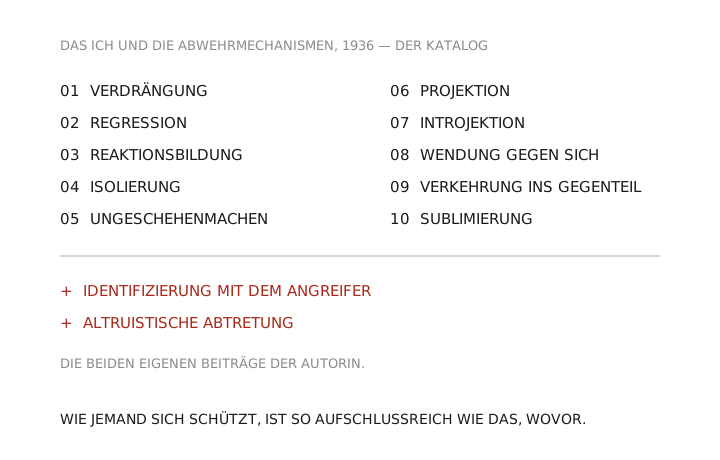
The Ego and the Mechanisms of Defence draws the scattered defence mechanisms together into a catalogue. Repression, regression, reaction formation, isolation, undoing, projection, introjection, turning against the self, reversal into the opposite, sublimation — plus two forms she added herself: identification with the aggressor, and the asceticism of puberty. Identification with the aggressor is the book’s concept that has travelled farthest: that a child who cannot avert a threat takes over the role of the threatener — from the play-acted dentist scare in the kindergarten to the extreme situations for which later literature claimed the term.
The real break with her father’s work lies in the direction of the gaze. Classical analysis looked behind the defence for the repressed; the defence itself was an obstacle to be pierced. Anna Freud made it the object: how someone protects themselves is as revealing as what from. The analyst, she wrote, stands equidistant from id, ego and super-ego and observes where the defence is at work — an instruction that turned the art of interpretation into a technique of observation. Out of this shift grew the ego psychology that shaped post-war American psychoanalysis through Heinz Hartmann and the New York emigration.
This too is no experiment. There is no sample, no scale, no test condition — it is a systematics built from clinical material, and its proving consisted in clinicians being able to work with it. Empirical personality research later tried to make defence measurable — with questionnaires, and with the idea of a hierarchy of mature and immature defences as George Vaillant developed it from longitudinal data. The instruments remained contested; the catalogue itself was never built as a measuring protocol.
The historical frame belongs in the file because it supplied the material. With the outbreak of war in September 1939 the British government, under Operation Pied Piper, evacuated well over a million people from the cities within days, most of them children — separated from their families, distributed among strange households in the countryside. It was the largest involuntary separation study in history, without anyone having designed it as a study. What it did was registered first by the practitioners: teachers, matrons, paediatricians reporting bed-wetting, muteness and running away. The Wartime Nurseries were founded into this situation — as a relief institution first, an observation post second, and only in retrospect as the laboratory that made the separation question answerable.
What became empirically load-bearing was something else: the war nurseries. From January 1941 Anna Freud and Dorothy Burlingham ran the Wartime Nurseries in Hampstead and Essex — crèches for children whose families the air war had bombed out of their homes. Financed by American donations, run on index cards: every child had a sheet recording feeding and sleeping, separation reactions and attachments to individual nurses. The monthly reports to the donors, collected in Young Children in War-Time and Infants Without Families, are in retrospect what psychoanalysis had not possessed until then: systematic behavioural observation of a defined population under documented conditions.
The finding they recorded was unexpected and became the foundation of an entire line of research: it was not the bombing itself that did the greatest damage, but separation from the mother. Children who lived through the air war at their parents' side came through markedly better than children housed in safety but alone — evacuation, well meant, turned out to be the greater burden. The nursery drew practical consequences that ran against every institutional routine of the day: mothers could visit at any time, siblings stayed together, and the children were assigned to steady caregivers in small “family groups” instead of a rotating duty roster.
The records themselves survive and are edited; whoever reads the monthly reports finds, beside the numbers, the miniatures that carry the method — the child who sleeps through his mother’s visit and punishes her for days, the three-year-old who only clings to her nurse when no one is looking.
The reception of these observations ran apart along two paths. Within psychoanalysis they became part of the quarrel with Melanie Klein, fought out in the Controversial Discussions of those same years: Klein read the children’s distress from the inner world of phantasy, Anna Freud from the outer, observable situation. Outside it, John Bowlby — who knew the nursery reports and drew the conclusion that the real relationship counts, not only its representation — picked up precisely this thread. His WHO report of 1951 on motherless children cites the Hampstead records; from there the line runs through Mary Ainsworth’s observational procedure to attachment research — the best-replicated field psychoanalysis ever produced. That Anna Freud and Bowlby criticised each other sharply on the substance belongs to the point: the observation outlived the quarrel of its interpreters.
One consequence of the nurseries can be traced into hospital regulations. Among the staff of the Wartime Nurseries was the young social worker James Robertson, who learned observation there and after the war carried it to a place no one until then had considered a research subject: the children’s ward. His film A Two-Year-Old Goes to Hospital of 1952 — a single hospital week of two-year-old Laura, filmed with a fixed camera, her parents allowed only at the permitted visiting hours — made visible the separation reactions the nursery records had described, and helped bring about that parents today may stay overnight with their children in hospital. It is the rare case of a psychoanalytic observation whose replication can be read off visiting regulations.
Anna Freud herself later systematised the observational line without ever carrying it into an experiment: her late work Normality and Pathology in Childhood (1965) orders development along so-called developmental lines — from being fed to eating independently, from the body to the toy, from dependency to self-responsibility — giving diagnostics a grid that still stands in training curricula. Empirical defence research, in turn, carries the 1936 catalogue as its family tree: where questionnaires today separate mature from immature defence styles, or longitudinal studies like the Grant Study correlate defence and life outcome, her categories stand at the origin of the instruments — testing is done with concepts never built for testing.
The archival double-finding of this file is thus unusually clean. The catalogue of defence mechanisms has remained professional vocabulary — every clinician learns it, no experiment has ever tested it, and in this form it is not testable. The observation from Hampstead has become science — with samples, control groups and fifty years of replications that have confirmed its core. Both come from the same woman, from the same years — written between air raid warnings and duty rosters, in an institution that was refuge, training school and archive at once. Where she systematised, language emerged; where she kept records, evidence did. It is the quietest point of this folder that its best-tested finding comes not from the couch but from a nursery.
Of the terms in the 1936 catalogue, one is entirely hers: identification with the aggressor. It describes a turn that looks absurd at first sight. Someone threatened should flee or fight back. Some do a third thing — they take on the bearing of the one threatening them.
Anna Freud observed it in children, and her examples are unspectacularly exact. A boy frightened at the dentist played dentist at home and drilled in other people’s mouths. A child startled by a ghost ran through the hallway making ghost noises itself. What was suffered becomes a role, and in that role the fear is gone — it is with the other person.
The term has grown beyond child analysis. In trauma research it describes part of what appears as perpetrator-victim reversal in relationships of violence; Bruno Bettelheim transferred it — on a thin and contested evidential basis — to behaviour in concentration camps. Caution is called for exactly here: a term that describes a child’s play well does not automatically explain the behaviour of adults under extreme violence. Anna Freud herself did not carry it that far.
Replication status: not applicable.
The Ego and the Mechanisms of Defence is a systematics, not an investigation. It names and orders; it does not test. The status refers to that work; it says nothing about the observational studies from the war nurseries — and those are the part of the work empirical research built on.
Primary work:
- Freud, A. (1936). Das Ich und die Abwehrmechanismen. Internationaler Psychoanalytischer Verlag, Vienna. — The catalogue, including identification with the aggressor.
- Freud, A., & Burlingham, D. (1943). War and Children. Medical War Books, New York. — The analysis of the Hampstead war nurseries; the finding on separation from parents.
- Freud, A. (1965). Normality and Pathology in Childhood. International Universities Press. — Developmental lines, her later contribution to diagnosis.
What became testable research:
- Bowlby, J. (1951). Maternal Care and Mental Health. WHO, Geneva. — The report that takes up the observations from the war nurseries and carries them on into attachment theory.
- Ainsworth, M. D. S., et al. (1978). Patterns of Attachment. Erlbaum. — The Strange Situation; the replicated end of that line.
Dispute and context:
- King, P., & Steiner, R. (Eds.) (1991). The Freud–Klein Controversies 1941–45. Routledge. — The other side; see file 016.
- Young-Bruehl, E. (1988). Anna Freud: A Biography. Summit Books. — Also on the analysis by her father, judged differently in the literature but not disputed.
- Peters, U. H. (1979). Anna Freud. Ein Leben für das Kind. Kindler, Munich. — German-language biography.
Overview: https://en.wikipedia.org/wiki/Anna_Freud