The Journal30 August 202612 min read
The Measure of Culture Is Itself Measured
How a Chinese list of values put Hofstede's grid straight
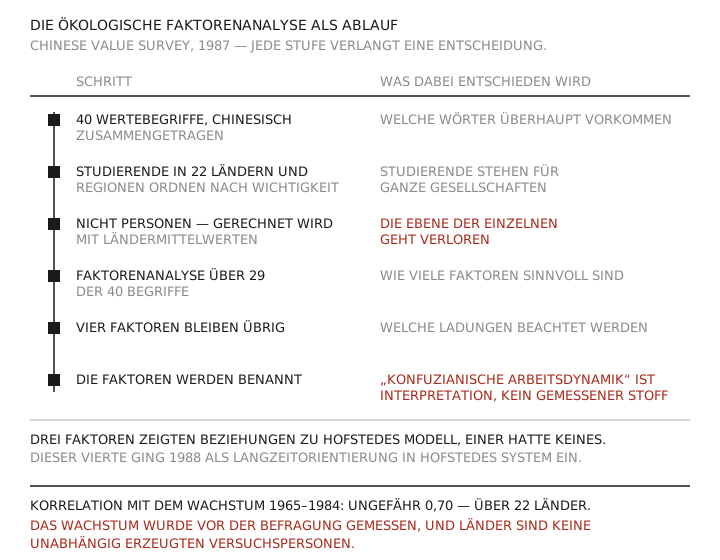
The paper that appeared in the Journal of Cross-Cultural Psychology in 1987 carried no individual author’s name. In the byline stood a collective: The Chinese Culture Connection. Its material was 40 value terms that Chinese scholars had assembled from their own tradition of language and thought. Students in 22 countries and regions ranked them by importance. From the country means the collective computed four dimensions. One of them was called “Confucian work dynamism” and correlated at around .70 with the economic growth of the participating countries between 1965 and 1984.
With that a double history begins. The questionnaire decentred Western psychology because it no longer treated that psychology’s concepts as self-evident. At the same time it produced new grand terms that make states look like personalities. It was a release from the old yardstick and a source of new templates. Anyone wanting to understand its effect has to hold both in view at once.
Where the questionnaire came from
A psychological questionnaire looks neutral: white pages, numbered statements, the same response scale for everyone. But before the first person ticks a box, somebody has decided which words matter. “Independence” can count as maturity, “obedience” as backwardness, plain speech as sincerity and reticence as insecurity. Every operationalisation takes a prior decision about what can become visible at all.
Early comparative research often took tests developed in the United States or western Europe, translated them and compared means. That can make sense where the same construct is understood similarly everywhere. But a translation does not solve the problem of selection. Imagine a catalogue of music containing only Western instruments: it can be rendered into many languages and remains incomplete. If people from Java or India could not name their most important timbres in it, the conclusion that their music is less differentiated would be absurd. In psychology the same error hides more easily, because words like “autonomy”, “happiness” or “self-worth” sound universal.
The Chinese Value Survey reversed the direction of the gaze. Chinese specialists were asked to name values that might matter to people in Chinese societies. Out of a larger collection came the list of 40 terms: among them social order, persistence, thrift, respect for tradition, reciprocal obligation, personal steadiness, the keeping of face and a sense of shame. The list was not a distilled essence of China but a deliberately differently positioned starting point.
Michael Harris Bond, born in Toronto in 1944, had studied in North America, worked for a time in Japan and spent most of his academic career in Hong Kong. His biography is readily told as a simple explanation for cross-cultural curiosity. That would be too neat. Mobility frees nobody from prior assumptions; but it can multiply the situations in which the self-evident comes to need explaining.
Hong Kong in the 1970s and 1980s was a British colony, Chinese in character, capitalist in organisation and connected both regionally and globally. Cantonese and English, local identity, Chinese traditions and colonial institutions did not stand tidily side by side but overlapped in daily life. For that reason alone, “Chinese” was no unambiguous container. Mainland China, Hong Kong, Taiwan and the diaspora communities had different political histories; within each region, class, generation, language, religion, education and gender differed. An instrument that took Chinese sources seriously could not be allowed to dissolve that variety into a supposedly timeless national character.
The collective authorship suited the structure of the project: researchers in many countries organised translations and data collection, and the idea was not meant to look like the export of a lone Western scholar. The name was also a gesture of science policy — knowledge about culture arises through a network, not out of a sovereign centre. A collective name does not automatically settle questions of power, though. Who formulates the first list? Who commands the language of publication? Who decides on the names of the factors? International cooperation can stay hierarchical even when many countries appear in a table.
It remains remarkable all the same, because it contradicts the cult of the “great man” that likes to reduce complex research to a single name. Bond was a driving figure, yet the data existed only through local teams and participants. Cross-cultural comparison is infrastructural work: testing terms, translating, back-translating, obtaining samples, documenting contexts, coordinating institutions.
Forty values, twenty-two countries
The finished questionnaire was put to students in 22 cultural contexts, in most places to groups of both male and female students. Universities offered reachable samples, and education was thereby kept partly comparable. At the same time that limited any statement about whole societies. Students are younger, more formally educated and often more urban than the general population. In some countries they belong to a small elite, in others to a broader middle class. The same status of “student” therefore does not carry the same social meaning.
Ranking values is also more demanding than it looks. Someone who ranks a term highly may find it morally important, may miss it in society, or may be picking the expected answer. Two people can name the same value and mean different things. “Harmony” can denote attentive coordination, fear of conflict or political conformity. Without qualitative knowledge of the context the number stays ambiguous.
The analysis therefore did not start with individual students but with the means of cultural groups. An ecological factor analysis over 29 of the 40 values looked for patterns: which terms are weighted high or low together in the same countries? Four factors were left, named in substance as integration, Confucian work dynamism, human-heartedness and moral discipline. Factor analysis is a mathematical condensation; it delivers groups of similarly varying variables, not their meaning. Researchers decide how many factors are sensible, which loadings to heed and which names to award. “Confucian work dynamism” is therefore the interpretation of a statistical pattern, not a substance that was measured.
| Detail | Value |
|---|---|
| Instrument | Chinese Value Survey, 40 value terms |
| Cultural contexts | 22 countries and regions |
| Entered into the factor analysis | 29 of the 40 terms |
| Dimensions found | four |
| Without a counterpart in Hofstede | Confucian work dynamism |
| Correlation with growth 1965–1984 | about .70 |
| Publication | Journal of Cross-Cultural Psychology, 18(2), 1987 |
Hofstede and the correlation of .70
Geert Hofstede’s influential country dimensions had come out of surveys of IBM employees. They described, among other things, power distance, individualism, uncertainty avoidance and a dimension labelled masculinity. The Chinese Value Survey offered a test: would similar country differences appear if the questionnaire came from a different cultural source?
Three of the four new dimensions showed relations to parts of Hofstede’s model. That could be read as an indication that certain differences were not merely artefacts of a Western instrument. The fourth, Confucian work dynamism, had no direct counterpart. In 1988 Hofstede and Bond carried it into Hofstede’s system as long-term versus short-term orientation.
Therein lies the real gain in knowledge: a theory can be partly confirmed and extended at the same time. Scientific universality does not come about because one centre lays its concepts over everything, but when different starting points test one another and in doing so make both shared and local structures visible.
Most attention went to the association between the new dimension and the economic growth of the countries from 1965 to 1984. At a time when the rise of East Asian societies called for explanation, “Confucian work dynamism” looked like a missing piece of the puzzle.
A correlation across 22 countries is fragile, however. Countries are not independently generated participants; they share history, region, trade, institutions and conflicts. Economic growth depends on the starting level, industrial policy, education, demography, geopolitical position, capital and colonial history. A cultural value can be a cause within all this, or a consequence, an accompaniment or a statistical stand-in. There is also the logic of time: the growth had been measured before the survey was taken. No causal chain of “Confucianism produces prosperity” can be built from such a pairing. Societies reinterpret their traditions in the light of their success; what appears in retrospect as an ancient economic ethic can be a modern selection from contradictory inheritances.
The label, too, carries less than it promises. “Confucian” sounds precise but takes in texts, rituals, state philosophies, family orders and modern political appropriations across centuries. Values such as persistence, thrift or ordered relationships are neither exclusively Chinese nor weighted alike in every Chinese life-world. The factor name bundled a pattern; it was not to become an explanation of all East Asian people.
Why country means do not describe people
The central methodological warning is called the ecological fallacy. An association between country means need not hold at the level of individual persons. If countries with a higher average value orientation grow faster, it does not follow that the person with the highest score has the highest income. A simple example: cities with more libraries may also have more thefts — not because library visitors steal, but because both quantities rise with population. Conversely, a strong individual association can vanish at country level. Cultural models therefore need multilevel analyses that treat persons as nested within groups.
A second problem sits inside the individual answer already. People rate themselves relative to their surroundings: someone who classes herself as “not very hard-working” may be measuring herself against an extremely performance-oriented reference group, while a person with the same behaviour elsewhere ticks “very hard-working”. In 2002 Heine, Lehman, Peng and Greenholtz described this reference-group effect as a systematic distortion of subjective Likert comparisons. Added to that are differing response styles — avoidance of extreme categories, a general tendency to agree, self-presentation according to norms — and translations that make scale anchors sound stronger or weaker. Modern cross-cultural research therefore tests measurement invariance: does a scale have the same structure, meaning and unit in different groups? Historically the Chinese Value Survey was a step towards culturally broader concept formation; it did not relieve the field of these later obligations to test.
The result is a limit that holds for the most popular of all cultural oppositions as well. “Individualism” can mean personal choice, legal autonomy, self-expression or slight family obligation; “collectivism” can mean solidarity, hierarchy, group loyalty or subordination. These components do not necessarily occur together. A person can be strongly duty-bound within the family and politically individualist. A firm can demand team harmony and produce brutal personal competition. Gordon Allport’s trait psychology asked after stable differences between individuals, cross-cultural dimensions after aggregated patterns between groups. The two levels can be connected and are not identical; the distributions overlap heavily. National character was historically a dangerous term, used to legitimise colonial rule, war policy and ethnic hierarchies. Modern scales use mathematics instead of physiognomy, but they can repeat the same error of thought when country scores are passed off as essences.
The opposite direction is just as tempting. Terms such as mianzi, “face”, are readily presented in accounts of Chinese psychology as a peculiarity. In fact standing, embarrassment and social recognition organise every human group; what differ are the forms and the situations. A culture can mark certain relationships more finely in language without owning an exclusive feeling. The exoticising reading makes Chinese people prisoners of harmony and face; the universalist one wipes local meanings away. Good cultural psychology needs the double movement: to find what is shared without denying difference; to describe difference without turning people into things.
Culture changes, and the criticism grows with it
Values shift through migration, education, media, crises, political movements and the turnover of generations. People learn several cultural repertoires and activate them according to context; a bilingual person cannot be cut in half. Nations, too, are not timeless cultures. Hong Kong’s transition from British colonial rule to a Chinese special administrative region in 1997 is a reminder that political categories are historical processes. A questionnaire score from 1985 must therefore not be used as an unchanging value for 2026 — and repeated surveys have at the same time to check whether the same words still mean the same thing.
The critique of Western instruments belongs today to the debate about WEIRD samples. In 2010 Henrich, Heine and Norenzayan showed how heavily psychology’s base of knowledge rests on Western, educated, industrialised, rich and democratic societies, and frequently on student groups:
Behavioral scientists routinely publish broad claims about human psychology and behavior in the world’s top journals based on samples drawn entirely from Western, Educated, Industrialized, Rich, and Democratic (WEIRD) societies.
The Chinese Value Survey anticipated part of this critique: it asked not only whether other people answer differently, but whether the questions themselves are provincial. Bond and Kwok Leung later continued the line. With the social axioms they searched for universal dimensions of general beliefs about how the world works — in 2002 across a first group of countries, in 2004 across 41 cultures.
Decolonisation means more in this context than a questionnaire from another language. It touches the research agenda, funding, authorship, ownership of data, access to publication and benefit. Local researchers should not merely supply samples while theory and renown stay in the global North. At the same time it would be a mistake to bind every finding to its place of origin. The question is not “universal or cultural”, but: by what procedure does a claim become universal? A genuine universal has to survive different languages, forms of life and counter-examples.
What remains
Secure is the methodological core: the cultural origin of a measuring instrument is empirically relevant. With a Chinese-generated list of values, both familiar and new country structures appeared, and one of them entered Hofstede’s system as long-term orientation. Everything inferred from that about societies remains contested. Twenty-two groups of students are a narrow base for macroeconomic explanations, factor names can harden traditions, and country correlations permit no individual diagnosis. The paper’s title promised culture-free dimensions; the expression is probably already a paradox. No questionnaire comes into being outside language, history and interests. Objectivity does not mean having no origin but making the origin visible, organising criticism, and having results tested in more than one place.
In ordinary use you recognise the error by a sentence pattern: “China is long-term”, “the West is individualist”, “Japan avoids uncertainty”. Such sentences turn heterogeneous societies into acting characters and hide conflicts between generations, regions, classes and institutions. The defensible formulation is less comfortable: in a particular sample and at a particular time, aggregated response patterns differed along a dimension given this name. Cultural knowledge thus supplies hypotheses — which norm might be relevant here? — but no diagnosis. A person is not the mean of their passport.
Sources, and why they are here
The Chinese Culture Connection (1987). Chinese values and the search for culture-free dimensions of culture. Journal of Cross-Cultural Psychology, 18(2), 143–164.
The study itself — source of the 40 value terms, the 22 contexts, the four factors and the correlation of .70.
Hofstede, G., & Bond, M. H. (1988). The Confucius connection: From cultural roots to economic growth. Organizational Dynamics, 16(4), 5–21.
Here the fourth dimension is taken into Hofstede's system as long-term orientation — the evidence for the sequel.
Leung, K., Bond, M. H., Reimel de Carrasquel, S., et al. (2002). Social axioms: The search for universal dimensions of general beliefs about how the world functions. Journal of Cross-Cultural Psychology, 33(3), 286–302.
The first step of the successor programme of social axioms, with which Bond and Leung continued the line.
Bond, M. H., Leung, K., Au, A., et al. (2004). Culture-level dimensions of social axioms and their correlates across 41 cultures. Journal of Cross-Cultural Psychology, 35(5), 548–570.
The extension of the social axioms to 41 cultures — the basis of the figure in the closing section.
Henrich, J., Heine, S. J., & Norenzayan, A. (2010). The weirdest people in the world? Behavioral and Brain Sciences, 33(2–3), 61–83.
The WEIRD critique against which the project's standing is measured; source of the quotation.
Heine, S. J., Lehman, D. R., Peng, K., & Greenholtz, J. (2002). What’s wrong with cross-cultural comparisons of subjective Likert scales? The reference-group effect. Journal of Personality and Social Psychology, 82(6), 903–918.
Establishes the reference-group effect, which burdens every country comparison of subjective scales.
van de Vijver, F. J. R., & Leung, K. (1997). Methods and data analysis for cross-cultural research. Thousand Oaks: Sage.
The standard methodological work behind the obligations to test measurement invariance and to use multilevel analysis.