Case file 026 · Learning & Personality
Gordon Allport
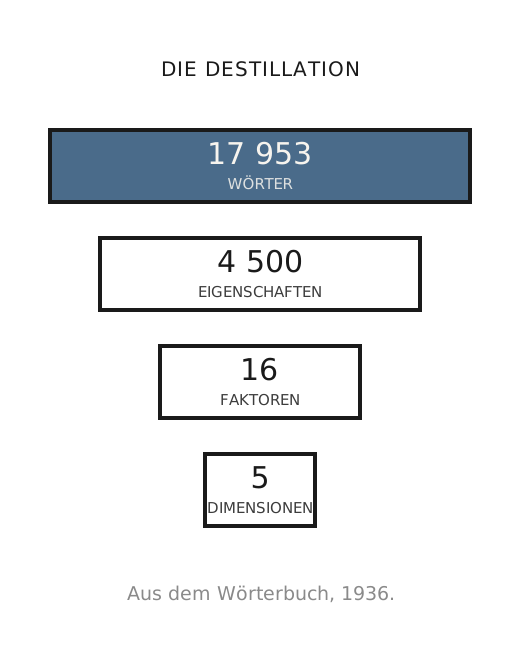
Fig. 1 — Drawing by the archive · free to use
Vienna, 1920: a twenty-two-year-old American, passing through on the way to his brother, asks for an appointment with Sigmund Freud and is received. In the consulting room a silence arises, which the young man fills with an anecdote — about a boy on the tram who feared everything dirty, and his mother, who looked as if she were the same. Freud looks at him and asks: and was that little boy you? Gordon Allport told the scene all his life, and with two points: the interpretation was ingenious, and it was wrong. Out of the misunderstanding grew a programme — a psychology that takes the obvious seriously before reaching into depths.
Allport was born on 11 November 1897 in Montezuma, Indiana, the youngest of four sons of a country doctor who ran his practice in his own house and lodged patients there — the boy grew up between sickrooms and consulting hours, in a household whose rules his mother, a former teacher, drew from a strict piety. He followed his brother Floyd, eleven years older and already a psychologist, to Harvard, graduated in 1919, taught English and sociology in Istanbul for a year, and returned for the doctorate he completed in 1922 with a thesis on personality traits — the first American dissertation on the subject.
After study years in Berlin and Hamburg, where he encountered Gestalt psychology and William Stern’s personalism, and in Cambridge, he taught from 1924 at Harvard a course that had not existed there before: Personality: Its Psychological and Social Aspects — by common count the first personality course at an American university. It became, in 1937, the book Personality: A Psychological Interpretation, which gave the field its name and its vocabulary and remained the standard work for two decades.
An early excursion into the field deserves a note because it shows Allport’s range: in 1947, with Leo Postman, he studied how rumours change in the retelling, and described three rules — sharpening, levelling, assimilation to expectation. The study is methodologically superseded and its basic observation as current as a newspaper page: stories become simpler, sharper and more expectation-conforming in circulation.
His second great field was prejudice. The Nature of Prejudice of 1954 — written in the years of the emerging civil rights movement — analysed hostility as the normal case of social categorisation, described its stages from disparagement to extermination, and formulated the contact hypothesis: encounter between groups reduces prejudice when four conditions are met — equal status, common goal, cooperation, support from authorities. It is the most consequential single thesis this folder contains, and half a century later it was confirmed in its core by a meta-analysis of more than five hundred studies.
Allport taught at Harvard for almost four decades, was president of the American Psychological Association in 1939, edited its most important journal for years, and sat on the commission that founded Harvard’s Department of Social Relations. His teaching was a workshop: among the doctoral students and auditors were Jerome Bruner, Anthony Greenwald, Thomas Pettigrew — and Stanley Milgram, whose dissertation he supervised. The line from Allport’s book on prejudice to Milgram’s obedience studies is no construction of the archive but a supervision record.
A third field that long occupied him the discipline has almost forgotten: the psychology of religiosity. Allport distinguished an outward-turned, useful piety from an internalised one that makes faith the motive of a life — and found that prejudice goes with the first and not with the second. The scale he built for it is still used in the psychology of religion.
From this field comes the one distinction of his psychology of religion that has survived: that between a religiosity that is an end and one that is a means — faith lived out as against belonging out of use. Allport developed a scale for it and reported the finding that interested him: it was not the devout in general who showed less prejudice but those whose faith was an end in itself; the churchgoers with social motives lay above average. It is the point at which his three fields of work — trait, prejudice, religiosity — converge on the same question.
He died on 9 October 1967 in Cambridge, Massachusetts, of lung cancer, a few weeks before his seventieth birthday. Two years earlier he had published the Letters from Jenny: the analysis of more than two hundred letters of a single woman, his plea that a science of the human being must also be able to bear the individual case. The field has thanked him for the dictionary list and forgotten the letters — this sheet’s case file is about exactly that halving.
The question of 1936 sounds like library work and was a methodological sleight of hand. The personality research of the day faced a problem of selection: every author kept his own list of drives, types or temperaments, none resembled another, and none had a justification beyond its inventor’s conviction. Gordon Allport and his co-worker Henry Odbert proposed a procedure to end the arbitrariness — the lexical hypothesis: if a difference between people matters enough in everyday life, a language will eventually have a word for it. So take not a scholar’s theory as the starting point, but the dictionary.
The execution was dull work in the best sense. The two went through Webster’s New International Dictionary, some half a million entries, and drew from it about 18,000 words by which people can be distinguished. This list they sorted into four columns: enduring traits — about 4,500 words —, temporary states and moods, evaluative judgments of social conduct, and a remainder of abilities, physical characteristics and doubtful cases. The result was not a finding but a raw material: the first systematic, theory-free catalogue of what a speech community notices about people at all.
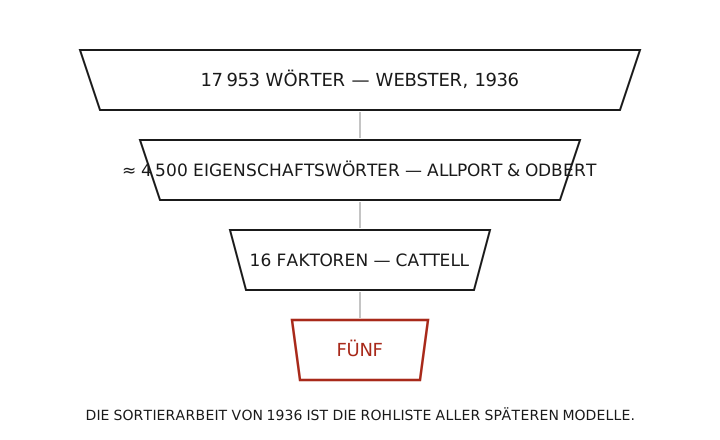
The sorting itself was the real theory. Whoever decides that “shy” is a trait and “embarrassed” a state makes a prior decision about what personality is supposed to be — namely the enduring, not the momentary, and the describable, not the evaluated. Allport and Odbert expressly called these boundaries fuzzy and carried their doubtful cases along; the successors mostly used only the first of the four columns and left the fuzziness out. It is the quiet founding error of factor research: it computes with a selection whose rule of selection it does not compute.
To the prehistory belongs the fact that the dictionary idea does not begin with Allport. Francis Galton had proposed in 1884 searching the lexicon for character words, and Ludwig Klages and Franziska Baumgarten had produced first lists in the German-speaking world; what Allport and Odbert added was completeness and the sorting rule. A suggestion became a procedure — and thereby, for the first time, something one can repeat in another language.
What became of it Allport no longer steered. Raymond Cattell took the list, shortened it through synonym groups to a few dozen scales and put it through the then-new factor analysis; Hans Eysenck distilled a few superordinate dimensions; and out of decades of such computation crystallised, in the 1980s, what stands in every textbook today: five factors — openness, conscientiousness, extraversion, agreeableness, neuroticism — found in ever new samples, in self- and other-ratings, and, with deviations, in dozens of languages. The lexical hypothesis has thereby proved one of the field’s most fruitful ideas: a dictionary project of 1936 supplies the axes on which the personality research of the twenty-first century computes.
The point of the file is that its author would have rejected this career. Allport held factors to be statements about populations, not about persons. His book of 1937 distinguished common traits, in which people can be compared, from personal dispositions that hold for one individual only and occur in no scale — and he insisted that a science of the human being needs both: nomothetic comparison and idiographic description. His own model work for the second, the Letters from Jenny of 1965, analysed more than two hundred letters of a single woman — single-case research with system, a genre the field then almost entirely abandoned and is rediscovering in the single-case statistics of the present.
A second concept from this workshop has had an even longer effect, although it stands athwart the dictionary study: functional autonomy. Motives, said Allport against Freud and against the drive theories, detach from their origins — the hunter who began to hunt out of hunger later hunts for the hunting’s sake. With that the person was no longer the sum of their childhood but a present-tense phenomenon with purposes of its own; the humanistic psychology in the neighbouring folder of this collection adopted the thought without always evidencing it.
How far the structure carries is decided in the languages where nobody does personality research. In the major European languages the five-factor solution could be recovered with deviations, and the lexical method counted as confirmed. In field studies with communities without literacy and without industry the result came out differently: surveys among small populations in South America produced structures with markedly fewer factors, in which features of prosocial behaviour and industriousness fall together more strongly. Whether this is down to translation, to the form of the survey, or to the fact that personality differences count differently in small groups, is open. The cautious reading runs: the five factors reliably describe the language about people in literate, labour-divided societies — which is a great deal, but less than an anthropology. For an archive that tests reach, that is the more exact statement about a model which likes to present itself as a human universal.
What stands today is a divided finding with an unusually clear boundary. The structure holds: the five factors belong to the best-replicated quantities in psychology, they are stable across decades, about half heritable, and predict occupational success, health and lifespan above chance — with small to medium effects that show reliably in large data sets. The cultural reach has been tested too: in most languages studied a similar structure is found, in some it deviates, and the discussion of a sixth dimension — honesty and humility — is running. What does not hold is the tacit assumption that five numbers describe a person: the prediction of single actions remains weak, because situations have a say — the objection Walter Mischel sharpened into personality research’s crisis in 1968 and which the field answered with interaction models.
The practical yield of these axes is by now itself well measured. Conscientiousness predicts school marks and occupational success, neuroticism psychological distress, agreeableness the durability of relationships; large longitudinal studies find associations with health and lifespan that are small and reliably present across decades. At the same time research has confirmed Allport’s basic intuition by a detour: personality is not set in concrete. The rank order between people remains strikingly stable, but on average adults become more conscientious, more agreeable and emotionally calmer with age — and intervention studies show that targeted practice can shift trait scores over months. The Five are axes, not fetters.
The final reckoning comes out most kindly for language itself. The lexical hypothesis produced not only five factors but a method one can repeat in any language — and exactly that has happened: in Dutch, German, Italian, Hungarian, Filipino, Korean and dozens more, with results that resemble one another and differ in detail. From the comparison of these word collections comes the most serious proposed improvement of recent decades: the HEXACO model with a sixth dimension of honesty and humility, which emerges more clearly in several non-English lexicons than in English. Allport’s procedure has thereby corrected its own result — the rare case of a method that lasts longer than the finding it first delivered.
For practice the file carries a warning as old as the model: personality tests say much about groups and little about the individual case — for personnel selection they serve as one source among several, for diagnoses not at all, and the commercial type tests that sort people into drawers belong in the neighbouring chapter on Jung.
The quarrel Allport opened is therefore not settled but institutionalised: whoever compares groups computes with his words; whoever wants to understand one person works with his second half, which scarcely anyone cites. For an archive that keeps replication records this is an instructive special case — the study held, the author would have objected, and both sides still produce evidence.
Allport counts as the father of personality psychology, and the field quotes from him almost only the word list. What it leaves out is the condition under which he compiled it: trait words describe wherein people can be compared — not what makes a person that person. For the second he held a science of its own to be necessary, with diaries, letters and case analyses, and he demonstrated it rather than merely demanding it.
The note records why the halving is not only a problem of citation. Whoever reduces a person to five values can compare them with millions and say where they stand; but they cannot say what that person will do when it matters. Precisely this gap — high prediction for groups, weak for single actions — drove personality research into its severest crisis at the end of the 1960s, and the field’s answer, that person and situation work together, is a return to Allport’s starting point with better means.
The practical maxim for this archive lies athwart both camps: scales are maps, not portraits. Whoever takes a map for a portrait finds their way and recognises no one.
Replication status: partial. The lexical structure has held and carries the five-factor model; prediction of single actions from traits has remained weak, and Allport’s single-case programme was never systematically tested.
Primary sources. Allport, G. W., & Odbert, H. S. (1936). Trait-names: A psycho-lexical study. Psychological Monographs, 47(1), i–171. — The dictionary study. Allport, G. W. (1937). Personality: A Psychological Interpretation. New York: Holt. — The founding textbook, with functional autonomy and the nomothetic/idiographic distinction. Allport, G. W. (1965). Letters from Jenny. New York: Harcourt. — The single-case study.
The succession. The factor line from Cattell and Eysenck to the Big Five; overview in John, Naumann & Soto (2008) in the Handbook of Personality. On heritability and stability: Roberts & DelVecchio (2000) on rank-order stability across the lifespan.
The objection. Mischel, W. (1968). Personality and Assessment. New York: Wiley. — The person-situation debate, out of which the interaction models grew.
The second field. Allport, G. W. (1954). The Nature of Prejudice. Cambridge: Addison-Wesley. Pettigrew, T. F., & Tropp, L. R. (2006). A meta-analytic test of intergroup contact theory. Journal of Personality and Social Psychology, 90(5), 751–783. — Over 500 studies: contact lowers prejudice, even without all four conditions, with small to medium effects.