The Journal30 August 202612 min read
The doctor who resigned from his own hospital
Fanon in Blida, and what colonial violence left in the case files
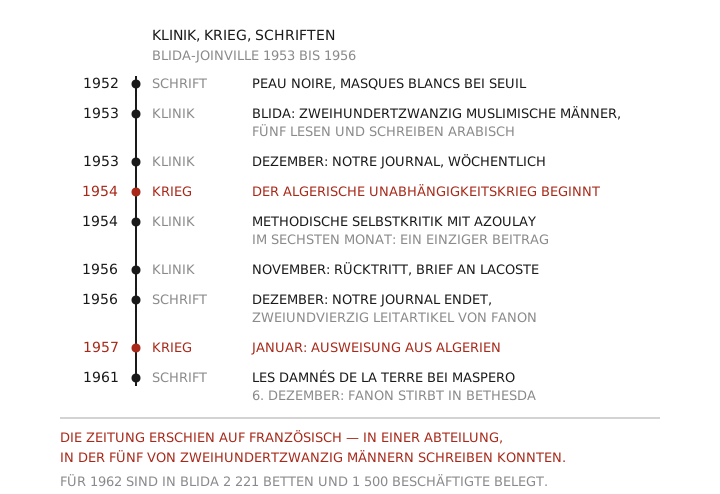
In 1953 Frantz Fanon took over, as médecin-chef, the fifth division of the psychiatric hospital Blida-Joinville south of Algiers: two hundred and twenty patients, Muslim men. Five of them could read and write Arabic. Fanon recorded the figure himself, and a few months later it would explain the first large failure of his reform of the ward.
The asylum carried the order of the colony inside its walls. European and Muslim patients were housed separately; diagnosis drew on a school of thought that had described North Africans as biologically primitive. Fanon was to treat people with mental illness while the political world outside the door and inside the hospital itself disputed their dignity. In 1954 the Algerian war of independence began, and before long the tortured and their torturers were both sitting in his consulting room. Three years after taking up the post, Fanon resigned.
Origins, war, apprenticeship with Tosquelles
Fanon was born in 1925 in Fort-de-France on Martinique. The island was a French colony and became an overseas department in 1946. French education promised universal citizenship; skin colour and colonial rank contradicted the promise in daily life. One could take on the language, culture and values of France and still be treated as not fully belonging. Especially correct French signalled education and status — and yet never fully protected. Accent became a verdict on character.
In 1943 Fanon left Martinique to fight National Socialism with the Free French forces. He was wounded by shrapnel near Montbéliard; Colonel Raoul Salan pinned the Croix de guerre on him. At the same time he met racism inside the very army that was defending freedom. The contradiction between official morality and experienced treatment produces more than disappointment: it attacks the ground on which a person understands belonging and sacrifice.
In Lyon, Fanon studied medicine and psychiatry, attended lectures in philosophy and engaged with phenomenology, existentialism, psychoanalysis and Négritude. In 1951 he took his doctorate with a thesis on a hereditary spinocerebellar degeneration, Friedreich’s ataxia. An earlier, more political draft — “Essai sur la désaliénation du Noir” — had been rejected as a dissertation and appeared in 1952 with Seuil under the title Peau noire, masques blancs.
The book describes scenes in which a black man is reduced to skin colour by the fearful or exoticising gaze of a white observer. The body is then no longer a self-evident lived starting point but the object of somebody else’s narrative; stereotypes come between person and action. The “mask” of the title is no voluntary deception but the product of a situation that makes whiteness the norm of intelligence, beauty and humanity. Modern social psychology examines related processes under names such as stereotype threat and objectification. Fanon’s text, however, is not an experiment but a mixture of autobiography, clinical observation, literature and philosophical analysis.
After his studies Fanon worked at the psychiatric hospital of Saint-Alban under François Tosquelles, a Catalan refugee who joined psychiatry to political critique. What developed there was an institutional psychotherapy that treated the hospital itself as part of illness and of healing. Patients were not merely to be kept in custody; clubs, work, assemblies and cultural activities created social roles.
The core claim is uncomfortable and still testable today: a ward is no neutral container. Its rules can produce passivity and then measure that passivity as illness. Someone who helps carry a team or produce a newspaper is addressed differently from someone whose identity consists only of a diagnosis. Institutional therapy does not claim that football cures schizophrenia. It asks which environment makes action and relationship possible — symptoms can persist while social function and dignity grow.
That thought accompanied Fanon to Algeria: treatment does not change the patient alone. It has to change the institution that addresses him.
The Algiers school
Blida-Joinville was one of the largest psychiatric asylums in North Africa; for 1962, 2,221 beds and 1,500 staff are documented. The medical culture Fanon entered was shaped by the École d’Alger around Antoine Porot. Its teaching held that North Africans possessed a “primitive” nervous system, were driven by impulse and intellectually inferior. Assumptions of this kind could present violence as given by nature and colonial rule as necessary control.
Fanon thus encountered not only outdated treatment but a diagnostic racial order. When a colonised person reacted with anger, psychiatry could read the aggression as an ethnic trait rather than as an answer to humiliation, poverty or violence.
Then there was language. Examinations were conducted in French, and the language of an interview helps decide which feelings, metaphors and relationships can be said at all. A patient who falters in the colonial language is not thereby showing a thought disorder. Assessment without awareness of power and language can mistake domination for a symptom — it measures the distance from the norm and enters it in the file as a finding.
The counter-position must nonetheless not declare every patient a healthy political protester. Psychoses, depressions and neurological diseases are real. Fanon’s task was a double one: to treat illness and to prevent colonialism from becoming the diagnosis.
The first attempt at reform and why it failed
Fanon at first transferred the forms of social therapy he had come to know at Saint-Alban to his division unchanged: European music, a calendar of festivals, clubs, a ward newspaper. The Muslim patients stayed away. A superficial reading would have found in that a confirmation of cultural passivity — precisely what the École d’Alger claimed in any case.
Instead, in 1954 Fanon published a methodological self-criticism together with Jacques Azoulay. They recorded that the programme had simply missed the world of meaning its patients lived in. That holds especially for the newspaper: it appeared in French, on a ward where five men out of two hundred and twenty could write at all. By the sixth month a single Muslim patient had contributed an item. What looked like disinterest was a barrier to access that the ward itself had built.
The team then rebuilt what it offered: local games, forms of storytelling, religious and cultural references. Participation rose. The newspaper Notre Journal appeared weekly between December 1953 and December 1956 and went to the whole institution; Fanon was its founder and editor-in-chief and wrote forty-two leading articles. A patient in it was not only the subject of a file but an author writing for others.
The episode is often told as a success story of intercultural sensitivity. Its sharper lesson is a different one: culture does not consist of folkloric ingredients. A local game does not make a therapy decolonial if the power of diagnosis and the language remain unchanged. The ward’s public sphere, too, remained a public sphere under conditions — who was allowed to write, what was edited and how voluntary participation was, all of that was decided by the staff.
The war enters the consulting room
In 1954 the Algerian war of liberation began. Fanon treated people on different sides: Algerians who had experienced violence and torture, and French soldiers or police officers who had themselves tortured and fell ill because of it. The clinic made visible that an apparatus of violence also changes those who carry it out.
Victims and perpetrators are not morally symmetrical; psychiatric symptoms create no equality of political responsibility. Even so, a doctor can treat suffering without excusing acts. That tension belongs to forensic and military medicine to this day.
From these consultations come the case vignettes Fanon later published in the chapter on colonial wars and mental disorders in The Wretched of the Earth. They are clinical casuistry: no control group, no sample, no follow-up. As a historical document they matter; as evidence they are weak, and readers have to distinguish source, genre and level of proof. What they show has since been spelled out by trauma research. Symptoms after torture — intrusions, pain, dissociation, sleeplessness, guilt — are no sign of a weak personality. They arise in a situation deliberately created.
The letter of resignation
In November 1956 Fanon gave up his post and addressed a letter to the French resident minister Robert Lacoste. His argument stands in a sentence that sets the task of the discipline against the order in which he was to practise it:
If psychiatry is the medical technique that aims to enable man no longer to be a stranger to his environment, I owe it to myself to affirm that the Arab, permanently an alien in his own country, lives in a state of absolute depersonalisation
A society that drives its members permanently into despair makes the psychiatric task impossible. The doctor cannot lead a person back into an order whose normal condition is degradation. In January 1957 Fanon was expelled from Algeria.
The resignation was an ethical decision and a political break at once. A doctor can attempt reform inside a harmful system or leave it and fight it; neither option is pure. Whoever stays may stabilise the institution. Whoever leaves leaves patients behind. Fanon decided that clinical neutrality had become collaboration in Blida.
Afterwards he worked in Tunis, treated Algerian refugees, wrote in the editorial collective of El Moudjahid and took on representative duties for the provisional government. In 1960 he was diagnosed with leukaemia. He wrote Les damnés de la terre under enormous pressure of time; the book appeared in 1961 with Maspero and a preface by Jean-Paul Sartre. On 6 December 1961 Fanon died in Bethesda, Maryland, at the age of thirty-six.
Violence, gender and the limits of a classic
In The Wretched of the Earth Fanon describes the colonial world as divided by violence and analyses counter-violence as a process in which the colonised regain agency. Sartre’s preface sharpened the rhetoric and shaped the reception; individual sentences are still lifted out of context today. Psychologically, the claim that violence purifies or heals cannot be sustained in that form: research on war shows trauma, moral injury and dynamics of escalation. Political self-efficacy can grow, but killing is not a therapy. Fanon himself documented the damage on all sides in those same chapters — the tension stands in his work and should not be dissolved artificially.
The chapters on desire between black and white people are open to attack too. They contain generalisations, heteronormative assumptions and a language in which female desire appears above all as material for a male-centred analysis of colonialism. An anti-racist theory is not automatically free of sexism; oppression in one dimension confers no infallibility in others. Later feminist and queer readings have corrected Fanon at these points.
A third limit concerns the concept of alienation. Fanon used it for colonial experience, not as a clinical diagnosis of a population. Political theory must not claim that every member of an oppressed group feels the same. People develop pride, ambivalence, accommodation, resistance and varied identities. Structure produces probabilities and conflicts, not identical personalities. Fanon is at his strongest where he describes situations — at his weakest where readers turn his concepts into templates for other people’s inner lives.
What stayed in the case files
The idea that a clinic itself treats or makes ill has not become merely historical. Restraint, isolation, constant changes of staff and a lack of say can increase distress; open wards, peer work, shared decisions and dependable relationships increase participation. Not every limit is oppression — acute danger can require protective measures. What counts is proportionality, duration, oversight and the search for less restrictive alternatives.
The Blida failure has a present-day version as well. Offer an intervention whose conditions of access part of the target group cannot meet — written language, the majority language, trust in authorities, a digital device — and you end up measuring the barrier and calling it motivation. The test question is not whether the offer is culturally garnished, but who developed it, whose goals count and whether patients can object. At the same time, nobody may be reduced to their origin: an Algerian can love European music, a Frenchman can seek religious healing.
Fanon’s actual claim was larger than “racism causes stress”. In his analysis, colonialism creates social categories, desires and body images: the colonised is described as inferior, and the coloniser needs that description in order to hold his position morally. Today’s research on structural racism examines the material side of this — how housing, work, policing, education and health care distribute psychological risk. In practice what follows above all is a warning against individualisation: when a patient is anxious after discrimination, it is not enough to correct their thoughts as though the danger were imagined. Reality testing here means testing the reality as well.
That leaves the question of neutrality. Therapists should not use their power to press a political side on clients; complete neutrality is nonetheless impossible where violence, racism or poverty structure the case, and silence can confirm the status quo. The professional stance distinguishes between acknowledging reality and prescribing an ideology. Fanon moved that boundary far towards revolutionary commitment. The clinic of today can keep his question without turning every therapeutic relationship into political recruitment.
What remains
Well documented are the reform of the ward at Blida, its failure and its rebuilding, the newspaper with its forty-two leading articles, the years of apprenticeship with Tosquelles and the resignation of 1956. Broadly supported too is the general thesis that racism, violence and institutional power affect mental health. Not established are the individual psychoanalytic readings in his work, his statements about gender and the thesis that counter-violence liberates; the case vignettes from the war are casuistry, not studies. Fanon gains from this limitation. He does not have to be an infallible scientist in order to have asked a question his discipline has too often pushed aside.
In everyday life the question can be recognised by a simple test: can a treatment adapt a person to an environment that is making them ill and still call itself healing? Sometimes a person needs relief from symptoms first in order to be able to change the environment at all; sometimes adaptation becomes the silent confirmation of violence. The line cannot be drawn in the abstract, only examined on three levels: the person’s symptoms and resources, relationships and institutions, political and material conditions. Fanon’s contribution is not a finished therapy but the sting: a psychiatry that does not examine its own social order can diagnose the wound and overlook the knife.
Sources, and why they are here
Fanon, F. (1956). Letter of resignation to the resident minister Robert Lacoste. Printed in Khalfa & Young (eds.), Alienation and Freedom (2018).
The document the article is built around, and the source of the quotation. It is not a farewell letter but a diagnosis of the order he was meant to work in.
Fanon, F. (1952). Peau noire, masques blancs. Éditions du Seuil.
The analysis that came before the clinic — autobiography, clinical observation and philosophy in one text, and for that reason not an experiment.
Fanon, F. (1961). Les damnés de la terre. François Maspero.
The late work with the war's case histories in its appendix — and with the chapter on violence that reception is still working through.
Fanon, F., & Azoulay, J. (1954). La socialthérapie dans un service d'hommes musulmans: difficultés méthodologiques. Printed in Khalfa & Young (2018).
The report on the failed first attempt at reform, written by Fanon himself. He names the error as methodological, not cultural.
Khalfa, J., & Young, R. J. C. (eds.) (2018). Alienation and Freedom: Frantz Fanon. Bloomsbury.
The critical edition that makes his psychiatric writings and hospital documents accessible for the first time — the basis for everything the article says about Blida.
Gibson, N. C., & Beneduce, R. (2017). Frantz Fanon, Psychiatry and Politics. Rowman & Littlefield.
Reads him as a psychiatrist and not only as a theorist of liberation — the separation the article holds to be necessary.
Egalité, N. (2025). Our newspaper as care: Narrative approaches in Fanon's psychiatry clinic. Journal of Medical Humanities, 46(3), 437–450.
The ward newspaper as a means of treatment — the most concrete evidence that social therapy was a craft for him and not an attitude.
Keller, R. C. (2007). Colonial Madness: Psychiatry in French North Africa. University of Chicago Press.
The Algiers school in its own writings — needed so that the article can show what Fanon was writing against rather than merely assert it.