Topic 10
Therapy and Its Effect
PsychoanalysisHumanistic PsychologyClinic & Therapy
Does it help anyone? It is the question this archive runs toward, and it is younger than the field likes to admit. Psychoanalysis treated for half a century without counting its successes; its form of proof was the interpreted single case, and whoever asked for control groups was held to be naive. That treatment must let itself be measured like a drug is an achievement of the century’s second half — and three folders of this archive tell how it came about.
The first step was taken by humanistic psychology, and it was technical in nature: Carl Rogers had therapy sessions recorded and transcribed — the treatment became a dataset. His conditions — warmth, genuineness, close listening — proved necessary and not sufficient; and from the comparisons of procedures with one another comes the dodo verdict: properly conducted psychotherapies differ astonishingly little in their effect.
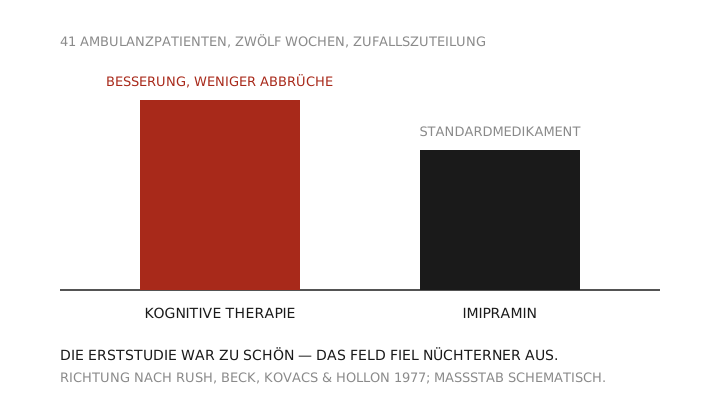
The second step Beck took with tools. A questionnaire that gave depression a number; a manual that made the treatment reproducible; and in 1977 the trial in which a talking treatment held up for the first time, randomised, against the standard drug. That the first study was too good and the large comparative trial came out soberer belongs to the pattern: the effect is there, it is meaningful, and it is smaller than the early figures promised. Beck’s school co-published the corrections itself — the rarest virtue in this collection.
Ellis was there earlier and left the testing to others; Frankl brought meaning into treatment and left the measuring of his school to successors; Seligman built a model of depression out of the animal laboratory, reversed it himself fifty years later — and founded with positive psychology a movement whose interventions lost considerable ground in the replication crisis. The span of this theme reaches from the manual to the bestseller, and the balance sheets differ accordingly.
What the large numbers show is sobering and consoling at once. Psychotherapy works — in hundreds of randomised trials, with medium effects, beyond the end of treatment. Why it works is open: behavioural activation alone achieves in several studies about as much as the whole cognitive package, and the lead of individual schools largely vanishes in clean comparisons. And under everyday conditions — the British routine-care programme has measured it at scale — the results stay below those of the studies from which they were derived.
For the archive the circle closes here: what Freud began in the consulting room is today counted, compared and corrected. The question “does it help?” has ceased to be a question of schools — it has become a question of measurement, and that is the progress this theme documents.
Sheets on this theme
- Case file 001Sigmund FreudProfile
- Case file 001Sigmund FreudCase file
- Case file 001Sigmund FreudNote
- Case file 001Sigmund FreudEvidence
- Case file 002Carl Gustav JungProfile
- Case file 002Carl Gustav JungCase file
- Case file 002Carl Gustav JungNote
- Case file 002Carl Gustav JungEvidence
- Case file 003Anna FreudProfile
- Case file 003Anna FreudCase file
- Case file 003Anna FreudNote
- Case file 003Anna FreudEvidence
- Case file 016Melanie KleinProfile
- Case file 016Melanie KleinCase file
- Case file 016Melanie KleinNote
- Case file 016Melanie KleinEvidence
- Case file 033Karen HorneyProfile
- Case file 033Karen HorneyCase file
- Case file 033Karen HorneyNote
- Case file 033Karen HorneyEvidence
- Case file 013Carl RogersProfile
- Case file 013Carl RogersCase file
- Case file 013Carl RogersNote
- Case file 013Carl RogersEvidence
- Case file 014Abraham MaslowProfile
- Case file 014Abraham MaslowCase file
- Case file 014Abraham MaslowNote
- Case file 014Abraham MaslowEvidence
- Case file 015Viktor FranklProfile
- Case file 015Viktor FranklCase file
- Case file 015Viktor FranklNote
- Case file 015Viktor FranklEvidence
- Case file 029Aaron T. BeckProfile
- Case file 029Aaron T. BeckCase file
- Case file 029Aaron T. BeckNote
- Case file 029Aaron T. BeckEvidence
- Case file 030Albert EllisProfile
- Case file 030Albert EllisCase file
- Case file 030Albert EllisNote
- Case file 030Albert EllisEvidence
- Case file 031Martin SeligmanProfile
- Case file 031Martin SeligmanCase file
- Case file 031Martin SeligmanNote
- Case file 031Martin SeligmanEvidence
From the journal
- 1900The Interpretation of Dreams is publishedEvery dream fulfils a wish in disguise, shaped by the dream-work.Sigmund Freud
- 1906Studies in Word AssociationAt the Burghölzli the hesitation before a stimulus word is measured — the spot is called a complex.Carl Gustav Jung
- 1932The Psycho-Analysis of ChildrenA child's play as the equivalent of free association.Melanie Klein
- 1936The Ego and the Mechanisms of DefenceThe ego's defences, ordered into a catalogue that is still professional vocabulary.Anna Freud
- 1943A Theory of Human MotivationA ranking of needs: one becomes effective only once the one below it is satisfied.Abraham Maslow
- 1945Toward, against, or awayKaren Horney describes neurotic conflict as rigid movement toward people, against them, or away from them.Karen Horney
- 1946Man's Search for MeaningThe will to meaning — against Freud's pleasure principle and Adler's striving for power.Viktor Frankl
- 1957Rational PsychotherapyThe ABC scheme appears in print — six years before Beck's first cognitive paper.Albert Ellis
- 1957The Necessary and Sufficient ConditionsThe therapeutic relationship predicts success — sufficient it is not.Carl Rogers
- 1967Learned HelplessnessThree groups, the same shocks, one difference: control.Martin Seligman
- 1977Therapy Beats the Pill41 patients, twelve weeks — talking treatment holds up against imipramine.Aaron T. Beck
- 2011Flourish appearsFrom happiness to flourishing: five components instead of one measure.Martin Seligman