The Journal29 August 202614 min read
A Nobel Prize for an operation that cured nothing
When quiet was mistaken for cure
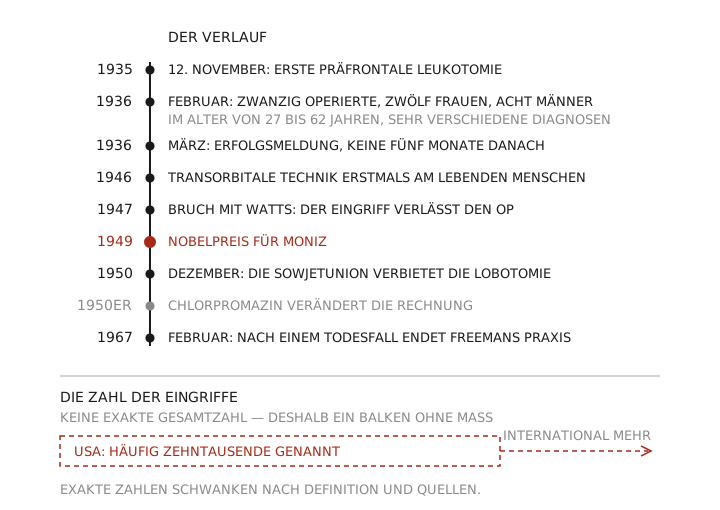
On 12 November 1935 the surgeon Pedro Almeida Lima carries out the first prefrontal leucotomy: alcohol is injected into the white matter of the frontal lobe to destroy nerve connections. The man whose idea he is executing does not stand at the operating table. The Portuguese neurologist Egas Moniz lacks neurosurgical training, and his hands are impaired by gout. By February 1936 twenty people have been operated on: twelve women and eight men aged between 27 and 62, with widely varying diagnoses. In the first eight, alcohol was injected; after that a leucotome cut out circular cores of tissue.
In March 1936, less than five months after the first operation, Moniz publishes the result: improvement in many cases. The verdicts “cured” and “improved” come from his own treatment team. There is no control group, no independent assessors and no standardised follow-up. Fourteen years later Moniz receives the Nobel Prize for it.
The medicine the operation arrived in
In the 1930s there were no antipsychotics, no modern antidepressants and only limited psychotherapeutic provision for the severely ill. The physical procedures included insulin coma therapy, cardiazol convulsions and later electroconvulsive therapy. Some disappeared; electroconvulsive therapy, applied competently and under anaesthesia, remained effective for certain severe depressions. Historically the procedures must not be lumped together. What they did share was a climate of great urgency.
State asylums were filling up. Poverty, war, the absence of outpatient care and social exclusion meant that people were institutionalised for years or for life. Small numbers of nursing staff looked after enormous wards. Under such conditions an intervention could count as a success if someone screamed less, stopped absconding or needed less supervision. A treatment that reduced agitation and promised discharge fitted the needs of the system.
This context explains the demand but excuses no bad evidence. Desperation in particular raises the danger of confusing hope with efficacy. When the untreated condition is dreadful, almost any change looks acceptable. And criticism was possible: some specialists doubted early on that short follow-up periods and heterogeneous cases demonstrated lasting benefit. The cliché that nobody at the time could have understood the risks lets institutions off too lightly. The methodological objections existed — they lost out to therapeutic optimism, professional authority and the prospect of a technically tangible procedure.
Freeman, Watts and the break of 1947
In the United States the neurologist Walter Freeman and the neurosurgeon James Watts made the procedure known. Freeman was a physician, a speaker and a media strategist, but not a trained neurosurgeon; Watts supplied the surgical expertise. Together they developed a more standardised prefrontal lobotomy and documented numerous cases. Watts operated in theatre, Freeman examined, photographed, wrote and marketed. This division of labour made the procedure visible in the United States.
The partnership broke down in 1947. Freeman had increasingly been using the transorbital technique, which he first applied to a living person in 1946, without neurosurgical infrastructure. A slender instrument is introduced above the eye through the thin bony plate of the orbit and moved to sever frontal connections. The skull stays closed and no operating theatre is required; electroshock served in part to render patients briefly unconscious. For Freeman the low technical threshold was the advantage: more clinics, lower costs, wider reach. For Watts it was a dangerous trivialisation of brain surgery.
The conflict displays two understandings of innovation. One is committed to accessibility and speed, the other to specialisation and control. In Freeman’s campaign, scaling won out before benefit and harm had been properly determined. Today one would ask not only whether a procedure is technically reproducible but also whether the conditions for its safe use can be scaled along with it.
For years Freeman travelled by car across the United States, visiting state hospitals in dozens of states and demonstrating the operation there, most of the time without charge. Popular accounts have turned this into the tour of a “lobotomobile”; there is no evidence that Freeman himself used the word. The term is so grotesque that it easily becomes the whole explanation. But the travelling was only the most visible surface of a network of hospital directorates, referring physicians, press reports and authorities looking for quick relief. The simple story of the wicked Freeman falls short: a systemic failure cannot be explained by pathologising a single doctor.
How success was measured
Early reports sorted people roughly into “cured”, “improved” or “unchanged”. Who was doing the judging, over what period and against what everyday standard often remained unclear. The operators knew the outcome, and negative courses could vanish. Freeman photographed patients before and after the operation, wrote to families and presented dramatic cases. A neatly dressed person after surgery could stand for progress. The image concealed what a still photograph cannot show: initiative sustained over hours, the ability to plan, inner emptiness, seizures, or the work that relatives took on afterwards. A selected face is a story, not an effect size.
The yardstick of success shifted accordingly. “Calmer” was easier to observe than initiative, judgement or a lost future. Families and hospitals could count passivity as improvement because care became simpler. Behind this lies a problem of power: who defines functioning — the person, their relatives, or the institution that needs quiet?
The operations were not accurate to the millimetre. They damaged white-matter connections between prefrontal, thalamic and other systems, and the consequences varied with technique, extent and person. Reported effects included apathy, loss of initiative, disinhibited behaviour, emotional flattening, poor foresight, weight gain, incontinence, epileptic seizures and death.
Some patients did in fact experience less anxiety, compulsion or psychotic agitation. That possibility must not be struck out merely because the practice as a whole was indefensible. The ethical criticism becomes stronger, in fact, when it names the awkward relationship: a symptom can decline while the capacities that carry a self-determined life decline too. That is exactly why complaints, functioning and quality of life have to be recorded separately. A single value called “improved” folds opposing developments together.
Who was operated on
Women were disproportionately affected. Expectations about female calm, sexuality, motherhood and obedience shaped which behaviour counted as intolerable. Depression, trauma, intellectual disability and family conflict could be gathered under broad diagnoses. This does not mean that every operation was social punishment: many women suffered severely, families sought help, doctors could have sincere therapeutic intentions. But intention neutralises no norm. When the same expression of anger counts as assertiveness in a man and as instability in a woman, the distortion begins before the consulting room.
Rosemary Kennedy, sister of the future US president John F. Kennedy, was operated on by Freeman and Watts in 1941 at the age of 23. Her father Joseph Kennedy had arranged the procedure. Afterwards she was severely disabled and needed lifelong support. Her case shows how gender, class and reputation intervene in consent: a wealthy family could reach top physicians and at the same time subject a daughter to a momentous intervention because her behaviour appeared to be a danger to herself and to the family. Access to medicine offers no protection from medical power.
Prominence makes the events visible and at the same time crowds out the many nameless patients. Rosemary’s life is usually told as a family scandal rather than as the story of a young woman about whose body others decided. The sources on her earlier abilities and conflicts are shaped by family interests; here too, diagnosis at a distance is out of place.
Children were operated on as well. Howard Dully was twelve years old when Freeman performed a transorbital lobotomy on him in 1960. Decades later he reconstructed his story publicly and asked why ordinary childhood conflicts had been treated as severe pathology. A single autobiographical account does not represent every course of events. It does, however, supply something clinical tables seldom contain: the experience of having to live with an operation whose justification one never chose. Seen this way, “follow-up” is not a medical appointment but a life. And with children the duty of protection is especially high: development is variable, consent is limited, and irreversible operations change possibilities before the person can formulate goals of their own.
The Nobel Prize and the end of the procedure
In 1949 Moniz received the Nobel Prize. The citation calls the operation a discovery and its value therapeutic:
for his discovery of the therapeutic value of leucotomy in certain psychoses
The award documents how a professional community weighted novelty, mechanistic plausibility and clinical urgency — at a point when severe harms were already known. Prestige acts as an amplifier: after a great honour, dissent costs more, and uncertain claims look more solid. Nobel Prizes distinguish historical decisions made by juries; they do not turn findings into eternal truth.
From the 1950s, chlorpromazine offered for the first time a drug that could reduce psychotic agitation and symptoms in many patients. That changed the institutional cost-benefit calculation. At the same time public criticism, legal oversight and sensitivity to losses of personality grew; neurosurgeons developed more targeted stereotactic procedures. The Soviet Union banned lobotomy as early as December 1950.
It would still be too easy to tell progress as the exchange of a barbaric operation for humane tablets. Early drugs had severe side effects, were likewise administered without adequate consent, and in institutions sometimes served the purposes of control. Deinstitutionalisation closed asylums without building viable community care everywhere. A less invasive means is not automatically person-centred.
Freeman’s own career ended in February 1967. His patient Helen Mortensen died of a cerebral haemorrhage after the operation; after that he was no longer permitted to operate. Until then he had held on to the procedure for decades, maintained contact with former patients, collected Christmas cards and gone looking for favourable outcomes on his travels. This persistence can be read as care and equally as a strategy of confirmation: anyone who believes in their own mission recognises successes more readily and interprets harms as the price of the illness. Diagnosing his personality from a distance would, however, be precisely the error that serious analysis warns against. What is documented is behaviour and decisions, not motives.
What modern neurosurgery does differently
Deep brain stimulation and rare ablative procedures are today researched or used in narrowly defined, severe conditions that cannot be treated otherwise. Imaging and stereotactic planning permit far more targeted interventions. In deep brain stimulation, tissue is not destroyed in the same way; parameters can be adjusted and systems switched off. These differences are substantial. The historical proximity nevertheless obliges particular care: independent diagnoses, alternatives genuinely exhausted, realistic disclosure, long-term recording of personality and function. Small case series with dramatic improvements must not become routine prematurely.
Language too has proved to be part of the inheritance. “Treatment-resistant” describes a treatment history, not a property of a person. Were adequate doses, duration, psychotherapy and social support really offered? Without that check, the label shortens the path to invasive options. The same applies to “difficult to manage” and “improved”: the words sound neutral and yet contain a perspective and a relation of power.
That leaves the question no technique answers. An intervention might reduce tormenting anxiety and at the same time dampen initiative or emotional depth. How are these changes to be weighed against each other? Autonomy does not consist only in saying yes before an operation. It includes the capacity to form and pursue one’s own plans afterwards. A treatment that obtains consent and destroys exactly that capacity produces a moral paradox. Not every pharmacological or surgical change is a loss of the “true self” — people are changed by illness, therapy, relationships and age. What matters is whether the person can reconcile the change with their values, and whether they retain the possibility of revising that judgement.
Consent under the conditions of the asylum
The modern formula “informed consent” must not simply be projected back into the 1930s; binding standards developed later. The moral question existed all the same. Many of those concerned were involuntarily committed, severely impaired or dependent on relatives and doctors. In such a position a signature can be formally present while the choice is practically empty.
A valid decision requires comprehensible information about purpose, alternatives, uncertainty and irreversible consequences. It was precisely this information that was inadequate in early lobotomy: the operators themselves barely knew the long-term risks and described successes optimistically. Relatives often decided under extreme strain. Consent must therefore be regarded as a process, not as a document that conjures institutional power away.
For children, or for people without present decision-making capacity, a surrogate decision applies. It is meant to be guided by previously expressed values or by best interests. An operation that can irreversibly change personality and judgement sets the threshold especially high. History shows how easily “the patient’s interest” merges with the quiet of the ward, relief for the family or the standing of the hospital.
How weak evidence became a movement — and an image
Moniz’s first series comprised only twenty heterogeneous cases. The procedure spread internationally all the same. That speed cannot be explained by data alone. A mechanical idea matched the picture of the time: if pathological loops of thought were stuck in frontal connections, cutting them might release the system. The explanation was vivid, the operation visible, the result quickly told.
Professional congresses, journals and the press turned individual cases into social confirmation. When respected clinics adopt a technique, the adoption itself works like evidence. This cycle is still relevant today: dissemination can follow from genuine benefit, but also from prestige, reimbursement, marketing and institutional imitation.
Negative results have a harder time. A successful discharge can be published as a case report; a person who remains apathetic on a ward produces no dramatic curve of success. Deaths can be attributed to the underlying illness. Without mandatory registries and defined follow-up, a distorted archive comes into being.
The total number of operations performed worldwide cannot be established exactly; for the United States, figures in the tens of thousands are often cited, and more internationally. Exact numbers vary with definitions and sources. That uncertainty is itself historically significant: an irreversible practice spread faster than its use was fully documented.
Freeman understood that medical innovation needs an audience. Photographs, talks and vivid cases presented the operation as a turning point. The before-and-after format has a powerful grammar: disorder on the left, calm on the right, the intervention in between. Everything that happened between the pictures disappears.
A photograph can measure neither spontaneity nor planning for the future. Relatives, too, can read a calmer face as relief if they have previously lived through violence, suicide risk or continual crises. Their relief is real and yet not identical with the well-being of the person who was operated on. Good outcome research therefore needs several perspectives and a period defined in advance.
The journalistic temptation works in both directions. Historical success reports romanticised the technique; present-day accounts sometimes make Freeman into a horror-film villain. Both individualise a system. An accurate account shows the charismatic promoter and, at the same time, hospital budgets, overcrowded wards, professional associations, family distress and missing alternatives. Responsibility is not diluted by this but distributed.
The prefrontal cortex takes part in planning, inhibition, evaluation, working memory and the linking of feeling to future consequences. It is not a single “personality centre”. Lobotomies severed networks to varying degrees. That is why outcomes ranged from severe disability and death to limited relief of symptoms.
Historical observers sometimes described a kind of contented indifference. The ambivalence lay in exactly that: tormenting worry could decrease because the capacity to weigh consequences emotionally decreased as well. When a person no longer suffers from a problem because initiative and evaluation have been taken from them, the meaning of “success” is radically unclear.
This touches a philosophical question about well-being. Does it consist only in less unpleasant experience? Or do authorship, attachment, competence and a relation to the future belong to it? A purely hedonic standard might rate indifference positively. A standard oriented to autonomy sees the loss of the capacity to form one’s own goals. Medicine needs both perspectives and the voice of the person concerned.
A modern test for irreversible innovations
Concrete requirements can be derived from this history. First, the target group must be narrowly defined; “difficult” or “chronic” are not diagnoses. Second, there must be comparison conditions, independent assessment and endpoints that record symptoms, functioning, quality of life and unwanted changes of personality separately.
Third, follow-up must last long enough. An early state of calm may be judged differently later in the light of seizures, dependency or social incapacity. Fourth, negative courses must be registered in full. Fifth, an independent advocate should check whether alternatives have really been exhausted and whether expectations are realistic.
Finally, technical precision must not be confused with ethical justification. An operation accurate to the millimetre can rest on a wrong indication; a device called reversible can produce infections, dependency or psychological change. Progress does not consist only in making the tool finer. It consists in making the person the measure of the outcome.
What remains
Lobotomy was not a horror story from a foreign era. It was regular medicine: published, awarded a prize, discussed in professional journals and applied in state hospitals. What was missing was not questions — those already existed — but procedures that forced those questions to be answered before a plausible idea became routine. Control groups, independent assessment, endpoints fixed in advance, published negative outcomes, patient advocacy: every one of these standards takes part of its justification from this history.
In everyday practice the pattern can be recognised in a single sentence: a treatment counts as successful because the person treated causes less disturbance. Wherever a decline in symptoms takes the place of functioning, autonomy and quality of life, the error repeats itself whatever the tool — with an operation as much as with a drug, a placement or a care routine. The useful test is uncomfortable and short: who judged the outcome, over what period, and would the person concerned agree?
Sources, and why they are here
Moniz, E. (1936). Tentatives opératoires dans le traitement de certaines psychoses. Masson.
The procedure's founding text — and the evidence of how thin the measurement of success was from the start: twenty cases, brief follow-up, the verdict given by the operator himself.
Freeman, W., & Watts, J. W. (1942). Psychosurgery. Charles C. Thomas.
The handbook with which the operation became routine in the United States — written by the two men whose 1947 break the article describes.
Nobel Foundation (1949). Nobel Prize in Physiology or Medicine to António Egas Moniz — official citation.
The source of the quotation. The wording of the citation is the document on which the question turns of what the field believed it knew in 1949.
Pressman, J. D. (1998). Last Resort: Psychosurgery and the Limits of Medicine. Cambridge University Press.
The medical-historical placement that explains the operation not as madness but out of the situation of its time — the only reading from which anything can be learned.
El-Hai, J. (2005). The Lobotomist: A Maverick Medical Genius and His Tragic Quest to Rid the World of Mental Illness. Wiley.
Freeman's biography, including the before-and-after dramaturgy with which he served the press.
Lichterman, B. L. (1993). On the history of psychosurgery in Russia. Acta Neurochirurgica, 125, 1–4.
The counter-case: the Soviet Union banned the operation in 1950 — years before it receded in the West. A ban is no proof, but it shows that the evidence at the time already allowed a no.