Case file 011 · Social Psychology
Solomon Asch
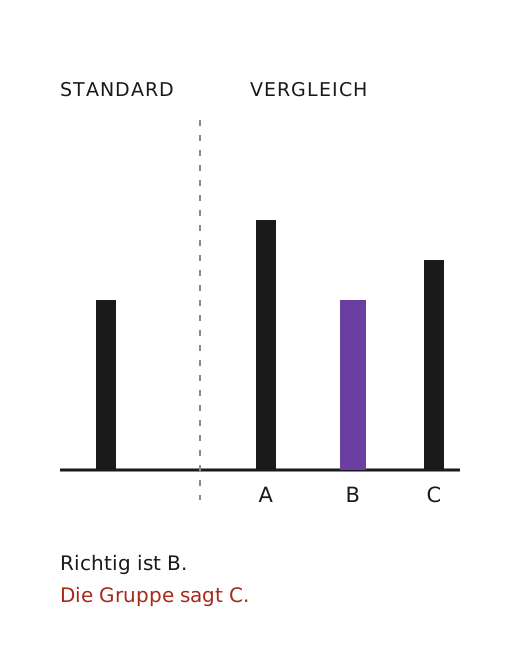
Fig. 1 — Drawing by the archive · free to use
Solomon Eliot Asch was born on 14 September 1907 in Warsaw, then Russian Empire, and the anecdote he himself told about his first notion of social influence comes from a childhood Seder evening: the boy watched the glass poured for the prophet Elijah and believed he actually saw the wine diminish, because his uncle said the prophet would take a sip any moment. The later researcher of what the surrounding people’s belief does to one’s own perception liked to trace his career back to that glass.
In 1920 the Jewish family emigrated to the United States and settled on the Lower East Side of New York. The thirteen-year-old arrived without English and learned the language, by his own account, largely through reading Dickens. He studied at the City College of New York and took his doctorate at Columbia in 1932 under Gardner Murphy — with an unremarkable thesis that betrayed nothing of what he would become: the American steward of Gestalt psychology.
Formative was the encounter with Max Wertheimer, who emigrated from the National Socialists in 1933 and taught at the New School in New York. From Gestalt psychology Asch took the basic assumption that perception and judgment are organised as wholes and cannot be explained as sums of single stimuli — and the conviction that human beings are at their core built toward truth. His textbook Social Psychology of 1952 is the manifesto of this stance: social psychology as the science of people who want to understand one another, not as the catalogue of their manipulability. The irony that precisely this man delivered the century’s most famous conformity study, he himself felt most keenly.
In the war years Asch worked on a question that anticipated his later programme: the effect of prestige on judgment. The current reading — that people adopt a statement blindly when a great name stands beneath it — he rejected experimentally: it is not the judgment that changes but the object; the same sentence means something different depending on whether Jefferson or Lenin is said to have said it. The distinction between a change in the judgment and a change of the thing judged remained his thinking tool — and it returns in the line study: Asch wanted to know what exactly yields when someone yields.
Already in 1946 he had opened a second influential field with the work on impression formation: with plain lists of traits he showed that single central traits — warm or cold, say — reorganise the whole impression of a person rather than adding one more building block, and that the order of information colours the impression. Modern person perception and stereotype research carry these papers as founding documents.
From 1947 he taught at Swarthmore College, the small Quaker college near Philadelphia where emigrated Gestalt psychology gathered around Wolfgang Köhler. There, from 1951, the conformity experiments with line comparisons were made — meant as a demonstration of human independence, read as proof of the opposite. Among his students and collaborators was the young Ulric Neisser; at the end of the 1950s Stanley Milgram worked as his assistant at Harvard and Princeton — the handing-down of the experimental logic, from the erring majority to the instructing authority, is one of the field’s most direct lines of inheritance.
Asch himself withdrew increasingly from the commotion around his famous study. He directed an institute of his own at Rutgers University in the 1960s, taught from 1972 at the University of Pennsylvania, and worked on questions closer to him than conformity: metaphors across languages, the formation of associations, the unity of the person. The great summa of his late work remained unwritten; colleagues describe a scrupulous, slow worker to whom publishing was repugnant and who watched the popularisation of his line study with growing distance.
Honours he accepted as he published: late and with reserve — among them the American Psychological Association’s award for distinguished scientific contributions. The sentence with which his most famous student honoured him is the tersest version of this career: Milgram called Asch his most important scientific model.
His relation to his own fame was that of a man who had meant something else. Asch understood the card experiments as a contribution to a Gestalt question — how a judgement comes about in a social field — not as proof of human weakness, and he pointed out several times that the majority of answers in his records were correct. That posterity turned an investigation of the independence of judgement into an investigation of conformity belongs to this file’s ironies; he himself commented on it with a shrug and went on writing about perception.
Asch died on 20 February 1996 in Haverford, Pennsylvania, at the age of 88. His obituary in the field was unanimous: the Gestalt psychologist who wanted to show that human beings are capable of truth — and who was honest enough to publish the opposite when his data showed it.
Scarcely any set-up in the field has managed with less material: two sets of cards, a seminar room, eight chairs — and a staging whose only technology was the seating order.
The study’s prehistory is an objection. Muzafer Sherif had shown in the 1930s that groups converge, with the autokinetic effect — the apparent wandering of a point of light in the dark — on shared norms that each individual adopts. Asch did not consider that a proof of conformity: where the stimulus is ambiguous, orienting oneself by others is reasonable. The interesting question begins where reality is unambiguous. So he built a situation in which one’s own eye and a unanimous group contradict each other directly — and expected, as a Gestalt psychologist and declared optimist of perception, that people would follow their eye. The experiment that entered the textbooks as the crown witness of conformity was planned as its counter-proof.
The task was as simple as can be. Subjects were shown two cards: on one a standard line, on the other three comparison lines. To be named was which of the three matched the standard in length. The differences were plain — sometimes several centimetres —; in the control condition without group pressure the error rate lay under one per cent. There was, in Asch’s words, nothing to interpret: the situation tested not seeing but standing firm.
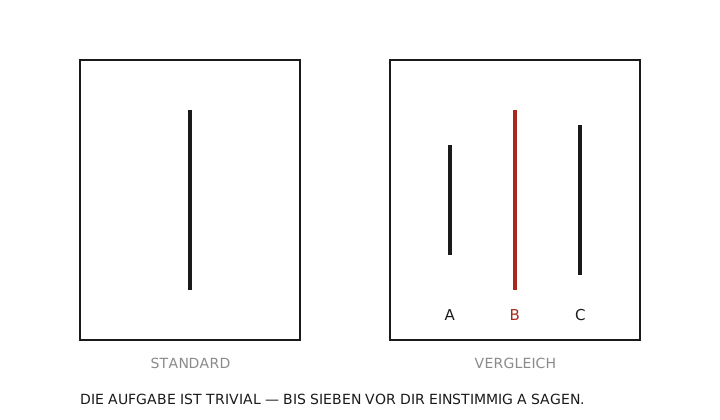
The subject sat in a group of seven to nine people who appeared to be fellow participants but were in fact instructed confederates. Answers were given aloud and in turn, the naive person answering next to last — hearing most of the judgments before their own. In the first series from 1951 at Swarthmore College, 50 male students took part; the detailed monograph of 1956 reports 123 subjects.
Of 18 trials, six passed unremarkably. In the twelve critical trials the group unanimously and confidently named an obviously wrong line. The question was whether the naive person follows their own perception or the judgment of the majority. The records describe what the numbers do not carry: people leaning forward, staring at the cards, laughing, whispering, rubbing their eyes — the whole body language of a witness who no longer trusts his own testimony.
Across all critical trials, subjects joined the false majority in about 37 per cent of cases. About three quarters yielded at least once; roughly a quarter remained independent throughout. The spread was thus large — there is no single conformity rate, but very different reactions to the same situation. Asch himself formulated both readings and never concealed the darker one: that healthy, intelligent young people are willing to call white black, he wrote in substance, is a matter of concern — the sentence stands in his own conclusions.
Asch’s variations showed what the effect hangs on. Decisive is unanimity: a single ally who names the right answer reduces yielding drastically — even when this ally gives a different wrong answer than the majority. It is not confirmation that liberates but the broken consensus. Group size, by contrast, works only up to about three or four persons; beyond that the pressure scarcely grows. When the subject could answer in writing while the others judged aloud, yielding fell markedly — an indication that what tips here is less perception than the willingness to stand publicly alone.
In the post-experiment interviews Asch distinguished different grounds for yielding: doubt in one’s own judgment, the — rare — conviction that the group must be right, and, most commonly, knowledge of the correct answer together with the dread of deviating from it alone. The distortion thus sits mostly not in the eye but in the statement; the conflict is not resolved but suppressed.
The independents, too, were no uniform breed. Asch’s records distinguish the self-assured, who simply takes the majority for misinformed; the withdrawn, who judges inwardly and scarcely registers the others; and the tense, who experiences every deviation as an imposition and still stays with his answer. Independence — that is the quiet second half of the finding — has many temperaments. And only a tiny minority of the yielders reported actually having seen the wrong line as right; perception itself proved astonishingly pressure-proof.
The conceptual harvest was brought in by Morton Deutsch and Harold Gerard in 1955, with a distinction every introduction has carried since: normative influence — one follows to belong — against informational influence — one follows because one takes the others to be better informed. Their variant of the line experiment showed the two cleanly apart: anonymous answers lowered yielding but left a remainder standing. And Serge Moscovici turned the design around in the 1960s: a consistent minority, too, can move a majority — more slowly, less visibly, through reflection rather than pressure. Asch’s paradigm proved a building site for half the field.
The reception made a slogan out of this differentiated finding, and the file on that reception belongs to the file. Ronald Friend, Yvonne Rafferty and Dana Bramel evaluated in 1990 how textbooks had presented the study over three decades: the emphasis migrated steadily toward yielding — 37 per cent conformity — while the complementary finding, that two thirds of the judgments remained independent and a quarter of the people never yielded, vanished from the summaries. The very study meant to demonstrate independence became the proof of human malleability — not through new data, but through retelling. It is the same mechanism the textbook archaeology found with Little Albert, only with the sign reversed.
A second challenge came from time itself. Stephen Perrin and Christopher Spencer repeated the design in 1980 with British engineering students and found almost no yielding — their conclusion: Asch’s finding was a "child of its time," born of the conformist climate of the McCarthy years. The field’s answer was one of social psychology’s great meta-analyses: Rod Bond and Peter Smith compiled 133 Asch studies from 17 countries in 1996. The effect exists everywhere but varies systematically — it has indeed declined slightly in the United States since the 1950s, and it comes out larger in collectivist societies than in individualist ones. The situation acts, but culture sets the dial.
The paradigm’s afterlife now reaches into the physiology of judgment: imaging studies of the 2000s suggested that yielding to a group shifts not only the answer but activity in perception-near areas, and that standing alone against the majority carries the signature of fear — findings to be read cautiously, but which give Asch’s interviews a neural echo: deviating costs, and the price is measurable.
The arrangement has become practically consequential where testimony is produced. When two people have seen the same event and then talk to each other, a considerable share take over details only the other supplied and later report them as their own perception — the effect has been measured many times under the name co-witness contamination, and it connects this file with Loftus’s. The recommendation that follows is as unspectacular as the one there: question witnesses early and separately, before the group settles on a version.
What stands today: the basic finding, at a breadth few classics reach — conformity toward a unanimously erring majority occurs reliably, hangs on unanimity and the publicness of the answer, and scatters widely across persons and cultures. What the reception made of it stands beside it as a finding about the field itself. And the line to Milgram is direct and personal: the assistant who edited Asch’s conformity volume in Princeton replaced, a few years later, the erring majority with an instructing authority — and thereby shifted the question from perception to responsibility.
Asch himself would probably not have called his studies conformity experiments. The title of his 1956 monograph reads Studies of independence and conformity — independence comes first. On his reading, the remarkable result was that around two thirds of all critical answers stayed correct even though the entire group claimed the opposite.
In 1990 Friend, Rafferty and Bramel traced how the textbook account shifted over the decades: from Asch’s emphasis on resistance to the story of the easily moulded human being. The finding stayed the same; the frame was turned around.
For an archive of psychology that is the more interesting case: it was not the data that were revised but their telling. Anyone citing the study as evidence of herd behaviour is citing a reception, not a result.
Methodologically the limits of the sample remain. The participants were young male students in the United States of the early 1950s — a group for whom social adjustment stood in a specific historical climate. How far the effect varies across cultures and across time was first quantified systematically by Bond and Smith’s meta-analysis in 1996.
Worth noting, too, is what the group here does not do: it does not threaten, it does not argue, it does not even remark on the deviating answer. The pressure arises from unanimity alone. That is precisely where the connection to Milgram lies — a few years later he put a single authority in the place of the unanimous group.
Replication status: replicated.
The line judgment is one of the most frequently repeated paradigms in social psychology. Rod Bond and Peter Smith’s 1996 meta-analysis brings together 133 studies from 17 countries that used Asch’s task. The conformity effect shows up throughout; the task is simple enough to be set unchanged across language and cultural boundaries.
The meta-analysis also names moderators. Conformity comes out higher in cultures with a more collectivist orientation, it rises with the ambiguity of the task and with the size of the majority, and it was higher in the United States in the 1950s than in later decades. The effect is stable, then, but its strength depends on context.
The status replicated therefore refers to the phenomenon, not to a fixed number. The frequently quoted 37 per cent holds for Asch’s conditions; it is not a constant.
Primary sources:
- Asch, S. E. (1951). Effects of group pressure upon the modification and distortion of judgments. In H. Guetzkow (Ed.), Groups, Leadership and Men (pp. 177–190). Carnegie Press.
- Asch, S. E. (1956). Studies of independence and conformity: I. A minority of one against a unanimous majority. Psychological Monographs, 70(9), 1–70.
Replication and context:
- Bond, R., & Smith, P. B. (1996). Culture and conformity: A meta-analysis of studies using Asch’s line judgment task. Psychological Bulletin, 119(1), 111–137.
- Friend, R., Rafferty, Y., & Bramel, D. (1990). A puzzling misinterpretation of the Asch “conformity” study. European Journal of Social Psychology, 20(1), 29–44.
Overview: https://en.wikipedia.org/wiki/Asch_conformity_experiments