Case file 015 · Humanistic Psychology
Viktor Frankl
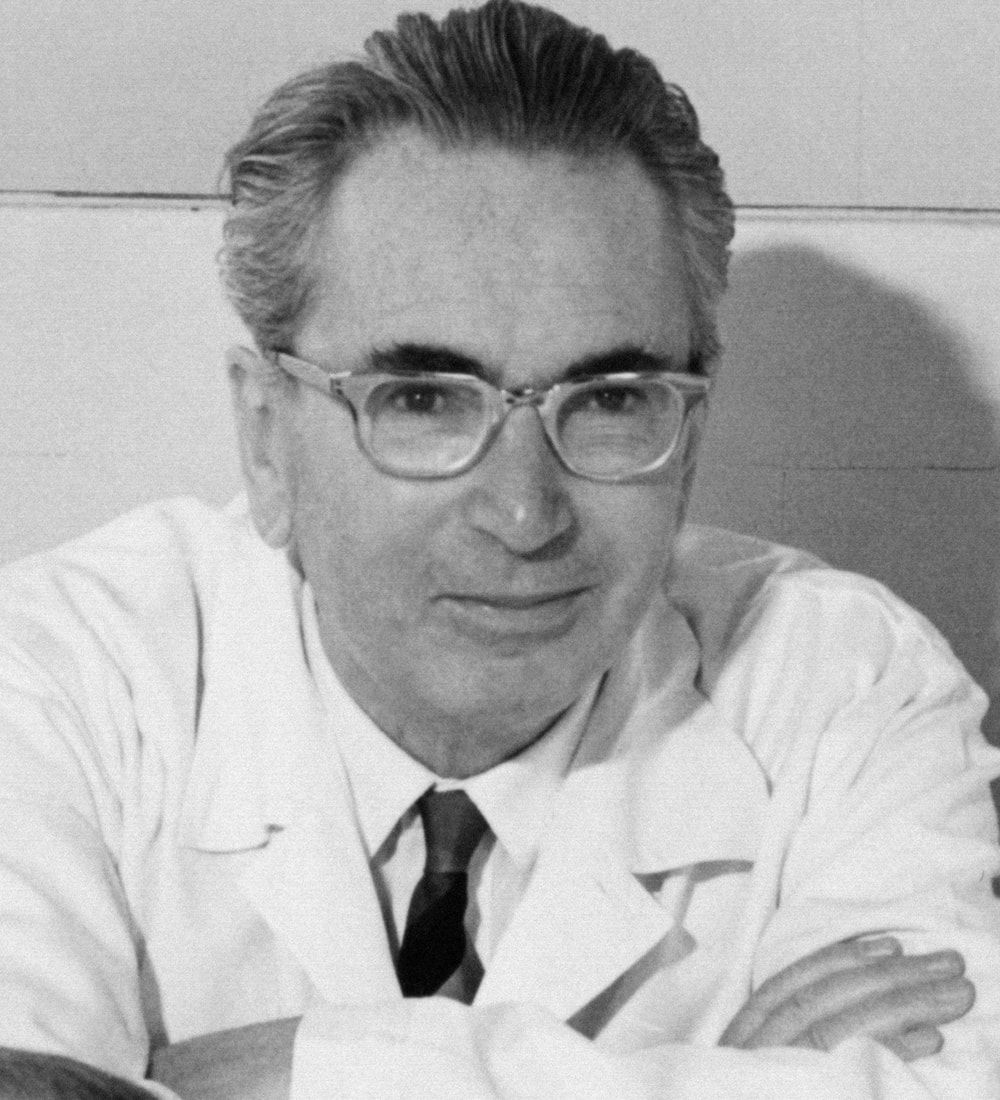

Nine days in the spring of 1945, in a Vienna room, three stenographers in shifts: thus arose the book that made Viktor Frankl known worldwide. He dictated it immediately after his liberation, at first anonymously — the report on the camps was not to be tied to a name. The publisher later put the name on the title page after all.
Frankl was born on 26 March 1905 in Vienna, the middle of three children of a ministry official, in the Leopoldstadt, the city’s Jewish district. As a secondary school student he corresponded with Sigmund Freud — the sixteen-year-old sent a manuscript, Freud passed it on for publication — and then turned to Alfred Adler’s individual psychology, in whose journal he published at eighteen. With both schools he broke early: from Adler’s circle he was excluded in 1927 because he insisted on a line of his own — the human being is to be understood neither from the pleasure principle nor from the striving for power, but from the will to meaning. The third Viennese school of psychotherapy, as logotherapy was later called, thus had its programme before its founder’s doctorate.
He studied medicine, specialised in neurology and psychiatry, and made an early name in practical suicide prevention: from 1928 he organised youth counselling centres where pupils found free advice at report-card time — in the years of these campaigns the number of pupil suicides in Vienna fell, and Frankl was thereupon brought to the psychiatric hospital Am Steinhof, where from 1933 to 1937 he ran the so-called suicidal women’s pavilion: thousands of patients, responsibility at piece-rate, the school of his clinical eye.
From 1938 the antisemitic laws applied to him; in 1940 he took over the neurological department of the Rothschild Hospital, the only Vienna hospital still admitting Jewish patients. There he wrote diagnoses meant to protect patients from the National Socialist euthanasia programme — deliberately falsified findings that turned schizophrenias into febrile deliria. An American visa offered to him in 1941 he let lapse so as not to leave his parents behind; the decision he later told as the touchstone of his own doctrine. In 1942 he was deported with his wife Tilly and his parents to Theresienstadt.
From there the road led on in October 1944. Frankl came to Auschwitz, then to the camps Kaufering III and Türkheim, satellites of Dachau, where he tended typhus patients. On 27 April 1945 he was liberated. His wife, his mother and his brother were murdered; his father had died in Theresienstadt. Besides him, only his sister survived of the family, having emigrated to Australia. The returnee who dictated two books within months wrote against this total loss — colleagues report that in those post-war Vienna years he swung between despair and furious work, and he himself never prettified it.
In the same year 1946 appeared also Ärztliche Seelsorge — The Doctor and the Soul —, his principal clinical work: the book whose manuscript he had carried sewn into his coat to Auschwitz and lost there, reconstructed after the liberation.
…trotzdem Ja zum Leben sagen appeared in 1946 and at first sold badly. The English edition of 1959, Man’s Search for Meaning, made it one of the most-read books of the century. Frankl called his direction logotherapy and set the will to meaning at its head — against Freud’s pleasure principle and Adler’s striving for power. From 1946 to 1971 he directed the Vienna Neurological Policlinic; in 1947 he married Eleonore Schwindt, the Catholic with whom he remained married for fifty years — the couple who kept the holidays of both confessions became themselves an object lesson of his teaching of responsibility before the individual.
The public Frankl too remained a case for debate: his speech on the fiftieth anniversary of the “Anschluss” in 1988, in which he warned against collective guilt laid on the Austrians, drew sharp criticism from survivors' associations — the man who had escaped the camps defended the distinction between perpetrators and those merely born alongside, and not everyone was willing to accept it from him on that date.
The second half of his life was that of a world traveller in his own cause: visiting professorships at Harvard, Stanford and Dallas, a chair of logotherapy in San Diego, lectures on five continents, twenty-nine honorary doctorates. He taught in Vienna into old age, climbed mountains as long as the doctors allowed, and took his pilot’s licence at 67 — the anecdote every tribute quotes because it is his point in miniature: it is never too late to begin something. Frankl died on 2 September 1997 in Vienna of heart failure; he lies in the old Jewish section of the Central Cemetery. The city that deported him keeps a Viktor Frankl Museum today.
The question Frankl works with is not a clinical but an anthropological one: what holds a person upright when everything that usually gives hold has been taken? His answer — the possibility of finding a meaning in one’s own life, even when nothing can be changed any more. The answer was older than its famous evidence: Frankl had developed the outlines of logotherapy in the 1930s, in work with suicidal adolescents and in the Vienna counselling centres, and he carried the manuscript of his first book sewn into his coat to Auschwitz, where it was taken from him. The camps did not produce the doctrine — they subjected it to the harshest conceivable test, and the report of that test became its vehicle.
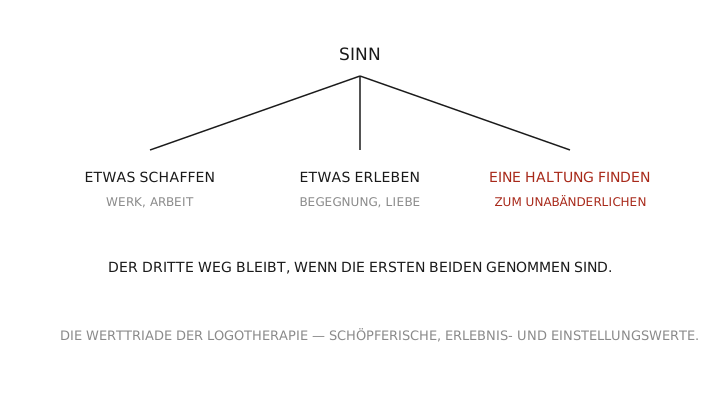
Meaning, for him, is expressly nothing invented. It is to be found, not made, and on three paths: through a work, through the experience of something or someone, and — where both are impossible — through the stance one takes toward unalterable suffering. The third path is the one the book is read for. To it belongs a concept that has reached everyday clinical language: the existential vacuum, the emptiness of the person who lacks nothing but a what-for — by Frankl’s diagnosis the signature of the post-war societies and the raw material of depression, addiction and aggression. And to it belongs the much-quoted reversal of the question: it is not man who has questions to put to life; he is the one being questioned, and to live means to answer.
As a treatment, logotherapy has techniques of its own. Paradoxical intention has patients deliberately wish for what they fear — whoever cannot fall asleep resolves to stay awake; whoever fears sweating before an audience tries to sweat properly. Dereflection steers attention away from self-observation. Both aim at the same mechanism: that the anxious observation of a process disturbs it — anticipatory anxiety as self-fulfilling prophecy. Behaviour therapy later rediscovered paradoxical intention under names of its own; it belongs to the few techniques of the existential schools that have been tested in controlled studies, with respectable if narrow findings for insomnia and anxiety.
Here the case file is more honest than the book jacket. Frankl’s work is not a study. The camp report is a testimony, not a data set; it has neither control group nor systematic survey, and Frankl never claimed otherwise. The famous observation that those without a future died first — the prisoner who smoked his cigarettes had given up — is an interpretation from inside the catastrophe, not a statistic. It is cited as evidence nonetheless, for decades, and the file notes the category error: a testimony can be true without being evidence in the field’s sense.
To the file belongs, further, a scholarly dispute over Frankl’s own account. The historian Timothy Pytell has shown that the common narrative diverges from the documents at several points. Most clearly established: Frankl was only a few days in Auschwitz, not years, as many summaries suggest — the longest time he spent in Theresienstadt and in the Dachau satellite camps. His professional situation in Vienna before 1942 — the work in neurology under conditions the regime set — and the question of how his work casts the relation of victim and stance are likewise debated: critics read the doctrine that a last freedom lies in suffering as an involuntary exoneration of the circumstances. Frankl himself never misstated the duration — the abbreviation arose in the reception, which made the most famous place name stand for the whole. Pytell’s sharper charges are themselves contested and have been rejected by other historians; the file keeps the dispute open instead of deciding it.
The making-measurable began expressly as a test of his teaching: James Crumbaugh and Leonard Maholick built the Purpose in Life test in 1964 to examine psychometrically Frankl’s claim of an independent need for meaning — one of the rare examples of an existential-philosophical thesis voluntarily letting itself be put on a scale. The test separated clinical from unremarkable groups and became the workhorse of early meaning research; its successors measure more finely, but the basic question has stayed the same. From Frankl’s observational vocabulary also comes the Sunday neurosis — the emptiness breaking in when the working week stops supplying distraction —, a concept that anticipates the later research on unemployment, retirement and weekend mood.
Even the title has a reception history. The first edition of 1946 was soberly called Ein Psychologe erlebt das Konzentrationslager; the consoling …trotzdem Ja zum Leben sagen — after the song line of the Buchenwald prisoners — migrated onto the cover only later, and the American version, after a false start as From Death-Camp to Existentialism, finally became Man’s Search for Meaning. Three times the same text, three promises to three audiences — from testimony through philosophy to self-help. The file carries the sequence of titles as a miniature of the entire history of effect.
The history of reception is itself a finding. …trotzdem Ja zum Leben sagen at first scarcely sold in German; the English version, Man’s Search for Meaning, became from 1959 one of the century’s most-read books, ranked by the Library of Congress among the ten most influential books in the United States. The book’s path traces the post-war state of the soul: a text about endurance in the extreme became a guide for the emptiness of prosperity — a shift Frankl saw and served, with lecture tours to the end.
Frankl’s late self-correction deserves a note of its own: in the afterwords of the 1980s he framed his teaching as tragic optimism — the capacity to say yes in the face of pain, guilt and death, expressly without denying the three — and repeated his standing American proposal that the Statue of Liberty on the East Coast be answered by a Statue of Responsibility on the West. The sentence is rhetoric, but it condenses the teaching more precisely than some chapters: meaning, in Frankl, is not a mood but a responsibility.
The clinical continuation with the best data today bears another name: the meaning-centred group psychotherapy that William Breitbart developed at Memorial Sloan Kettering for patients with advanced cancer appeals expressly to Frankl — eight sessions on sources of meaning in the face of death — and has shown, in randomised trials, improvements in experienced meaning, quality of life and despair. It is the irony of this file that the most convincing evidence for Frankl’s programme comes from a New York oncology ward and not from his own institutes: the teaching is best attested where it is led back to its original question — what holds, when nothing can be changed any more.
Against the most widespread reading of his book Frankl himself objected, and the objection belongs in the file. Whoever reads him as saying that the right attitude secured survival has misunderstood him: those who died did not die for want of meaning. Frankl recorded several times that the best did not come back, and that life and death in the camp were decided by circumstances nobody could influence. His claim concerns not the chance of survival but the question of how a person deals with a suffering they cannot avert. The self-help literature that has made the book into an instruction manual for holding out reverses precisely that sentence.
What stands today: the construct, not the method. The experience of meaning is measurable today — the Meaning in Life Questionnaire of 2006 is the most-used instrument, with the two cleanly separated scales of presence and search — and is reliably associated, in large samples, with well-being, lower depression and better coping with illness; meaning research has become, via positive psychology, a field of its own that carries Frankl as ancestor. For logotherapy as a distinct procedure the efficacy evidence is thin by contrast: few controlled studies, small samples, often from the school’s own circle. The file’s finding is thus a clean separation: the claim that meaning is a basic need has passed its test. The claim that a particular Viennese school can administer it is still waiting for one.
Of Frankl’s techniques, one has migrated into behaviour-therapy practice, mostly without his name attached: paradoxical intention. The instruction is to aim deliberately at precisely what one is afraid of.
The point of attack is a loop familiar to anyone who has ever been unable to fall asleep. Fear of a state produces a tension that makes the state more likely — Frankl called this anticipatory anxiety. Someone who is afraid of blushing while speaking watches themselves, and the watching drives the blush. Someone afraid of not falling asleep controls the falling asleep, and control is the opposite of falling asleep.
Paradoxical intention breaks the loop at the anticipation. The patient resolves to stay awake as long as possible tonight; the person with the fear of blushing resolves to go as red as they possibly can. When the effort to prevent the symptom drops away, the symptom often drops away too. Frankl set store by the humorous tone of the exercise — distance from one’s own symptom was part of the effect.
Empirically the component stands better than the method as a whole. Paradoxical interventions have been examined in controlled studies above all for difficulties falling and staying asleep, with usable effects, and modern methods contain related elements — dropping avoidance in exposure therapy rests on the same idea.
Replication status: not applicable.
Man’s Search for Meaning is a testimony and an anthropological position, not an investigation. There is no sample, no control condition and no statement of the observation under which the thesis would be false. The status records that. Two neighbours are testable: the construct of experienced meaning, and the individual technique.
Primary work:
- Frankl, V. E. (1946). …trotzdem Ja zum Leben sagen. Ein Psychologe erlebt das Konzentrationslager. Verlag für Jugend und Volk, Vienna. — Published in English as Man’s Search for Meaning.
- Frankl, V. E. (1946). Ärztliche Seelsorge. Deuticke, Vienna. — The systematic account of logotherapy; in English as The Doctor and the Soul.
- Frankl, V. E. (1960). Paradoxical intention: A logotherapeutic technique. American Journal of Psychotherapy, 14(3), 520–535.
What became measurable:
- Steger, M. F., et al. (2006). The Meaning in Life Questionnaire. Journal of Counseling Psychology, 53(1), 80–93. — The common instrument; separates meaning present from the search for it.
- Czekierda, K., et al. (2017). Meaning in life and health: A systematic review and meta-analysis. Health Psychology Review, 11(4), 387–418. — The association with health measures.
Historical dispute:
- Pytell, T. (2015). Viktor Frankl’s Search for Meaning. Berghahn Books. — The source-critical biography; documents among other things the short duration of the stay in Auschwitz. The author’s further-reaching interpretations are contested in the scholarly discussion.
- Klingberg, H. (2001). When Life Calls Out to Us. Doubleday. — The authorised biography; the opposing position.
German-language:
- Frankl, V. E. (2005). Der Wille zum Sinn. Huber, Bern. — Collected lectures; the most compact account of the approach in his own words.