The Journal30 August 202613 min read
One Thousand and Thirty-Seven Children, Fifty Years
What a birth cohort reveals about the course of a life — and what it does not
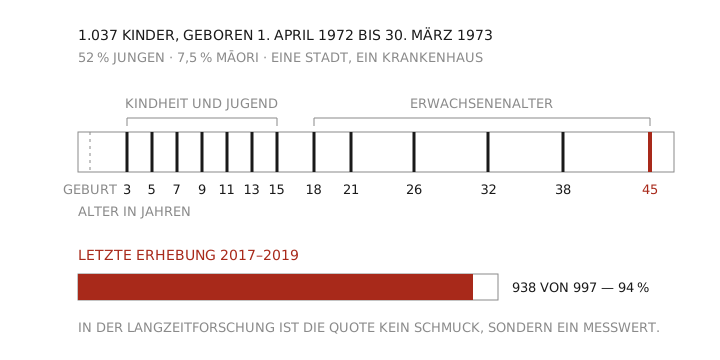
The criterion for inclusion was a span of the calendar. Anyone born between 1 April 1972 and 30 March 1973 at the Queen Mary Maternity Hospital, then Dunedin’s only maternity hospital, and still living in the region at the age of three, was in. There were 1,037 children, 52 per cent of them boys. They were assessed at three, five, seven, nine, eleven, thirteen and fifteen, then at eighteen, twenty-one, twenty-six, thirty-two, thirty-eight and forty-five. At the last of these waves, between 2017 and 2019, 938 of the 997 members still living came back — 94 per cent.
The Dunedin Multidisciplinary Health and Development Study is famous because it joins large questions to unusually dense data. Do difficult children become difficult adults? Who ends up in lasting conflict with the law? Does early self-control predict later health? Why do people of the same age grow old at different rates? These questions in particular invite hasty verdicts on human beings. Dunedin’s real lesson is more demanding: prediction is not determination, group statistics are not a personal judgement, and an association is still not a cause.
The cohort and its measuring systems
In the early 1970s Phil Silva was examining questions of development in preschool children in Dunedin. He was a former teacher and an educational psychologist, not a medic — and out of the initially limited project grew the idea of following an almost complete local birth cohort onwards.
The figure of 1,037 looks large but is no cross-section of humanity. With a share of 7.5 per cent Māori, the cohort matched the population distribution of the South Island at the time reasonably well; it nonetheless stays bound to a place, a time and a set of historical conditions. A person born in Dunedin in 1972 grew up with different schools, family norms, labour markets and health services than a child in today’s Auckland, Lagos or Berlin. Every long-term study gains depth by following one section doggedly. That is exactly how it loses breadth.
Silva’s decisive achievement was therefore not finding the “right” people. He built a research relationship that could survive decades. For long-term research rarely fails on the statistics and often fails on vanished participants. People move, lose interest, die or no longer wish to be examined. If it is chiefly the burdened, the poor or the ill who drop out, the remaining group becomes systematically too healthy and too orderly. A high participation rate is therefore not a decorative figure; it protects what the findings can say.
For the assessment at forty-five, members travelled back from other countries. Loyalty like that does not come from reminders. The team kept in contact, organised journeys, protected identities and designed the assessments so that nobody felt treated as an interchangeable source of data. Accounts of the study put a plain maxim in that place: treat people as you would want to be treated. That is method and ethics at once. Respect lowers attrition, confidentiality raises the chance of honest answers. At the same time the relationship raises questions: someone examined over decades knows the research and can orient behaviour towards it, and researchers do not want to squander the cohort’s trust. Complete distance is a fiction.
We aim to treat our Study members as we ourselves would like to be treated – with respect, care, honesty and kindness, and without judgment.
| Detail | Value |
|---|---|
| Birth window | 1 April 1972 to 30 March 1973 |
| Cohort | 1,037 children, 52 per cent boys |
| Māori share | 7.5 per cent |
| Assessments in childhood and adolescence | at 3, 5, 7, 9, 11, 13 and 15 years |
| Assessments in adulthood | at 18, 21, 26, 32, 38 and 45 years |
| Latest assessment | 2017–2019, 938 of 997 living members |
| Participation rate | 94 per cent |
“Multidisciplinary” in Dunedin means more than a long list of questionnaires. In individual waves, members went through intensive assessment days: psychological interviews, lung and cardiovascular tests, dental examinations, sight and hearing checks, cognitive tasks, physical measurements and later brain imaging. Added to that were reports from parents, teachers, partners or peers, along with administrative data where consent and rules allowed.
This use of several perspectives guards against the weaknesses of a single source. People do not remember without gaps. Parents see a different child from the one teachers see. A police record does not measure every breach of a rule; it measures policing practice and social inequality as well. A laboratory value has precision but says little about meaning. Only when they sit side by side does it become clear where reports agree and where the instrument itself produces a blind spot.
More data still do not automatically mean more truth. Hundreds of variables open up countless possible associations, and the more hypotheses are tested, the greater the danger of chance hits. The strength of a rich cohort therefore hangs on questions justified in advance, on replications in other samples, on transparent analysis — and on the willingness to correct spectacular results later.
Two roads, self-control and genes
The most influential work out of Dunedin comes from Terrie Moffitt. In 1993 she proposed that antisocial behaviour should not be regarded as a single uniform trait. In a smaller group, problem behaviour begins early, shows itself across different areas of life and continues comparatively stably; Moffitt called this pattern life-course-persistent. In a larger group, rule-breaking occurs mainly in adolescence and declines with the move into adult roles: adolescence-limited.
The typology joined two apparently contradictory findings. Statistically, crime peaks in adolescence and early adulthood; at the same time, some people show enduring problems as children already. For the adolescence-typical group Moffitt described a “maturity gap”: young people reach biological maturity but do not yet hold all the rights and status symbols of adults. Breaking rules can then function as a demonstration of autonomy or as imitation of older peers. For the persistent pattern she assumed a developmental cascade: neuropsychological vulnerabilities, difficult temperament, strained parenting, trouble at school and rejecting responses from the environment reinforce one another. That is no tale of the “born criminal” but a transactional hypothesis. A child acts on its environment, the environment reacts, and both alter the next step.
The distinction has influenced research and legal policy and has been invoked in debates about a less punitive youth justice. It must not become a forensic stamp. Real trajectories are more varied than two boxes, and the limits of measurement, social control and institutional responses all affect who comes to be seen as deviant in the first place. Recognising a risk trajectory is not yet knowing the next behaviour of an individual person.
In 2011 an analysis linked childhood self-control to health, financial position and offending in adulthood. Self-control was not captured in a single test but composed from several observations and points in time. On average, lower scores were associated with less favourable later outcomes, even after other characteristics had been taken into account statistically.
The finding is politically seductive: children, it seems, need only learn discipline. But self-control does not exist in a vacuum. Poverty, insecurity, sleep, stress, expectations at school and reliable future prospects all affect whether deferring is sensible and even possible. A person asked to go without today has to be able to trust that there will be a reward tomorrow; a child in an unstable environment learns short-term action as a reasonable adaptation. There is also the point that statistical control is no substitute for an experiment. Holding income, intelligence or social background numerically constant leaves unmeasured differences possible, and a composite self-control score can partly reflect early adversity.
Much the same happened with the gene–environment studies for which Dunedin also became famous. A paper of 2002 reported that a variant related to the enzyme MAOA alters the association between maltreatment in childhood and later antisocial behaviour. A second, in 2003, linked variants of the serotonin transporter gene, stressful life events and depression. The basic idea matters: biological differences can influence how people respond to environments, and the environment decides whether a disposition becomes relevant at all. That contradicts genetic fatalism just as much as it contradicts a psychology without a body.
The specific findings held up to differing degrees. A meta-analysis by Byrd and Manuck supported the MAOA interaction in 2014. For the candidate-gene hypotheses about depression, by contrast, a large test by Border and colleagues in 2019 found no support — the serotonin transporter result is among the most prominent cases of the replication crisis. The instructive part lies in the scientific process: a plausible biological story is not yet a robust effect. Modern genetics therefore works with very large samples and genome-wide methods. For individual people the reading “risk gene equals offender” is out of the question in any case.
The p factor and the pace of ageing
Measure only on one day and you miss the earlier episodes. When the Dunedin team compared prospective and retrospective assessment in 2010, the lifetime prevalence of common mental disorders turned out roughly twice as high under continuous observation as under a single interview. Diagnoses and symptoms also change: people with one form of distress not infrequently develop another later.
Out of such observations came the discussion of a general psychopathology factor, the p factor for short. It is meant to describe what different mental problems have in common, much as a general factor does in models of intelligence. A high score statistically means a broader or more persistent burden. It is not a new illness and not a hidden substance in the brain. Factors are models of covariation; depending on the data and the theory, other structures can fit as well.
With this the study touches the question of whether diagnoses are natural kinds or practical systems of order. Dunedin shows both: recognisable patterns and fluid transitions. Categories help with communication and provision of care, but the courses of lives do not always respect their boundaries. People are more than their diagnosis, and diagnoses are more than inventions — they bundle real suffering without being its only possible description.
Because all members of the cohort are almost exactly the same age, biological ageing can be studied here with unusual cleanness. Researchers combined the changes in several biomarkers into an estimate they called the “pace of ageing”. By their late thirties, people of the same age already differed markedly in physical function, in how old they were judged to look, and in other health characteristics.
The concept shifts the view: ageing does not begin with the first disease of old age. Metabolism, lungs, kidneys, immune system and cardiovascular system change over decades, and social disadvantage, strain and health behaviour can inscribe themselves into the body along the way. An index is not a biological clock displaying a date of death, though. It depends on the markers chosen, on measurement error and on the assumptions of the model.
The moral danger is obvious. Insurers, employers or wellness providers could turn research on population risks into a verdict on the worth of a body. The search for modifiable causes and for early prevention is scientifically defensible. Denying people opportunities on the basis of an uncertain ageing score would not be.
What “predicted” really means
The ordering in time is the great advantage of a cohort. If a characteristic was measured at five and an outcome at thirty, the later outcome cannot have caused the early measurement retrospectively. That does not prove the cause. A third factor can influence both, earlier measurements can be incomplete, and statistical models rest on assumptions. In an observational study, “predicted” usually means: was statistically associated with a later outcome. It does not mean that researchers knew a person’s fate.
The same holds for continuity of personality. Features of temperament in early childhood could be linked to later patterns of behaviour — which argues for continuity, not for an unchanging core of character. It can have at least three causes. First, dispositions can be relatively stable. Second, people seek out environments that suit them and thereby reinforce earlier tendencies. Third, the environment reacts to a child: the “difficult” child gets different feedback from the compliant one. A rank position on a trait can stay relatively stable while the actual life changes a great deal. Someone can remain vulnerable and learn new strategies.
Popular portraits like to shorten this. “A group with certain early characteristics had on average a raised risk” becomes “at the age of three it is settled who you will be”. Groups overlap: many people with a risk do not develop the outcome, many with the outcome did not have the supposed marker. When a risk doubles it sounds dramatic; if it rises from one to two per cent, 98 people in 100 remain without the outcome. Without absolute numbers, distributions and error rates, the analysis of human beings turns into rhetoric — in criminal forecasting as much as in health screening.
The ethical weight of half a century
A three-year-old cannot consent to a lifelong study. At first those with custody decide; later the members must be able to agree afresh and with full information. Consent is not a ticket signed once, all the more since new technologies generate new information: a blood sample stored in 1975 could not then answer the same genetic questions it can today. Brain images, register data and family information also touch relatives at times.
There is also the risk of recognition. Even without names, an unusual combination of place of residence, occupation, illness and life event can make a person identifiable — especially in a modest-sized city. The study therefore publishes group results and protects individual data strictly. “Open data” cannot mean here that intimate archives of a life are free to download. The burdens, too, are unevenly distributed: participants give time, bodily data and memories, researchers receive publications and careers. Thanks, travel costs and respectful treatment soften this asymmetry but do not dissolve it.
A further question arises with particular sharpness in New Zealand. Given the colonial history and the obligations towards Māori, it matters who defines categories, who controls data and who receives the benefit. Data sovereignty, partnership and culturally appropriate interpretation belong to this beyond general consent. A cohort begun in 1972 cannot meet these requirements retrospectively and perfectly, but it may not ignore them either. And finally the world changes along with the members: laws, diagnostic systems, tobacco policy, digital media, labour markets and forms of family are not what they were in 1975. An age effect can therefore be confused with a period effect, and what holds for this birth cohort need not hold for a later generation. Comparisons with other cohorts are indispensable; differences there are not a failure but can show that a supposedly personal effect depends on politics, culture or the economy.
What remains
Well documented is what a cohort can do. It orders events in time, makes courses visible instead of snapshots, and corrects numbers that come from one-off surveys. The lifetime prevalence of mental disorders, for instance, doubles once you accompany people rather than ask them once. Almost everything inferred from such courses about individual people remains contested. The trajectory typology of antisocial behaviour has proved its worth as a research heuristic and is not a diagnosis; the self-control gradient is robust and still no evidence that discipline is the cause; the candidate-gene findings have held up only in part. Fifty years of measurement simply do not contain all the conversations, accidents, losses and reasons of a life.
In ordinary use you recognise the misstep by a turn of phrase. The moment “on average a raised risk” becomes a verdict on a particular person, the group statistic has been overstretched. The most humane use of prediction is to make systems more reliable: good early education, accessible health care, protection from violence, support for families. The most dangerous would be a life-chances score that holds people’s pasts up to them as a judgement. In any case the real protagonist of the study is no famous psychologist. It is 1,037 people, their families, and a team that handed responsibility on across generations — and the course of a life is neither a blank sheet nor a finished programme.
Sources, and why they are here
Poulton, R., Moffitt, T. E., & Silva, P. A. (2015). The Dunedin Multidisciplinary Health and Development Study: overview of the first 40 years, with an eye to the future. Social Psychiatry and Psychiatric Epidemiology, 50(5), 679–693.
The study's standard overview — source for the inclusion criterion, the cohort size, the waves of assessment and the composition.
Poulton, R., Guiney, H., Ramrakha, S., & Moffitt, T. E. (2022). The Dunedin study after half a century: reflections on the past, and course for the future. Journal of the Royal Society of New Zealand. doi:10.1080/03036758.2022.2114508
The retrospect at the fiftieth year; source of the quotation on how the study members are treated.
Moffitt, T. E. (1993). Adolescence-limited and life-course-persistent antisocial behavior: A developmental taxonomy. Psychological Review, 100(4), 674–701.
The paper that introduced the two developmental types and the maturity gap — the most influential work to come out of Dunedin.
Moffitt, T. E., Arseneault, L., Belsky, D., et al. (2011). A gradient of childhood self-control predicts health, wealth, and public safety. PNAS, 108(7), 2693–2698.
The self-control analysis whose gradient is regularly shortened into a doctrine of child-rearing.
Caspi, A., McClay, J., Moffitt, T. E., et al. (2002). Role of genotype in the cycle of violence in maltreated children. Science, 297(5582), 851–854.
The MAOA finding — the model case of a gene-environment interaction.
Byrd, A. L., & Manuck, S. B. (2014). MAOA, childhood maltreatment, and antisocial behavior: Meta-analysis of a gene-environment interaction. Biological Psychiatry, 75(1), 9–17.
The meta-analysis that supports the MAOA finding; evidence that not all candidate-gene work met the same fate.
Caspi, A., Sugden, K., Moffitt, T. E., et al. (2003). Influence of life stress on depression: Moderation by a polymorphism in the 5-HTT gene. Science, 301(5631), 386–389.
The serotonin-transporter finding, which became the most prominent case of the replication crisis.
Border, R., Johnson, E. C., Evans, L. M., et al. (2019). No support for historical candidate gene or candidate gene-by-interaction hypotheses for major depression. American Journal of Psychiatry, 176(5), 376–387.
The large test that removed the ground from the candidate-gene hypotheses for depression.
Moffitt, T. E., Caspi, A., Taylor, A., et al. (2010). How common are common mental disorders? Evidence that lifetime prevalence rates are doubled by prospective versus retrospective ascertainment. Psychological Medicine, 40(6), 899–909.
Establishes the doubling of lifetime prevalence under continuous rather than single assessment.
Caspi, A., Houts, R. M., Belsky, D. W., et al. (2014). The p factor: One general psychopathology factor in the structure of psychiatric disorders? Clinical Psychological Science, 2(2), 119–137.
Introduces the p factor — as a model of covariation, not as a new illness.
Belsky, D. W., Caspi, A., Houts, R., et al. (2015). Quantification of biological aging in young adults. PNAS, 112(30), E4104–E4110.
Source of the Pace of Aging and of the findings on people of the same age growing old at different rates.
Dunedin Multidisciplinary Health and Development Research Unit, University of Otago: dunedinstudy.otago.ac.nz.
The ongoing documentation of the study by the research unit itself — the state of assessment and the participation figures.