The Journal29 August 202612 min read
Gage Drove a Coach, for Years
The man behind the iron bar and the legend of the new person
From 1852 to 1859 Phineas Gage lived in Chile and drove mail coaches there, mostly on the route between Valparaíso and Santiago. The work demanded routes and timetables, the care of the animals, responsibility for luggage and money, dealing with passengers, and control of several horses at once. Four years earlier an iron bar had shot through his head.
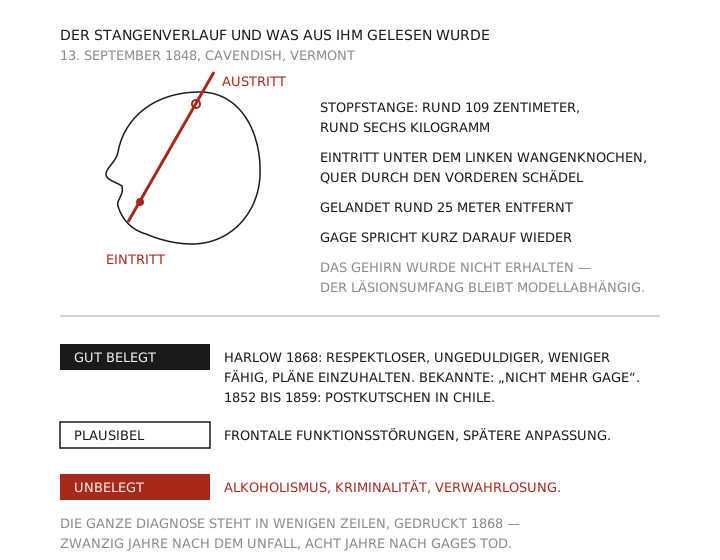
On the afternoon of 13 September 1848 the 25-year-old foreman was preparing a blast for a railway cutting in Vermont. Powder and sand lay in the borehole. A tamping iron about a metre long struck the rock, and a spark ignited the charge. The iron entered beneath Gage’s left cheekbone, passed through the front of his skull, and landed some 25 metres away. Gage fell — and was speaking again shortly afterwards.
Between these two scenes lies the most famous personality diagnosis in the history of neurology — and its long exaggeration.
Survival was not a single moment
The familiar short version — bar through the head, got up, carried on living — leaves out the medically decisive middle. The physician John Martyn Harlow did not find Gage in a stable condition. He documented exposed brain tissue, bleeding, and repeated vomiting. Over the following days a severe infection developed; Gage’s condition worsened, and for a time he was barely responsive. Harlow opened up wound cavities, removed dead tissue, and provided drainage. Without antibiotics, the inflammatory response was itself a life-threatening second injury.
This phase matters for every later interpretation. A traumatic brain injury is not a geometrical channel affecting only the cells a piece of metal touches directly. Pressure, bleeding, swelling, infection, and later scarring can cause additional damage. Which of these processes altered which function in Gage can no longer be separated out. Anyone who derives a personality diagnosis accurate to the millimetre from the presumed path of the bar is confusing an anatomical reconstruction with a clinical time machine.
Harlow’s achievement deserves a sober appreciation too. His treatment was not modern neurosurgery, but he observed the patient over weeks, documented the course, and later preserved the skull and the iron for medical teaching. That did not make him a neutral measuring device. His terms for character and self-control came from the moral vocabulary of the nineteenth century. The same text can be a valuable clinical source and a culturally shaped interpretation.
One paragraph becomes a whole character
In 1868 Harlow described Gage as more disrespectful, more impatient, and less able to hold to a plan. The sentence that carries the history of the discipline stands at the end of that list:
In this regard his mind was radically changed, so decidedly that his friends and acquaintances said he was „no longer Gage“
Note who is speaking here: not the doctor about a finding, but the doctor about what acquaintances are said to have said. Almost all the dramatic statements about his personality come from those few lines — published twenty years after the accident and eight years after Gage’s death. There is no psychological test, no systematic questioning of the family, and no observation from before the accident.
The story grew all the same. Textbooks made him a drinker, a brawler, or a morally unrestrained vagrant — claims for which the historian Malcolm Macmillan found no solid evidence. In terms of how people are analysed, this is a classic error: a whole person is constructed out of a plausible change. Damage to the ventromedial and orbitofrontal systems can impair planning, impulse control, emotion regulation, and social judgement. It does not, however, explain every later conflict. Pain, visible disfigurement, loss of work, the reactions of those around him, and a life after severe trauma belong to the causal chain as well.
“No longer Gage” is moreover a report about social recognisability, not a diagnosis. People notice changes in personality where expectations of reliability, courtesy, planning, and hierarchy are violated. That acquaintances experienced him differently is relevant. What remains unclear is how often, for how long, and in which situations the changes appeared.
The same sentence still belongs to everyday clinical life after neurological illness. Relatives often notice subtle changes earlier than any test does, because they have seen the person in many situations; their reports are indispensable and at the same time perspectival. Roles shift, conflicts increase, the earlier life is idealised in memory. For the person concerned the formulation is particularly hard, because after it every unexpected action is attributed to the injury. They thereby lose the right to ordinary contradictions, to development, and to bad days.
What the records actually cover
Between the accident and Harlow’s detailed report lies a patchwork of documentation. At first Gage returned to his family. His former employer apparently did not take him back as a foreman. He then exhibited himself for a time together with the bar for an entrance fee, and worked for around eighteen months at a livery and coaching business in Hanover, New Hampshire. In August 1852 he went to Chile. Only in 1859 did he return, ill, to his family in California; in 1860 he died after epileptic seizures. These stations are more certain than any psychological detail.
The measurements are certain as well. The tamping iron was about 109 centimetres long and weighed some six kilograms. Such figures make the story vivid, but they must not create the illusion that anatomical precision automatically supplies psychological precision. Because Gage’s brain was not preserved, the exact extent of the lesion remains dependent on the model used.
The famous photograph, too, is a late discovery. When collectors put it online in 2009, the man pictured was at first taken for a whaler with a harpoon; only tips from the public and comparison with the surviving tamping iron led to his identification as Gage. A second portrait later came to light. The sitter wears neat clothing and holds the bar not like a chance relic but as a visible part of his story. Neither pride nor psychological working-through can be diagnosed from that. But the picture contradicts the comfortable iconography of the “destroyed” human being. And it generates an authority of its own: because we see Gage’s face, the past seems nearer and more certain, although the date, the occasion, and his thoughts while sitting remain unknown.
What his working life shows — and what it does not
The years as a coach driver are thin in documentation and rich in analysis. Driving a mail coach over long distances demanded punctuality, orientation, dealing with passengers, and control of several horses. Macmillan and Matthew Lena suggested that this highly structured occupation may have helped Gage towards a social and cognitive rehabilitation. A doctor who knew him towards the end of his time in Chile later reported that he had noticed no impairment whatever of Gage’s mental faculties.
Both remain a hypothesis and a single retrospective testimony, not a therapy programme proved after the fact and not an examination. This gradation is exactly what matters. Freedom from symptoms cannot be inferred from holding a job; conversely, several years of demanding work are hard to reconcile with the picture of a permanently uncontrollable man. The fair conclusion lies between the two: Gage’s level of functioning was probably neither unchanged nor destroyed for good.
Modern rehabilitation uses similar principles more deliberately. Fixed routines, external memory aids, immediate feedback, gradually rising demands, and dependable social roles can support impaired self-regulation. An environment can amplify deficits or compensate for them. Personality after a brain injury is therefore not only what is left inside the head, but also what a daily life makes possible again.
Before the accident Gage led a blasting crew in railway construction. That was not merely physical work. A foreman had to plan sequences, judge dangers, manage materials, coordinate men, and appear reliable to his superiors. That his employer did not take him back into this role afterwards is a sign to be taken seriously. But it does not say unambiguously why the decision was made. Cognitive change, uncertainty about seizures, physical consequences, the disfigured face, and the liability logic of a dangerous business may all have been at work at once.
Here a basic problem of historical analysis of people shows itself: behaviour usually becomes visible only when it violates an institutional expectation. Nobody kept a list of Gage’s everyday mistakes before 1848. What has come down to us is that employers and acquaintances noticed a difference afterwards. The record therefore does not simply measure a personality but a relationship between person, working role, and social judgement. An impulsive sentence at the kitchen table has different consequences from an impulsive decision beside blasting powder.
What “personality” even means here
In everyday speech, personality sounds like an inner core: friendly or rough, dependable or erratic, “the same person” or “someone else”. Psychologically that is too coarse. One can distinguish at least temperament, habits, values, self-control, social perception, motivation, and autobiographical identity, and these levels change in different ways. A person can keep their memories, attachments, and convictions and still break rules more often, because consequences carry less weight at the decisive moment.
Frontal networks are no container for morality. They help to stabilise goals over time, to weigh conflicting signals, to bring emotional bodily states into account, and to adapt actions to changing contexts. Such performances arise in a distributed way. Talk of a “personality centre” is memorable and misleading; no single place possesses either courtesy or a sense of responsibility.
In Gage’s case there are no standardised tasks, no ratings from several areas of life, and no repeated measurements. We do not know whether the difficulties described were constant or occurred mainly in the early phase of recovery. Nor do we know whether mood, sleep, pain, or possible seizures influenced his behaviour. And we hear almost exclusively other people speaking about him: no letters, diaries, or extended statements of his own are known. This gap cannot be filled with empathy. Consequences can be analysed without inventing an inner voice.
That also shifts the old philosophical question. John Locke tied personal identity closely to the consciousness of one’s own experiences over time; other traditions emphasise bodily continuity, relationships, or a continuously narrated life story. Gage decides none of these positions. What is interesting is rather how people attribute identity when memory, character traits, capacity for responsibility, and social roles do not remain stable to the same degree. How much responsibility is appropriate? At what point does protection become paternalism? Personhood, at any rate, is not a variable that jumps to zero or one after an accident.
Harlow, Bigelow, and the quarrel over the frontal lobe
The case fell into a period when the function of the frontal brain was disputed. Some doctors held large anterior regions to be of little functional significance; others linked them — often speculatively — with higher mental faculties. In 1850 the Harvard surgeon Henry Jacob Bigelow emphasised above all the astonishing survival; Harlow’s later account moved the psychological change to the centre. The very choice of what appears worth reporting about a case steers its scientific career.
The phrenology popular at the time acted as background noise. It assumed that individual mental characteristics could be assigned to clearly bounded brain organs and even to shapes of the skull. Gage’s case did not simply become its proof; the historical situation was more complicated. But it did make a localisationist narrative attractive: part of the head is destroyed, so the vanished quality must have sat there. Modern network models are more cautious, yet the same dramaturgy lives on in headlines about “the area for” love, morality, or malice.
Because Gage’s skull was preserved, researchers were later able to study the probable path of the iron with computer models. This work suggests that above all left frontal regions and their connections were affected; different models, however, do not arrive at identical results. Angle of entry, position of the head, movement of the iron, and deformation of tissue all have to be estimated from incomplete traces. The connectivity study by Van Horn and colleagues in 2012 showed that a limited local injury can compromise numerous connections. It would nonetheless be circular to explain every claimed behaviour with a connection that has likewise been reconstructed. A model gains from named uncertainty, not from psychological embellishment.
Why the myth grew stronger than the record
A good teaching story has a clear before-and-after contrast, a memorable object, and a moral point. Gage supplies all three: the dutiful foreman, the flying iron bar, and the supposedly disinhibited survivor. Uncertain intermediate stages disturb this form. So they disappeared from the retellings, while unevidenced embellishments travelled from text to text — often with no identifiable original source.
The process resembles a memory distortion at the cultural level. Information that fits the schema is retained more easily; contradictions such as the work in Chile drop out. Repetition is confused with confirmation. Once a claim stands in several textbooks it looks independently evidenced, although all of them are paraphrasing the same late source.
One question is enough to counter this: does a particular claim about his character come from Harlow, from a later recollection, or from a modern retelling with no primary evidence? It does not destroy the story. It makes visible how knowledge is made.
What remains
The record can be read at three levels of certainty. Well evidenced are the accident, the treatment, the surviving anatomical objects, several stations of his working life, and Harlow’s published observation. Plausible but not fully proved are specific frontal impairments and a later partial adaptation. Unevidenced are the spectacular attributions of alcoholism, criminality, or complete moral dereliction. This threefold division protects against two opposite errors: playing down Gage’s changes because the myth was exaggerated, or accepting every legend because a brain injury undoubtedly occurred.
For the clinic today, little that is spectacular follows, and much that is practical. Diagnoses of function are more precise than global judgements of character: planning, inhibition, perspective-taking, irritability, and the organisation of daily life belong to separate assessments. An evaluation needs several sources and several points in time, because the change immediately after a severe injury is not the final state. Participation is itself an active factor — work, dependable relationships, and structured tasks are not only the reward after recovery, they help to make it possible. And that Gage somehow went on working excuses no absence of care; modern rehabilitation was not available to him.
That leaves the language. Brain injuries can change a person deeply, and stories about brain injuries can change them a second time. Gage became, posthumously, “the frontal-lobe case”. The more honest description would be: a workman who survived an extreme injury, probably underwent considerable changes, and over the years found ways back into organised work. The better question is therefore not “who was Gage after the accident?”, as though a reliable record existed. It is: which abilities were probably impaired, which returned, and why did psychology prefer to remember the ruined character rather than the man on the coachman’s box?
Sources, and why they are here
Harlow, J. M. (1848). Passage of an iron rod through the head. Boston Medical and Surgical Journal, 39, 389–393.
The contemporaneous report, written while Harlow was treating the patient. Here stands the medical middle section the short version omits: exposed tissue, haemorrhage, severe infection.
Harlow, J. M. (1868). Recovery from the passage of an iron bar through the head. Publications of the Massachusetts Medical Society, 2, 327–347.
The source of the quotation — and the only source for almost everything ever claimed about Gage's personality. Twenty years after the accident, eight years after his death, assembled from recollections.
Macmillan, M. (2000). An Odd Kind of Fame: Stories of Phineas Gage. MIT Press.
The archival work that could not confirm the textbook drinker and brawler — and that made the second half of his life in Chile visible at all.
Macmillan, M., & Lena, M. L. (2010). Rehabilitating Phineas Gage. Neuropsychological Rehabilitation, 20, 641–658.
The proposal to read the course as a recovery rather than a lasting decline: the demanding work in Chile cannot be reconciled with the legend.
Van Horn, J. D., Irimia, A., Torgerson, C. M., Chambers, M. C., Kikinis, R., & Toga, A. W. (2012). Mapping connectivity damage in the case of Phineas Gage. PLoS ONE, 7(5), e37454.
The modern reconstruction of the path of damage — useful as anatomy and at the same time the best example of how easily a reconstruction is taken for a diagnosis.