The Journal29 August 202613 min read
The War Ended, the Diagnosis Did Not
From shell shock to PTSD — and the names in between
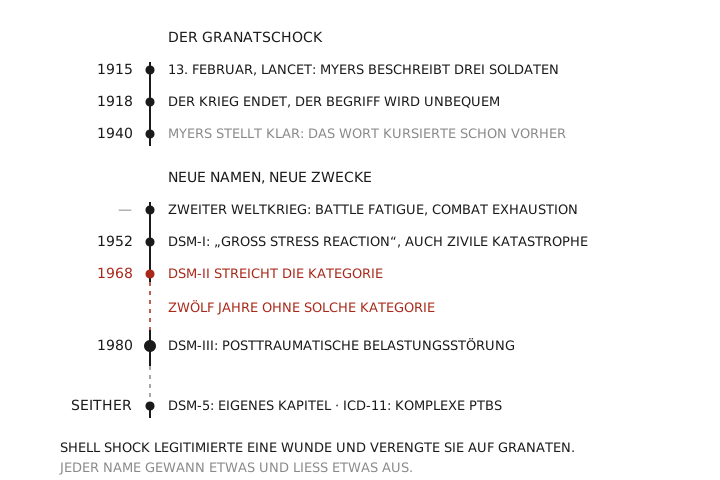
On 13 February 1915 a short paper about three soldiers appears in the Lancet. Memory, sight, smell, and taste have failed in all three; all three had been near exploding shells. The author, the British physician and psychologist Charles S. Myers, introduces the expression “shell shock” into the professional literature for this picture. The word sounds like blast wave and damaged tissue, like a wound that has to be taken seriously.
Soon men who had been nowhere near an explosion are trembling and falling silent too, and the explanation splits: injured brain, psychological shock, cowardice, malingering, or unconscious conflict? Medicine alone does not decide the answer. If the reaction counts as a wound, the soldier deserves treatment and a pension. If it counts as weakness of will, discipline and shame follow. Some doctors use rest, nutrition, and graded activity; others use electric shocks, coercion, and military pressure to return men quickly to the front. Treatment serves the patient and the army at once — aims that can contradict each other.
Trauma had names before 1914
The psychological consequences of extreme events did not begin in the trenches. In the nineteenth century, doctors described complaints after railway accidents as “railway spine”. Jean-Martin Charcot studied paralyses of traumatic origin; Pierre Janet wrote about dissociated memories; Freud and Breuer connected symptoms with experiences that had not been integrated. The interpretations were contested, but the connection between an event and later suffering was not new.
Wars had long had their terms as well: nostalgia, soldier’s heart, exhaustion, neurasthenia. Each name emphasised a different mechanism — attachment, circulation, nerves, or morale. Diagnoses migrate because medicine develops new theories and institutions prefer particular explanations.
The First World War changed the scale. Artillery, sustained bombardment, the industrialisation of killing, and long static battles produced a mass of conspicuous cases. What could be dismissed in individuals as weakness became a problem for whole armies.
A term Myers did not invent
The common story makes Myers the coiner of the word. He himself contradicted that: in 1940 he stated explicitly that “shell shock” had been circulating beforehand. His 1915 case series belongs among the first scientific uses, not to the invention. The expression spread quickly, although it soon became clear that the same symptoms could occur without any immediate explosion. Myers later preferred more exact descriptions and took a critical view of the term’s popularity.
The episode shows the power of a name. It can legitimise suffering, because “shock” sounds like injury. But it can also narrow research onto the wrong mechanism. A good diagnostic word has to be communicable without confusing its own metaphor with the cause.
Myers tried to build up psychological treatment within the military but came into conflict with organisational interests. The doctor stood between confidentiality, recovery, and the demand to make men fit for service again. This triangle is no personal failure but a structural conflict of interest in military medicine.
The trench as a learning environment
Soldiers lived under bombardment, sleep deprivation, cold, mud, infection, and the sight of mutilated comrades. Danger was unpredictable and often not controllable through one’s own behaviour. Psychologically, uncontrollability and unpredictability are especially burdensome: the nervous system can learn no reliable rule about when the alarm may end.
At the same time, military norms of masculinity, duty, and comradeship applied. Showing fear threatened not only status but could have criminal consequences. Symptoms therefore became expressible through the body, even where words were forbidden or shaming. This does not mean that paralysis or tremor was staged deliberately. Involuntary symptoms can take forms, within a culture, that are recognisable as suffering. The unit could protect and burden at once: comradeship gave meaning and help, guilt towards the fallen kept some in dangerous situations. Resilience is therefore not merely inner hardness but attachment — with a saving side and an obligating one.
Some of the cases probably rested on direct brain injury from blast waves, shrapnel, or carbon monoxide; others showed symptoms with no visible lesion. The debate of the time set “organic” against “psychological”, as though real suffering had to be either tissue damage or imagination. Today we know that experience alters biological systems without a gross lesion having to be present. Stress hormones, sleep, attention, fear learning, and memory consolidation are bodily processes. “Psychological” does not mean unreal. The sensible account allows for mixtures: mild traumatic brain injury, chronic stress, grief, infection, pain, and moral conflict can act together. Diagnostic purity is often a need of the file, not of the life.
Care for officers, discipline for other ranks
Some British officers' hospitals offered rest, conversation, occupation, and a relatively protected environment. The physician W. H. R. Rivers treated the poet Siegfried Sassoon among others and tried to bring his experiences into a form that could be told. Other institutions used painful electrical stimuli, humiliation, or coercion, particularly on ordinary soldiers. The difference followed not only a theory but class and rank. The same body could be read, depending on the uniform, as a sensitive nervous system or as a failure of will.
Sassoon had been sent to Craiglockhart in 1917 after a public declaration against continuing the war. The diagnosis possibly protected him from a court martial, but it also pathologised political dissent. With Rivers he negotiated duty, protest, and his bond to his comrades; later he returned to the front. At Craiglockhart he met Wilfred Owen, whose poems destroyed the heroic vocabulary of the war. Literature is not a clinical measurement, but it can express what diagnoses smooth over: noise, recurrence, guilt, deadened time. Owen was killed on 4 November 1918, a week before the armistice. A person can suffer psychologically and at the same time protest reasonably against the conditions that produce the suffering.
At the other end of the scale stood the firing squad. How many men it reached is disputed to this day, and the dispute is itself instructive: of around 3,080 death sentences passed by the British army, 346 were carried out. The Armed Forces Act 2006 pardoned 309 of those executed; 37 who had been convicted of murder were excluded. The Shot at Dawn memorial at the National Memorial Arboretum carries 306 names — three men shot for mutiny were added only in 2016. Anyone who quotes a single figure has already chosen a reading.
Not every one of these cases can be diagnosed retrospectively as PTSD, and the records are incomplete. What is certain is that the procedures of the time often recognised psychological impairment inadequately and that military deterrence weighed more heavily. The later pardons cannot give back lost lives and are no substitute for examining individual cases. But they do show a shift in moral attribution: behaviour under extreme strain is no longer automatically read as a flaw of character. At the same time the history warns against retrospective certainty in both directions. Not every breach of the rules is illness; not every apparent decision is free under conditions of war.
From battle fatigue to the diagnosis of 1980
After 1918 shell shock did not disappear, but the term became institutionally inconvenient. In the Second World War people spoke of battle fatigue or combat exhaustion. Military psychiatry fell back on the PIE principle, which had already been formulated in the First World War and is associated with the name of the US medical officer Thomas W. Salmon: treatment close to the front, immediately after onset, and with the expectation of return. Some of the soldiers did in fact return to duty. But an expectation easily becomes pressure, and the rate of return is no measure of later health. Long-term consequences, alcohol problems, family conflict, or nightmares remained invisible after discharge. The term itself worked in two directions too: “combat exhaustion” avoided the image of lasting illness and possibly reduced shame — but it treated suffering as a temporary malfunction whose solution lay in functioning again.
After 1945 doctors examined the consequences of persecution, concentration camps, and loss. Terms such as survivor guilt tried to capture why safety does not automatically mean the end of danger for the mind. Compensation proceedings demanded proof of psychological damage and confronted survivors with sceptical assessment. With that, trauma research was bound once and for all to the politics of recognition: a diagnosis can open access to a pension and to treatment, but it may force people to translate their lives into the expected symptoms. Anyone who does not appear “ill enough” can come away with nothing despite real consequences of persecution.
After the Vietnam War, veterans' groups organised so-called rap groups in which they talked through experience, anger, and estrangement. Clinicians such as Chaim Shatan and Robert Jay Lifton connected these accounts with the older trauma research; feminist activists and professionals at the same time brought rape and domestic violence into the debate as causes of severe psychological consequences. In 1980 post-traumatic stress disorder appeared in the DSM-III.
An external event thereby moved explicitly back into the core of a psychiatric diagnosis. Back, not for the first time: in 1952 the DSM-I had already carried such a category with the “gross stress reaction”, naming civilian catastrophe alongside combat — and the DSM-II struck it in 1968. The inclusion in 1980 was scientific and political work at once. It shifted the causality: what stood at the centre was not a fundamentally weak personality but an event outside ordinary experience. Its Criterion A named what counted as trauma:
Existence of a recognizable stressor that would evoke significant symptoms of distress in almost everyone
At the same time the DSM-III established a categorical list of criteria. Trauma became more comparably researchable, but also administratively bounded — and every boundary produces cases just below it, and incentives to tell one’s experiences in the fitting form.
What became of the diagnosis since
Later DSM versions changed the definition of the triggering event and the symptom groups. The DSM-5 no longer assigned PTSD to the anxiety disorders but to a chapter of its own on trauma- and stressor-related disorders. Alongside intrusion, avoidance, and hyperarousal, negative changes in thought and mood gained more weight. The ICD-11 uses a narrower core and additionally distinguishes a complex PTSD with problems of emotion regulation, a negative self-image, and difficulties in relationships. DSM and ICD are therefore not identical. That does not mean the disorder is invented. It shows that a real range of suffering can be categorised in different ways; the validity lies in recurring patterns and clinical usefulness, not in the eternal stability of a boundary.
What is being described here is more than “bad memories”. Intrusions make the past appear as present danger; avoidance narrows life; hyperarousal keeps body and attention on alert. After danger, neutral stimuli — a noise, a smell, a place — can set off the alarm. Classical conditioning explains part of this: stimuli become linked with threat. Extinction does not undo the old link but builds new, safe expectations alongside it, which remain dependent on context. That is why fear can return in a different setting. The hippocampus helps to place memories in space and time; the amygdala and further networks evaluate salience; prefrontal systems regulate the response. This simplified map is useful, but it must not turn into the “trauma brain” as an unchangeable personality: findings are group averages and are influenced by sleep, depression, medication, and life history.
The majority of people do not develop lasting PTSD after a single trauma. The risk rises with the kind and duration of violence, with earlier burdens, injury, absent support, and continuing threat; social security, material stability, and access to help offer protection. These factors work probabilistically, not as fate. Resilience does not mean remaining untouched. Grief, sleep problems, or anxiety in the first weeks can be expectable reactions and can subside again. Pathologising too early can leave people feeling permanently damaged; conversely, waiting must not delay necessary help. “Post-traumatic growth”, too, should be spoken of with care: some report new priorities or relationships, but nobody owes their suffering a positive lesson.
Trauma-focused cognitive behavioural therapy, prolonged exposure, cognitive processing therapy, and EMDR are among the well-studied psychotherapeutic approaches. They differ in technique but share a structured approach to avoided memory, to meanings, and to present safety. Certain antidepressants can relieve symptoms; sleep, pain, addiction, and depression often need additional treatment. What matters is deciding together about pace, aim, risks, and preferences. Confrontation without stabilisation and consent repeats the loss of control instead of working through it. And care has to examine the present: anyone still experiencing violence needs protection, housing, or legal advice. The nervous system cannot learn a safety that does not socially exist.
What the diagnosis does not tell
The term moral injury describes the consequences of acts, omissions, or betrayals that violate fundamental moral convictions. Soldiers can suffer from having killed, from having failed to protect others, or from having carried out the orders of an organisation they experienced as unjust. Not every moral injury meets the PTSD criteria, and guilt does not dissolve at the message that nobody is responsible. Some people need a differentiated moral reckoning: what was possible under coercion, what remains to be mourned, what reparation is realistic? Therapy must be neither an automatic acquittal nor a court. Here the limit of purely medical language shows itself — some wounds are responses to real injustice, and healing can include memory, action, and community, not only the reduction of symptoms.
A second limit concerns testimony in court. High arousal can store central aspects of a danger strongly, while temporal sequence and peripheral details remain patchy; dissociation can impair encoding. At the same time memory is reconstructive: later information and repeated retelling can alter details. It follows neither that inconsistent testimony is automatically false, nor that traumatic certainty guarantees historical accuracy. Forensic interviews should use open questions, low suggestion, and clean documentation; therapeutic conversations pursue a different aim. A therapist should not “confirm” a memory she cannot verify; a court should not treat the absence of cinematic coherence as a lie detector.
A third limit is cultural. The PTSD criteria were developed within Western-shaped diagnostic systems. Intrusion, avoidance, and alarm responses are found across cultures, but explanations and expression vary: some people report bodily complaints, spiritual injury, family conflict, or collective shame. The same holds historically — in the First World War, tremor and paralysis were especially visible; today intrusion and hyperarousal are named more often. Body, concepts, and expectations jointly shape how suffering is communicated. After war or displacement the community itself can be damaged; individual therapy is then not enough, and remembrance, justice, schooling, and economic security belong to the restoration.
What remains
Shell shock legitimised a wound and narrowed it to shells. Battle fatigue normalised the reaction and tied recovery to function. PTSD acknowledged the external event and drew new boundaries. Each term gained something and left something out, and none was pure knowledge: each arose where medicine, the military, and social policy met. What is secure today is that extreme experience can alter fear learning, sleep, attention, and self-image, that the majority recover, and that treatment works. What remains contested is where the diagnosis ends — DSM and ICD draw the line differently, and complex PTSD is an open case.
In everyday life the old quarrel can be recognised in two sentences. One turns a diagnosis into a person: “he’s just traumatised” then explains every decision and leaves no freedom over. The other turns a reaction into a character: “others put up with it too.” Both sentences decided treatment in 1917, and both are still in circulation. The usable question lies between them and is asked twice over: does the diagnostic pattern fit — and which story does the diagnosis leave untold? Poverty, racism, the military mission, displacement, and moral conflict remain real, even when a therapy reduces symptoms.
Sources, and why they are here
Myers, C. S. (1915). A contribution to the study of shell shock: Being an account of three cases of loss of memory, vision, smell, and taste. The Lancet, 185(4772), 316–320.
The first publication of the term in a professional journal — three cases, all without a visible wound. That Myers did not invent the expression but found it in use, the article sets out expressly.
American Psychiatric Association (1980). Diagnostic and Statistical Manual of Mental Disorders, 3rd ed., p. 238 — Criterion A of post-traumatic stress disorder.
The source of the quotation and the turning point of the whole story: an external event moves explicitly back into the core of a diagnosis.
Young, A. (1995). The Harmony of Illusions: Inventing Post-Traumatic Stress Disorder. Princeton University Press.
The sharpest counter-reading: the diagnosis was not discovered but made. The article does not follow it, but carries it, because its questions are open.
Jones, E., & Wessely, S. (2005). Shell Shock to PTSD: Military Psychiatry from 1900 to the Gulf War. Psychology Press.
The military-historical line — and the source for the PIE principle together with its double edge: rates of return are no measure of later health.
Crocq, M.-A., & Crocq, L. (2000). From shell shock and war neurosis to posttraumatic stress disorder: A history of psychotraumatology. Dialogues in Clinical Neuroscience, 2(1), 47–55.
The chain of names in one piece — useful because the article claims that the names say more about the institutions than about the suffering.
Armed Forces Act 2006 (United Kingdom), provision pardoning the soldiers executed in the First World War for cowardice or desertion.
The late legal postscript: what was treated in 1915 as a disciplinary case was recognised in 2006 as a case of illness — ninety years afterwards.
Shot at Dawn Memorial, National Memorial Arboretum, Staffordshire.
The place where this history stands not as a diagnosis but as a list of names. It belongs among the sources because the article is about people and not only about terms.