The Journal22 February 20268 min read
The Dream as Noise — or as Wish
Hobson against Solms, and why the argument is still open
Public domain · Wikimedia Commons
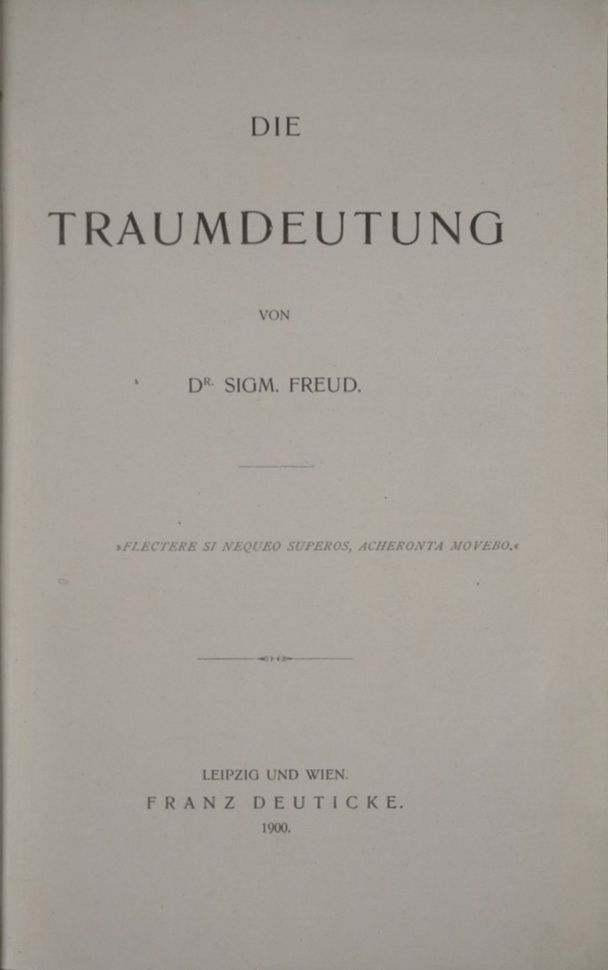
The book whose title page stands above this text carries the date 1900 — the publisher had post-dated it to make it a work of the century’s threshold. Freud regarded The Interpretation of Dreams as his most important work all his life, and its core sentence is the most famous in the field:
Der Traum ist die (verkleidete) Erfüllung eines (unterdrückten, verdrängten) Wunsches.
Note the parentheses. They are no stylistic flourish but the place at which the doctrine insures itself against every objection. The disguise is the doing of the dream-work — condensation, displacement, regard for representability — and interpretation undoes that work. The dream is a message, and there is a method for reading it.
A hundred years on, little of the doctrine is left and all of its question. What took its place was at first the exact opposite: the dream as a by-product of random nerve activity. And what set that counter-model wobbling came neither from the consulting room nor from the sleep laboratory but from neurology. The argument about it is still being conducted today.
Freud’s doctrine and its design fault
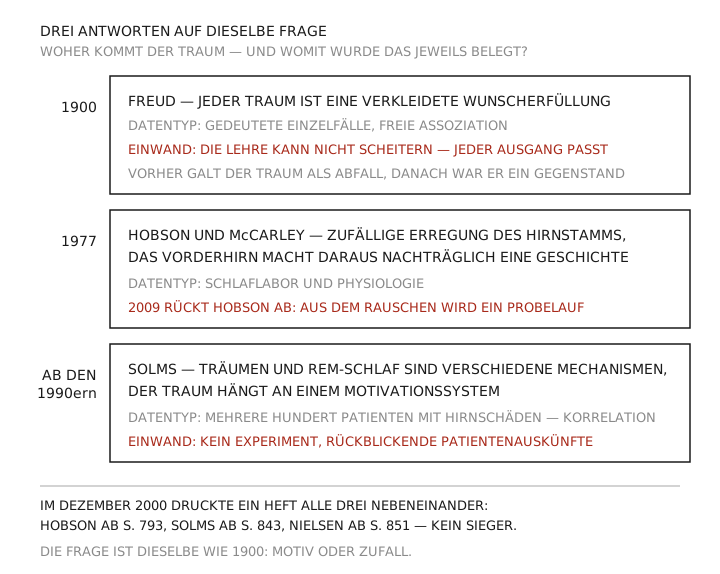
Freud’s evidence was interpreted single cases — his own dreams foremost — and his method was free association: you follow the associations to a dream element until the latent thought appears. The censor that renders the repressed wishes unrecognisable is, in all this, not an observed organ but a postulate.
The procedure has a built-in design fault that file 001 of this archive calls by its name: it cannot fail. Every dream can be traced back to a wish if reinterpretation is permitted — the nightmare as a wish for punishment, the anxiety dream as a wish whose disguise miscarried. A doctrine that explains every outcome predicts nothing; that is Popper’s old objection, and dream interpretation is his textbook case.
Two things must nonetheless be granted it. First, the gift for observation: that day residues migrate into dreams, that dreams condense and displace, that they are built from the material of one’s own life — these are descriptions that later research confirmed in soberer language. Second, the effect of the question itself: before 1900 most sciences treated the dream as refuse; afterwards it was an object. One can bury a theory and see at its burial that it laid out the ground it lies in.
Jung, this archive’s second interpreter of dreams, deserves a marginal note here: he had discarded the censor doctrine early and read dreams as undisguised self-presentations that merely happened to be pictorial — not a costume but another language. With the compensation idea, that dreams offset one-sided waking attitudes, he remained as untestable as Freud with the wish; but his refusal to suspect a hiding place behind every image reads more modern today than the doctrine he aimed it against.
What the sleep laboratory put in its place
In 1953 Eugene Aserinsky and Nathaniel Kleitman described regularly recurring phases of rapid eye movement in sleep, and with that dreaming became measurable to a schedule for the first time: you wake the sleeper and ask. Tore Nielsen later reviewed 35 such awakening studies from the years 1953 to 2000: in REM sleep, awakenings yield a report in around 82 percent of cases on average, in the rest of sleep in about 43 percent — and in the more recent studies the figure outside REM sleep is closer to 60 percent. Precisely that gap, and the fact that it is not a chasm, becomes important later.
In 1977 Allan Hobson and Robert McCarley drew the conclusion that struck Freud deepest: dreams do not begin with a wish but with random bursts of brainstem activation; the forebrain then makes of the noise, after the fact, the best story it can. The bizarreness of dreams is not disguise but physiology — no censor anywhere. In the textbooks the activation-synthesis model displaced dream interpretation; the dream had gone from letter to by-product.
The argument over the lesions
Then neuropsychology arrived with a type of data neither side had: lesions. From the 1990s onwards Mark Solms interviewed several hundred patients with circumscribed brain damage — a clinico-anatomical correlation study, not an experiment — and reported a pattern the noise model had not predicted in that form: patients with brainstem damage in some cases went on dreaming; patients with intact REM sleep but damage to the ventromesial forebrain white matter stopped dreaming — in the same dopaminergic tract that carries wanting and incentive. A second site abolishes dreaming as well and fits no motivational reading: the parieto-temporo-occipital junction. Solms’s conclusion was that dreaming and REM sleep are different mechanisms and that the dream hangs on a motivational system.
This did not go unchallenged. Critics object that in his brainstem cases it was never established that REM sleep had actually ceased — which removes the decisive evidence for separating the mechanisms — and that retrospective patient reports about one’s own dreaming are a soft data type. In any case the finding is no rehabilitation of dream interpretation: no censor, no doctrine of disguise, no method of reading comes back. All that returned to the table was the basic question — whether dreams have anything to do with motivation or are mere noise.
How open the question is can be read off the place where it was published. In the sixth issue of volume 23 of Behavioral and Brain Sciences, in December 2000, three contributions stand immediately one after another, each with open peer commentary: Hobson with Edward Pace-Schott and Robert Stickgold from p. 793, Solms from p. 843, Nielsen from p. 851 with the proposal to dissolve the opposition by way of “covert” REM sleep — REM-like processes running outside the measured REM phases, which could account for the reports from there. The journal printed no winner but three submissions side by side. And Hobson himself moved away afterwards from the pure randomness reading: in 2009 he described REM sleep as protoconsciousness — a state in which the brain runs through a virtual model of the world and so prepares waking consciousness. The noise had become a rehearsal. That is no surrender to Solms, but it is the abandonment of the position with which the argument had once begun.
What dream research can measure today
The message question has since been broken up into smaller, testable ones. The continuity hypothesis is well supported: dream content mirrors, above chance, the worries and preoccupations of waking life — examinees dream of examinations, mourners of the dead. The “dream-lag” is a neat fine-grained finding: the day’s experience surfaces preferentially the following night and once again five to seven nights later.
The side of terror has become clinically useful. The recurring nightmare of the traumatised contradicts any simple doctrine of wishes, and the best-evidenced treatment handles the dream as an editable script rather than a message: in imagery rehearsal, sufferers rewrite the nightmare while awake and practise the new version. Barry Krakow and colleagues tested the procedure in 2001 in a randomised trial with 169 women and published the results in JAMA; it has been in the guidelines ever since.
The question of function, by contrast, has candidates instead of answers: memory consolidation during sleep is solidly evidenced, the specific contribution of dreaming to it is not; Revonsuo’s threat simulation and emotion regulation are plausible, competing frames.
What remains
Little is secure, and what is secure matters. Dreams are made from the material of one’s own life; that is well measured. They follow no universally valid dictionary, and free association proves nothing. Nightmares are treatable, and treatable without any theory of interpretation. What remains open is the one question Freud, Hobson and Solms were arguing about: whether a motive underlies the dream or a random excitation that acquires sense after the fact. Both camps have moved towards each other since 2000 without meeting: Hobson has traded randomness for a rehearsal, and Solms has no experiment to show, only a correlation. The most plausible picture on present evidence is a motivationally tinted soliloquy under poor supervision — and a picture is not a finding.
The lesson about method belongs in this journal’s register: the argument was never moved by better arguments but by new types of data. Interpretation could achieve nothing against interpretation; only the sleep laboratory made dreams countable, only the lesions brought the question of mechanism within reach at all. Where a debate has been treading water for years, one more argument is rarely worth it — and the question of which data type is missing almost always is. At the kitchen table a modest, usable piece of advice survives all this: whoever talks about their dreams is talking about themselves. Which is exactly why dreams work in the consulting room as conversation openers, entirely without a theory of the censor.
Sources, and why they are here
Freud, S. (1900). Die Traumdeutung. Franz Deuticke, Leipzig and Vienna — chapter IV, „Die Traumentstellung“.
The source text and the source of the quotation. The formula stands there graded by parentheses — and precisely those parentheses are the design fault the article describes.
Aserinsky, E., & Kleitman, N. (1953). Regularly occurring periods of eye motility, and concomitant phenomena, during sleep. Science, 118, 273–274.
The point at which dreaming became measurable: you wake people and ask. Without this observation none of the later points of dispute would exist.
Hobson, J. A., & McCarley, R. W. (1977). The brain as a dream state generator: An activation-synthesis hypothesis of the dream process. American Journal of Psychiatry, 134, 1335–1348.
The counter-model that struck Freud deepest: no wish at the beginning but volleys of brainstem excitation — and no censor anywhere.
Hobson, J. A., Pace-Schott, E. F., & Stickgold, R. (2000). Dreaming and the brain: Toward a cognitive neuroscience of conscious states. Behavioral and Brain Sciences, 23(6), 793–842.
The first of the three papers that stood one after another in December 2000. The journal printed no winner but three submissions.
Solms, M. (2000). Dreaming and REM sleep are controlled by different brain mechanisms. Behavioral and Brain Sciences, 23(6), 843–850.
The second paper — and the kind of data neither side had: lesions. Its conclusion separates dreaming from REM sleep.
Nielsen, T. A. (2000). A review of mentation in REM and NREM sleep: „Covert“ REM sleep as a possible reconciliation of two opposing models. Behavioral and Brain Sciences, 23(6), 851–866.
The third paper, together with the review of 35 awakening studies — and the proposal to dissolve the opposition by way of a covert REM sleep.
Solms, M. (1997). The Neuropsychology of Dreams: A Clinico-Anatomical Study. Erlbaum.
The full account of the patient study. Important for the qualification the article carries with it: a clinico-anatomical correlation, not an experiment.
Hobson, J. A. (2009). REM sleep and dreaming: Towards a theory of protoconsciousness. Nature Reviews Neuroscience, 10(11), 803–813.
Hobson's own turn away from the pure randomness reading. The noise becomes a rehearsal — no capitulation, but the abandonment of the starting position.
Domhoff, G. W. (2003). The Scientific Study of Dreams: Neural Networks, Cognitive Development, and Content Analysis. American Psychological Association.
The basis of the continuity hypothesis — dream contents mirror the concerns of waking life, and that can be counted.
Domhoff, G. W. (2004). Why did empirical dream researchers reject Freud? A critique of historical claims. Dreaming, 14, 3–17.
The disciplinary history of the rejection — useful because it shows that Freud did not fall to an argument but to measurability.
Nielsen, T. A., Kuiken, D., Alain, G., Stenstrom, P., & Powell, R. A. (2004). Immediate and delayed incorporations of events into dreams. Journal of Sleep Research, 13(4), 327–336.
The dream lag: waking experience turns up preferentially in the following night — and again five to seven nights later.
Krakow, B., Hollifield, M., Johnston, L., et al. (2001). Imagery rehearsal therapy for chronic nightmares in sexual assault survivors with posttraumatic stress disorder. JAMA, 286(5), 537–545.
The clinical yield without any theory of interpretation: 169 women, randomised, and a method that treats the dream as a script rather than as a message.