Case file 027 · Learning & Personality
Leon Festinger
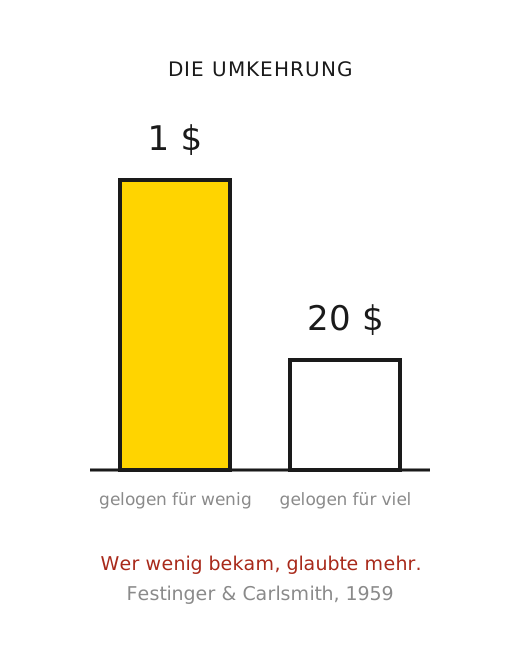
Fig. 1 — Drawing by the archive · free to use
In the autumn of 1954 three social psychologists read in a local paper about a Chicago housewife who received messages from a planet called Clarion: on 21 December the world would perish in a flood, but the believers would be collected beforehand by a flying saucer. Leon Festinger, Henry Riecken and Stanley Schachter smuggled observers into the group — not to refute but to be there when nothing happens. The night passed, the saucer failed to come, and the group, which until then had shunned publicity, began in the morning to proselytise. From that night comes social psychology’s most famous prediction: refuted convictions are not given up but reinforced — if one has invested enough.
Festinger was born on 8 May 1919 in New York City, the son of Russian-Jewish immigrants; his father, an embroiderer from Russia, was a freethinker and socialist. He studied at the City College of New York, went in 1939 to Iowa to Kurt Lewin and took his doctorate there in 1942 — the last doctoral student from Lewin’s American workshop, and the one who most thoroughly took over its combination of strict theory and risky experiment. After war years in pilot selection he followed Lewin to MIT, to the Research Center for Group Dynamics, and after Lewin’s death in 1947 moved with the whole group to Michigan; posts in Minnesota and Stanford followed.
The yield of these years is a series of middle-range theories the field still uses. The study of a student housing estate — who lives next to whom, who befriends whom — founded the research on proximity as a cause of friendship; the theory of social comparison of 1954 explained why people measure themselves against others when objective standards are missing, and is the ancestry of half of today’s research on social media; in 1957 came A Theory of Cognitive Dissonance, the book that secured his fame, and in 1959 the one-dollar experiment that fills his case file.
To the workshop’s history belongs the invention of a genre: the dissonance experiments brought the elaborate staged deception into social psychology — script, extras, embarrassed experimenters — and Festinger’s student Elliot Aronson made of it the art form that shaped the field for two decades. The ethics committees that later limited this stage belong to the same story as Milgram’s file in the neighbouring folder.
Then Festinger did what no one else in this archive does: he stopped. Around 1964 he left social psychology at the zenith of his reputation because, as he later said, the field no longer surprised him, and moved to perception research — eye movements, visual after-effects, the seeing of shapes. A decade later he moved again, this time to archaeology and cultural history, and wrote books on the origins of human tools and institutions. Colleagues have called it waste; Festinger called it curiosity.
As a teacher he was notorious and sought-after at once: relentless in seminars, sparing with praise, incorruptible toward weak arguments. From his workshop came Stanley Schachter, Elliot Aronson, Judson Mills and a generation that led experimental social psychology through its most productive period. The American Psychological Association honoured him in 1959 for distinguished scientific contributions; the field’s history regularly lists him among the most influential psychologists of the century.
Social psychology has held his departure against him and forgiven it at the same time: scarcely an introduction does without his three theories, and the journals in which he published list him in their retrospectives as the man who turned a describing discipline into a predicting one.
His first field study, incidentally, had nothing to do with sects or dissonance and is still taught today. In the late 1940s Festinger, together with Stanley Schachter and Kurt Back, investigated in a housing estate for married students who was friends with whom — and found that the friendships followed the architecture: whoever lived beside the stairs or on the way to the mailboxes had more acquaintances, and the probability of a friendship fell with every door of distance. The finding has been called the proximity effect ever since, and it is one of the earliest demonstrations that relationships depend at least as much on opportunities as on preferences. Whoever argues today about the effect of open-plan offices or dormitory corridors is arguing about Festinger’s stairwell.
Festinger died on 11 February 1989 in New York of liver cancer, aged sixty-nine. His bequest to the field is a sentence everyone now knows without naming the source, and a stance that has become rare: that a theory is worth something only when it predicts something improbable — and that one may leave the field when it no longer does.
The question of 1959 set itself against common sense and against the ruling learning theory at once. Both said the same thing: whoever receives more reward changes their attitude more — reinforcement works by amount. Festinger’s theory of cognitive dissonance, published two years earlier, predicted the opposite. Whoever does something that contradicts their conviction falls into an unpleasant state of tension; whoever is well paid for it has a comfortable explanation — the money — and need not touch their conviction. Whoever gets almost nothing must resolve the tension otherwise, and the only route available runs through the opinion: perhaps it was not so bad after all.
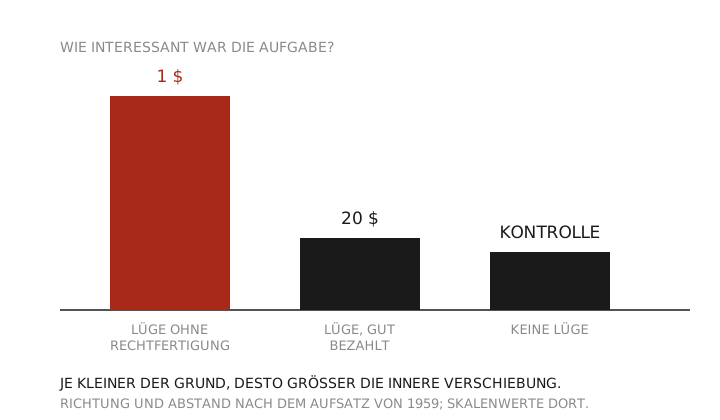
The arrangement Festinger built for this with James Carlsmith is a masterpiece of boredom. Stanford students spent an hour on two tasks of selected tedium: placing spools on a tray and clearing them off again for half an hour, then turning forty-eight square pegs a quarter turn each in a board, for another half hour. Then came the actual procedure. The experimenter explained with embarrassment that his assistant had failed to appear, and asked the subject to tell the next participant in the waiting room that the tasks had been interesting and enjoyable. For this small service he offered one group a dollar, another twenty; a control group did not lie and went straight to the follow-up interview.
The result read like a misprint and was the finding. In the closing survey — ostensibly by the department, not the experimenter — the one-dollar people rated the tasks markedly more positively than the twenty-dollar people, who barely exceeded the control group. Whoever had lied for twenty dollars knew why he had lied; whoever did it for one had to explain to himself why he says such a thing, and found the explanation in the matter: it was not so bad. The reward worked inversely to learning theory — the smaller, the greater the inner shift.
The theory that predicted this is of a spareness that explains its reach. Two cognitions — convictions, perceptions, knowledge of one’s actions — either agree, are indifferent to one another, or contradict; in the last case an unpleasant state arises, which Festinger expressly treated like hunger or thirst: a drive pressing toward reduction. Reduction is possible in three ways: change the action, change the conviction, or bring in a third cognition that defuses the contradiction — the classic excuse. From this threefold choice follows the whole predictive power, and from it also the reproach that accompanies the theory: because in hindsight one of the three routes was always taken, the conditions must be fixed in advance, or it explains everything and predicts nothing.
With that social psychology had its first genuinely counter-intuitive prediction experiment, and the theory behind it unfolded in series: the justification of effort — whoever suffers for a group finds it better afterwards —, post-decision dissonance — the chosen alternative is talked up, the rejected one down — and the field study with which it all began: in 1954 Festinger and his colleagues had infiltrated a doomsday sect and observed what happens when the prophecy fails. The answer — the most committed proselytised harder afterwards — stands in When Prophecy Fails and is the field illustration of the same mechanism.
To the history of effect belongs the fact that the theory supplied its own test bench. Because it predicted what common sense does not expect, one could do with it something social psychology had rarely managed: make risky predictions and be able to fail in the experiment. Out of this possibility grew the genre of the artfully staged laboratory study that shaped the 1960s and 1970s — with Elliot Aronson’s initiation experiment as the model piece: whoever had to undergo an embarrassing test to join a discussion group found the deliberately boring session that followed more interesting than whoever got in without a hurdle. The same logic, different material.
The criticism came at two points. Methodologically: the cells were small — about twenty people per condition —, eleven participants were excluded afterwards, and the twenty dollars of 1959 were a strikingly large sum that could arouse suspicion. Theoretically, the most serious objection came in 1967 from Daryl Bem: perhaps people feel no dissonance at all but infer, like outsiders, their attitude from their behaviour — whoever praises something without a visible reason concludes that he must have liked it. Bem’s self-perception theory predicted the same results without assuming an inner state of tension; the two camps argued for a decade, and the answer today runs: both, in different domains — dissonance where the contradiction to conviction is strong, self-perception in the ambiguous margins. Later a third reading was added, which attributes the tension not to the contradiction as such but to the threat to the self-image: whoever considers himself honest bears his own lie badly.
That dissonance is more than a laboratory quirk shows in its everyday trace. Whoever buys expensively praises louder afterwards; whoever has suffered through a training defends its harshness; whoever has voted for a candidate finds his faults smaller than the day before — the post-decision shift has been described at polling stations, racetracks and car dealerships. Advertising research uses it as management of buyer’s remorse, sect research as an explanation for post-failure recruitment, and political communication still argues over how much of the hardening of public opinion goes to this account. For an archive that tests reach, this is the rare case of a theory whose everyday evidence is older than its meta-analyses.
The sect study that counts as the field evidence has a methodological problem its own authors name. In order to observe the group from within, Festinger and his co-workers infiltrated several observers — with a handful of members, the investigators were at times almost as numerous as the investigated. New, convinced arrivals strengthen a group whose prophecy is wobbling; observers who nod in agreement do the same. What When Prophecy Fails describes as the behaviour of a sect is therefore in part the behaviour of a sect under observation, and the study serves better to illustrate the theory than to test it.
Beside dissonance stands a second theory by the same author that has made a quieter career and may today carry more. In 1954 Festinger formulated that people measure their abilities and opinions against others where objective standards are lacking — and by preference against similar others. Out of this sentence came the research on upward and downward comparison, a large part of research on justice, and, more recently, the study of social networks in which comparison is continuously available. The basic assumption holds; what is contested is under which conditions an upward comparison spurs and when it discourages. For this archive the neighbourhood of the two theories is telling: the more spectacular one became famous, the plainer one has carried longer.
What stands today is a pattern with footnotes. The basic phenomenon — less justification, more attitude change — has been rediscovered in hundreds of variants and belongs to social psychology’s core stock; the choice paradigms that show it especially elegantly, however, came under fire in the replication crisis, because part of the classic findings may rest on a statistical bias of the procedure. The free-choice variant has counted since as in need of repair, the task-for-money variant as robust; neuroscience has moreover located dissonance in the brain’s conflict network, and studies with children and capuchin monkeys suggest that the mechanism is older than human self-justification. The reach remains limited, and the file says so: dissonance explains what happens to a conviction after an action — not which convictions people hold first. The sentence that carries the file has survived the sixty years: people do not change their behaviour to fit their convictions — they change their convictions to fit their behaviour.
This file’s most famous side-finding comes from a night in December 1954, and it is misquoted to this day. When Prophecy Fails does not show that people always believe more firmly after a refutation — the group fell apart within weeks. It shows something more precise: whoever has invested much, taken a public stand, and lives through the disappointment inside a group proselytises harder afterwards. Whoever sat alone at home gave up.
The note records this because the short version now furnishes political debate: facts only harden convictions, it is said, so enlightenment is not worth the trouble. Research does not say that. The so-called backfire effect, traded for years as a standard finding, could scarcely be reproduced in large replication attempts — corrections mostly work, if more weakly than one hopes; hardening is rare and happens under exactly the conditions Festinger’s sect met: high costs, public commitment, social backing.
For this archive it is the familiar movement: a precise finding becomes everyday wisdom, loses its conditions in the process, and thereby becomes false. Whoever reads the conditions along gets a usable sentence back — and an explanation of why some groups grow louder after the embarrassment while most people simply grow quieter.
Replication status: partial. The basic pattern of induced compliance is confirmed many times over; the free-choice variant has counted as methodologically vulnerable since 2010, and the theoretical reading competes with self-perception and self-image protection.
Primary sources. Festinger, L., & Carlsmith, J. M. (1959). Cognitive consequences of forced compliance. Journal of Abnormal and Social Psychology, 58(2), 203–210. Festinger, L. (1957). A Theory of Cognitive Dissonance. Stanford: Stanford University Press. Festinger, L., Riecken, H. W., & Schachter, S. (1956). When Prophecy Fails. Minneapolis: University of Minnesota Press. Festinger, L. (1954). A theory of social comparison processes. Human Relations, 7(2), 117–140.
The rival theory. Bem, D. J. (1967). Self-perception: An alternative interpretation of cognitive dissonance phenomena. Psychological Review, 74(3), 183–200.
Method criticism. Chen, M. K., & Risen, J. L. (2010). How choice affects and reflects preferences: Revisiting the free-choice paradigm. Journal of Personality and Social Psychology, 99(4), 573–594. — The bias in the choice paradigm.
Reach. Egan, L. C., Santos, L. R., & Bloom, P. (2007). The origins of cognitive dissonance: evidence from children and monkeys. Psychological Science, 18(11), 978–983. — The mechanism is older than human self-justification.