Topic 08
Learning from Models
BehaviorismLearning & Personality
The doctrine this theme ran up against was the strictest of its day. Behaviourism explained behaviour from consequences: what is reinforced occurs more often, and whoever does nothing learns nothing either. Watson had conditioned fear, Skinner had surveyed the schedules of reinforcement — a closed building with no room in the plans for mere watching.
Albert Bandura’s objection was an everyday observation with explosive force: children acquire language, manners and bad habits at a pace no reinforcement schedule can supply, and they display actions they have never performed themselves and for which they have never seen a reward. The Bobo doll turned this into an experiment: whoever had watched an adult strike the doll struck it too — in the same movements, with the same phrases.
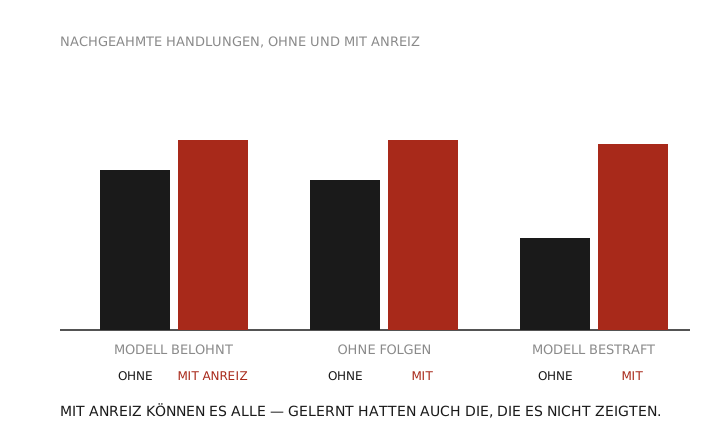
The decisive move came in 1965 and refuted behaviourism in its own language. Children who saw the model punished for striking imitated it less often — offer them a small reward and suddenly all could do it equally well. Acquisition and performance are two different things: all had learned; only those who saw a reason had shown it. The whole programme stands on this distinction.
The neighbourhood of the two folders is no either-or. Skinner’s shaping builds behaviour in steps of approximation; Bandura’s modelling skips the steps where an example suffices — and behaviour therapy uses both to this day: whoever treats a phobia performs the feared act first, lets the patient watch and then join in. In controlled comparisons this participant modelling beat pure confrontation.
Reception loaded more onto the experiment than it can carry. In the quarrel over media violence the doll became a weapon; the meta-analyses find small, scattered associations, and the registered studies on video games have shrunk the early effects further. Bandura himself held both abbreviations to be wrong: whoever derives a ban from his findings overrates them; whoever declares them refuted confuses small effects with none.
Out of the same programme grew the most-measured concept in modern psychology: self-efficacy, the conviction of being able to manage a particular task under particular circumstances — with one’s own success as the strongest source and the observed model as the second. And the largest application of model learning runs not in the laboratory but on television: serial characters who demonstrate what an audience is meant to learn, consequences included. The sentence that carries the theme is narrower than the headline and more durable: we also learn what we have only watched. Whether we do it is decided by something else.
Sheets on this theme
- Case file 004Iwan PawlowProfile
- Case file 004Iwan PawlowCase file
- Case file 004Iwan PawlowNote
- Case file 004Iwan PawlowEvidence
- Case file 005John B. WatsonProfile
- Case file 005John B. WatsonCase file
- Case file 005John B. WatsonNote
- Case file 005John B. WatsonEvidence
- Case file 006B. F. SkinnerProfile
- Case file 006B. F. SkinnerCase file
- Case file 006B. F. SkinnerNote
- Case file 006B. F. SkinnerEvidence
- Case file 026Gordon AllportProfile
- Case file 026Gordon AllportCase file
- Case file 026Gordon AllportNote
- Case file 026Gordon AllportEvidence
- Case file 027Leon FestingerProfile
- Case file 027Leon FestingerCase file
- Case file 027Leon FestingerNote
- Case file 027Leon FestingerEvidence
- Case file 028Albert BanduraProfile
- Case file 028Albert BanduraCase file
- Case file 028Albert BanduraNote
- Case file 028Albert BanduraEvidence
From the journal
- 1903Pavlov presents classical conditioningAfter pairing with food, a neutral stimulus triggers salivation on its own.Iwan Pawlow
- 1920Little Albert experimentAfter seven pairings, fear of the rat, generalised to similar things.John B. Watson
- 1936The dictionary study appears18,000 words from the lexicon — the raw material from which the five factors came.Gordon Allport
- 1938The Behavior of OrganismsVariable reinforcement produces the highest rates and the greatest resistance to extinction.B. F. Skinner
- 1959One dollar and twentyWhoever lied for a dollar believed it afterwards — the weaker justification works the stronger.Leon Festinger
- 1961The Bobo doll experimentChildren struck the doll in the model's own movements — learned by watching alone.Albert Bandura